

These Masked Portraits Are an Instagram Sensation
Self-representation has always been a fertile creative territory for artists, portraiture being a visual medium that has most directly expressed concepts of identity, emotional individuality, gender, and social status-issues around which today’s conversations gravitate and which are also obliquely yet imaginatively addressed in the work of the German painter Volker Hermes.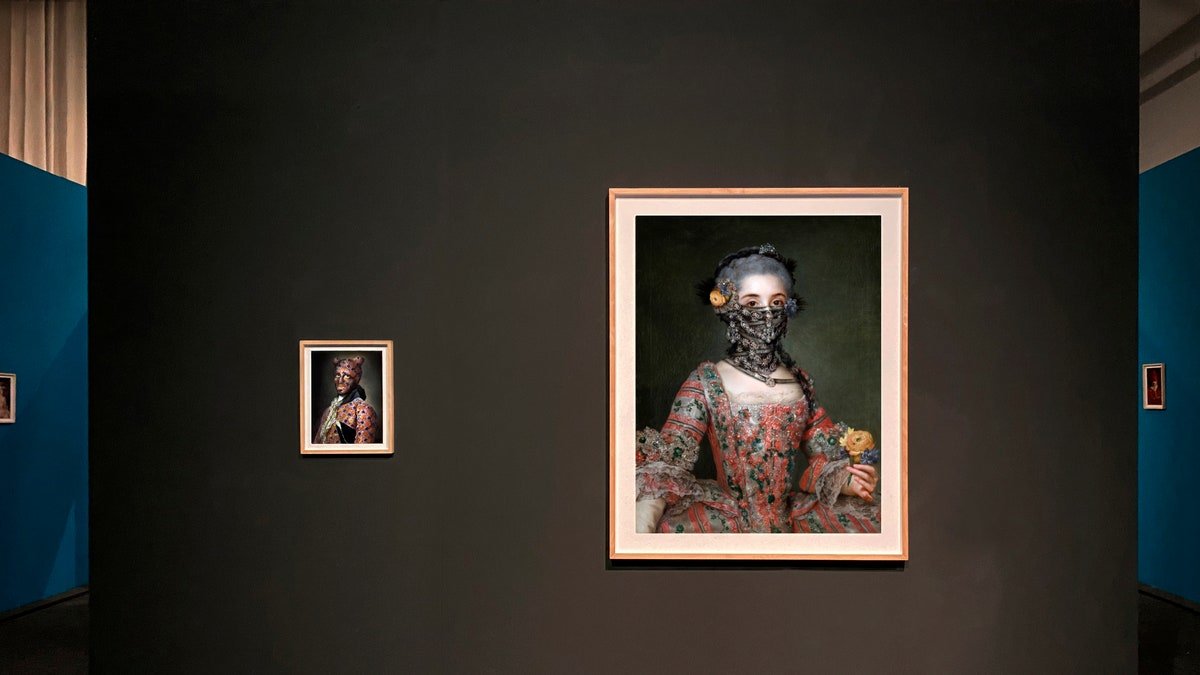
Hermes’s visual manipulations of famous Old Masters paintings, which he humorously morphs into masked portraits, have become Instagram sensations. His series of photo-collaged images, “Hidden Portraits,” is the subject of an exhibition at the Castello Visconteo in Pavia, a charming small town in Northern Italy. Though the exhibition was forced to close when the country’s second lockdown began, there’s still a chance to pay a visit, if and when restrictions are lifted. It officially runs until January 6, 2021.
On a Zoom call from his studio in Düsseldorf, Hermes talked about his “conversations” with Rembrandt, Van Eyck, and the whole Old Masters’ lot; the role that art can play in times of crisis; and, obviously, the utmost importance of wearing a damn mask.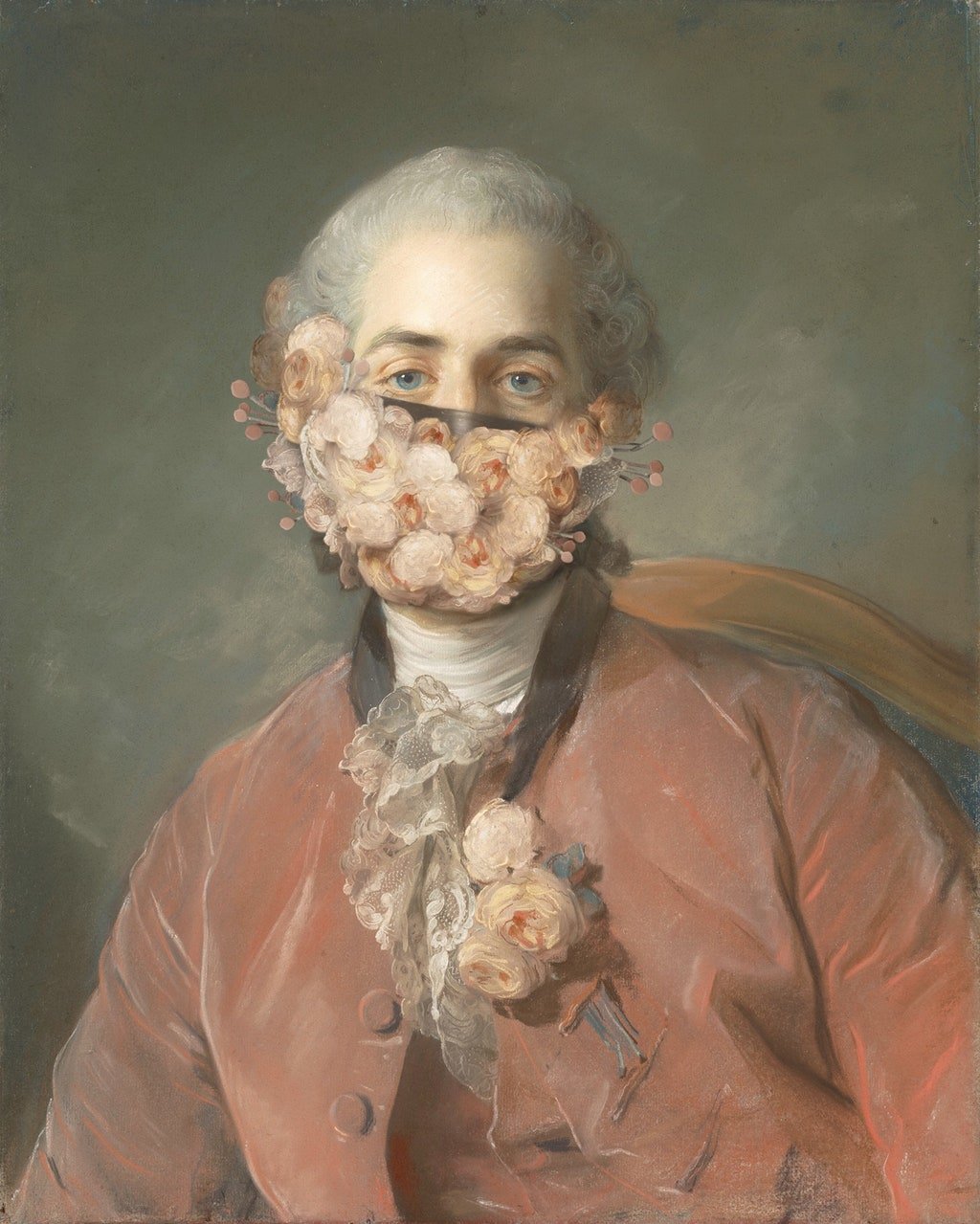
Hidden Perronneau, Photocollage 2020. Based on a portrait of Olivier Journu by Jean-Baptiste Perronneau 1756. Photo: Courtesy of Volker Hermes Courtesy of Volker Hermes.
It goes without saying that your masked portraits are utterly apropos in this moment. When and why did you start working on such significant representations?
The whole project started 10 years ago. At some point I started thinking about the social context of paintings. This research led me to delve deeper into the meaning of portraits, what function they have in representing the self, which kind of people were able to have their portraits taken in history. And what I amazingly discovered is that you don’t know that much about the people painted in those portraits, and we don’t know the codes of fashion and the meaning of the clothes they’re wearing as symbols of self-representation and social status at that time. When we look at a portrait, what is in focus is actually just the face-when we go to museums and we see all those beautifully dressed portraits by Old Masters, we don’t really pay much attention to their elaborate clothes, full of incredibly telling details about the society they were living in-we just look at their faces. So I thought: if I cover the face, I somehow block the focus on the emotions expressed by the face, which somehow obfuscate the perception of the rest of the image. There’s so much information and knowledge in those portraits: what they hold in their hands for instance, or some exquisite detail that you don’t really register as meaningful. So I started to cover their faces at the beginning in quite a naïve way, and for many years it stayed as a side project as I continued my work as a painter. Then over the years I realized how shifting the focus and covering the faces was an important point of view, it somehow resonated with a contemporary perspective and I started to layer codes of our times over the codes of ancient times. Then the pandemic came and obviously masking our faces is an everyday issue now. So all of a sudden my work became of interest-then Instagram came across it and made it known to a wider audience.
So, by covering the faces you shifted the attention to how the subjects were dressed and how fashion conveys deep meanings.
Absolutely. The focus on fashion is an essential part of my work on these Old Master portraits, which were actually portraying not regular people but an élite. These portraits were hugely expensive at that time, they could be afforded only by extremely wealthy commissioners, who obviously wanted to be seen as powerful and influential and affluent; their clothes were important in expressing their status and the effect and reactions they wanted to elicit from the audience. Having a portrait taken was a totally celebratory act of self-representation. But we don’t know exactly what the dressing codes in those times actually meant. If today we go to the bakery and we see a fabulous woman dressed in head-to-toe Chanel, we know what’s going on, don’t we? We know the codes, we’re able to read the message she’s sending out. The way the symbolic weight of fashion played out in those times was probably the same. Fashion has always been essential in self-definition in all times in history.
Covering our faces has become a gesture of necessity, yet it has a visual impact, not only a physical one. Masks are definitely a revealing new tool of self-representation, which is what fashion is all about.
Masks convey many different meanings and reactions, as we know well enough. In my portraits, which are photo-collages elaborated via a self-taught photoshop process on existing images, I try to see masks under a humorous light, even if obviously the situation is all but humorous. I try to add a fashionable element, a bit of a relieving touch, so to speak. I try to make them seem beautiful and not threatening. I work on exaggerating details of the costumes worn by the subjects in the portraits, which leads to reading the image as slightly bizarre and ironic and funny, with an over-the-top quality that makes the meaning of the masked face less dramatic or threatening. They’re seen through our contemporary eyes, as a maximalist, visually charged take on historical codes. I never add any extra element to the pictures, I just work digitally manipulating the pictorial elements already present in them. These are amazing pieces of art that I deeply respect. I don’t want in any way to belittle their invaluable place in art history, quite the contrary. I don’t want to add a mobile phone or a joint or something nonsensical into the picture! I try to elaborate them in a way that’s plausible and that fits without distorting their beauty. I’d like them to look like an original. It’s my way of expressing my respect to this wonderful art.
When I came across your work, which was some time ago, I was puzzled. Knowing art history quite well, I asked myself how have I never seen this portrait before? In which museum is it exhibited? I thought they were original paintings. Your manipulations are realistic to a fault.
Yes, people think they’re the real thing. Sometimes while I’m working I talk with the original portrait, saying, ‘sorry Rembrandt that I’m putting you through this!’ But dealing with the history of art in our time I think is an important way of conveying positivity. People have said to me that through my work they have felt a renewed appreciation for the healing power of art imagery. Which is obviously very flattering for me. They see the work of Old Masters as a layered, complex work where codes and meanings are expressed beautifully and powerfully. I also keep my works smaller than the originals, it’s a humble sign of respect. I’m not a digitally trained manipulator. I’m just transforming and moving different parts of the existing image—a light, a piece of jewel, the draping of a fabric. Sometimes I feel like I’m actually painting. I’m having constant discussions with these portraits!
It’s ironic that many museums are closed now. People probably appreciate your work even more because of that. Art can be of help in this quagmire, can’t it?
Yes, this is absolutely true. Instagram has been instrumental to spread my message of seeing a difficult situation in a lighter perspective, a masked face can be beautiful and make you smile and accept it differently. And also another aspect of my work which is probably interesting and deeper is that we have to contextualize art to better understand its underlying message.
Fashion isn’t the main focus in your work, yet as you said it plays an important part. How did your interest in fashion come about? Do you follow the industry? Individual designers?
I’m not a fashion freak but I’m obviously paying attention. You cannot escape fashion today. I worked for some time in a workshop here in Düsseldorf for opera costumes, so I‘ve got to know the history of costume more deeply. They’re one of the best ateliers and they do costumes for major opera houses around the world-the Metropolitan, La Scala, the Bolshoi. So I’ve got an understanding of how those historical dresses were made, their construction and silhouettes, the fabulous details. We also did projects with Viktor & Rolf, so I had the chance to meet them, their early shows were mind-blowing. Alexander McQueen’s shows also had an influence on my perception of fashion. Sometimes images from some fashion show just come to my mind when I work, like an outfit from a Jean Paul Gaultier show where the full face was covered in black and white. The dark, industrial aesthetic of Helmut Lang was also a strong influence; sometimes when I look at some old Dutch portraits from the 15th and 16th centuries, with their severe black costumes and high white collars, which sometimes I extend and exaggerate high up to cover the face, their reduced color palette, their austere, intellectual lines—they make me think of how he has rewritten the fashion codes in a spare, minimalistic way. But so powerful. So I’m finding echoes of contemporary fashion works in those Old Masters portraits.
You’ve worked on masked portraits for a long time. Has the pandemic shifted your perspective?
I must admit that my perspective shifted, the focus is sharper. My attention has a more personal understanding, now I know how it feels to wear them, the fabric in your face; it’s more about the eyes, for instance. And even if I don’t really have a political agenda, I know that my work is used to highlight the importance of wearing a mask. Art can play such an important role in times of crises, on so many levels. If my art can help people to be aware of the importance of wearing a mask, I’m happy with it. It’s true, we don’t see people smiling anymore, but masks can be beautiful. Saving lives is beautiful.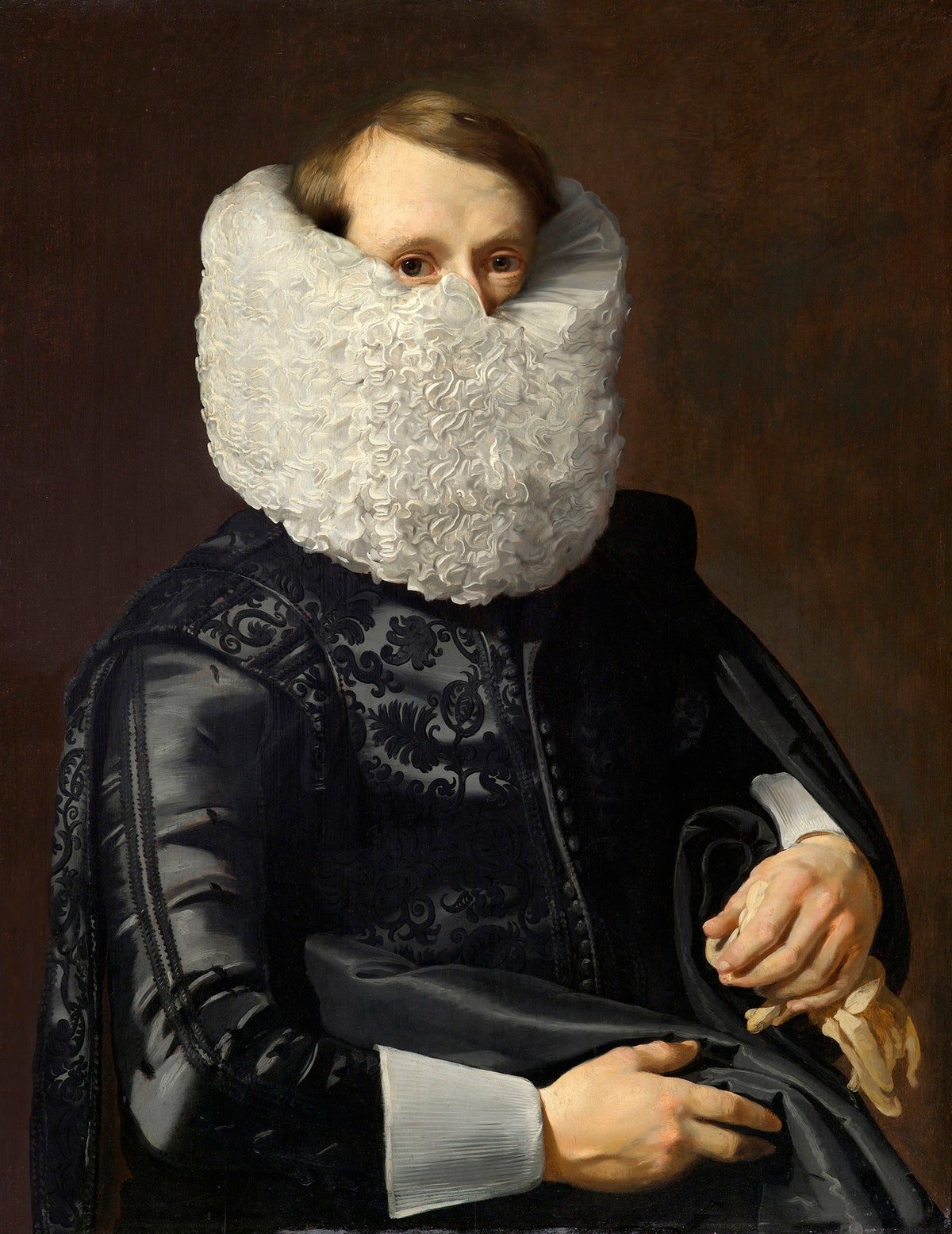
Hidden De Keyser, Photocollage 2019.
Based on a portrait of a Gentleman by Thomas de Keyser, 1626. 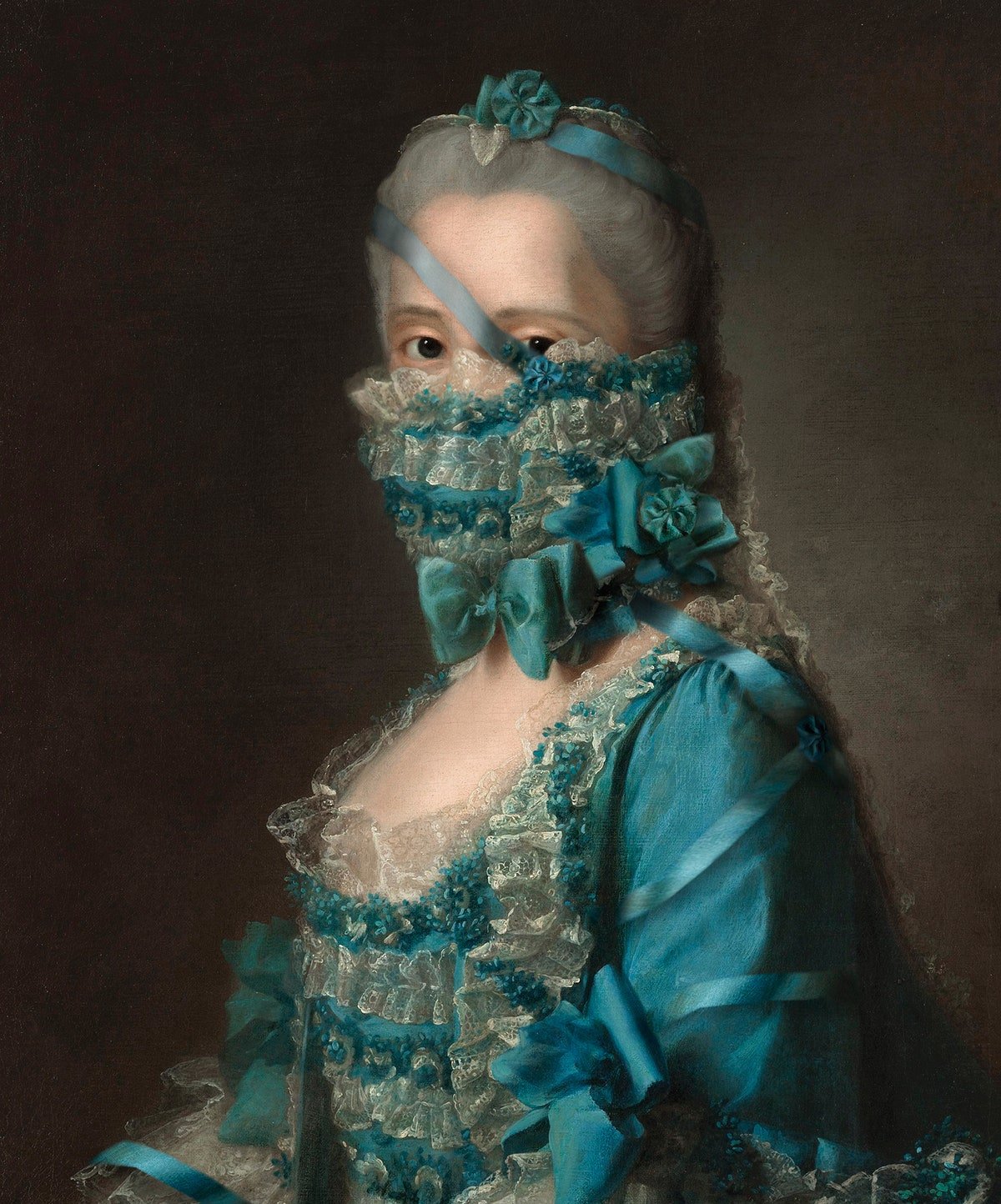
Hidden Frédou, Photocollage 2020.
Based on a portrait of Marie-Josèphe of Saxony, Dauphine of France by Jean-Martial Frédou, 1760.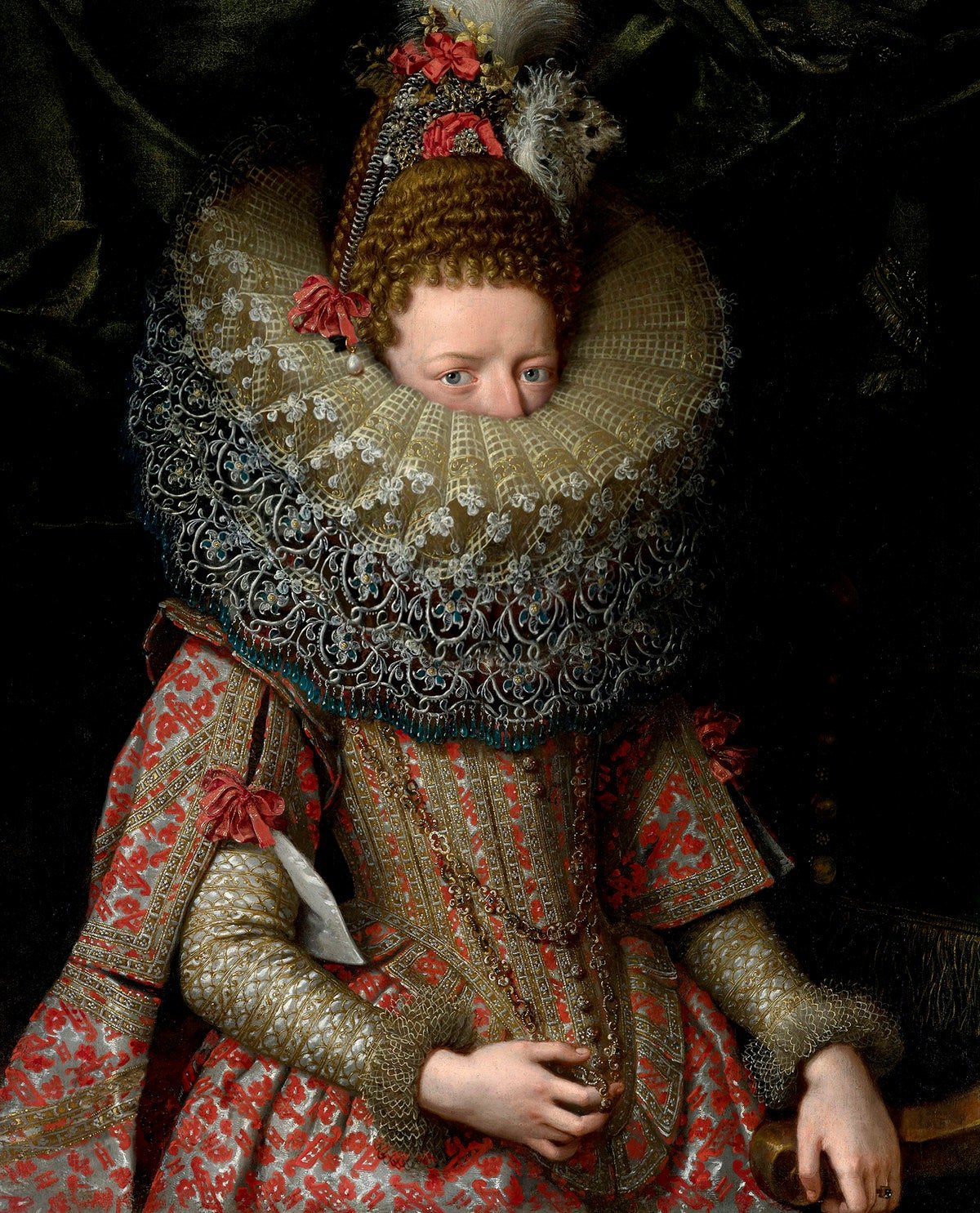
Hidden Pourbus V, Photocollage 2019.
Based on a portrait of Margherita Gonzaga, Duchess of Lorraine by Frans Pourbus the Younger, 1606.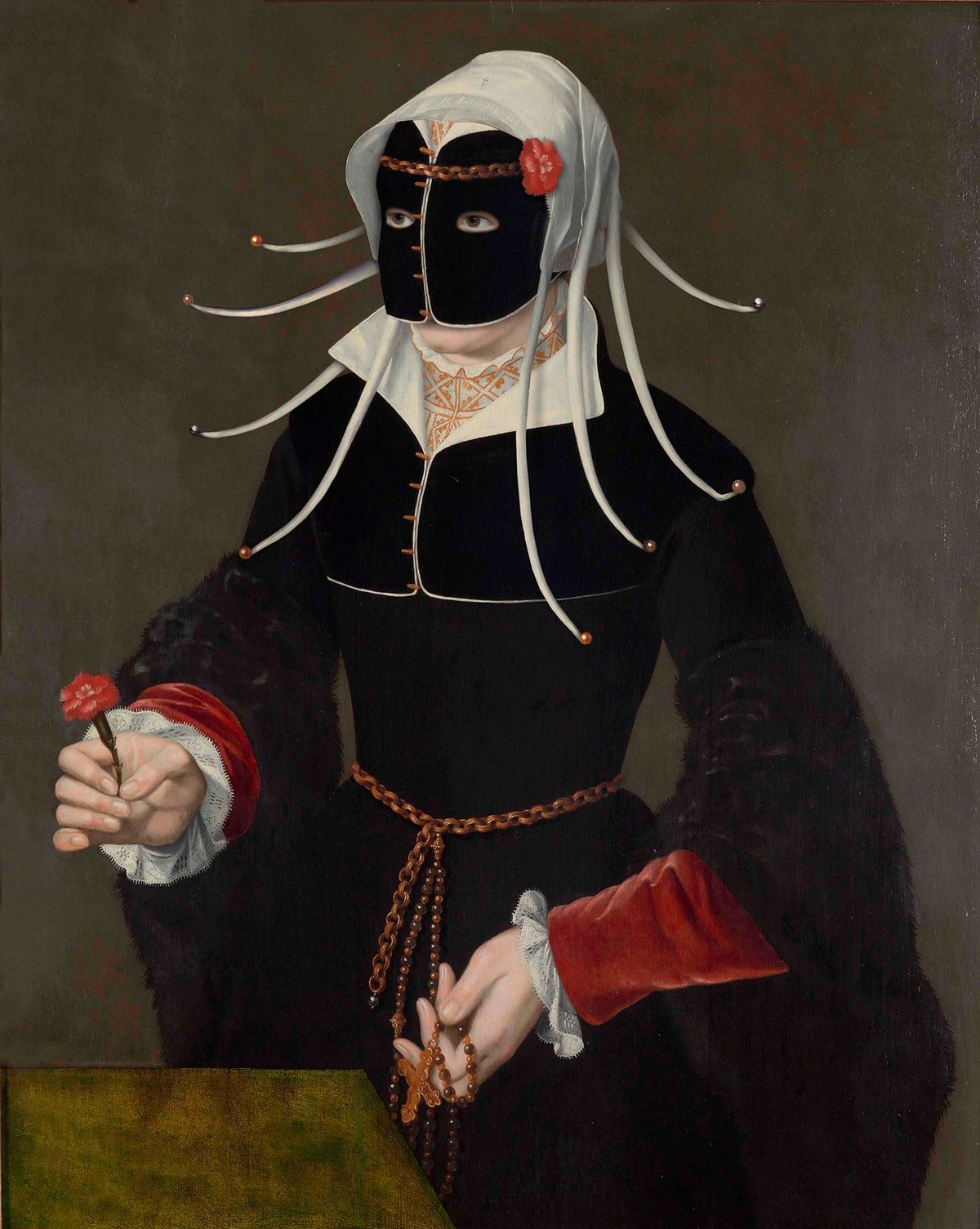
Hidden Anonymous (Flower), Photocollage 2020.
Based on a portrait of Margaretha Egbrechtsdr. Ramp, alias Proost by an anonymous artist, 1550-1560. 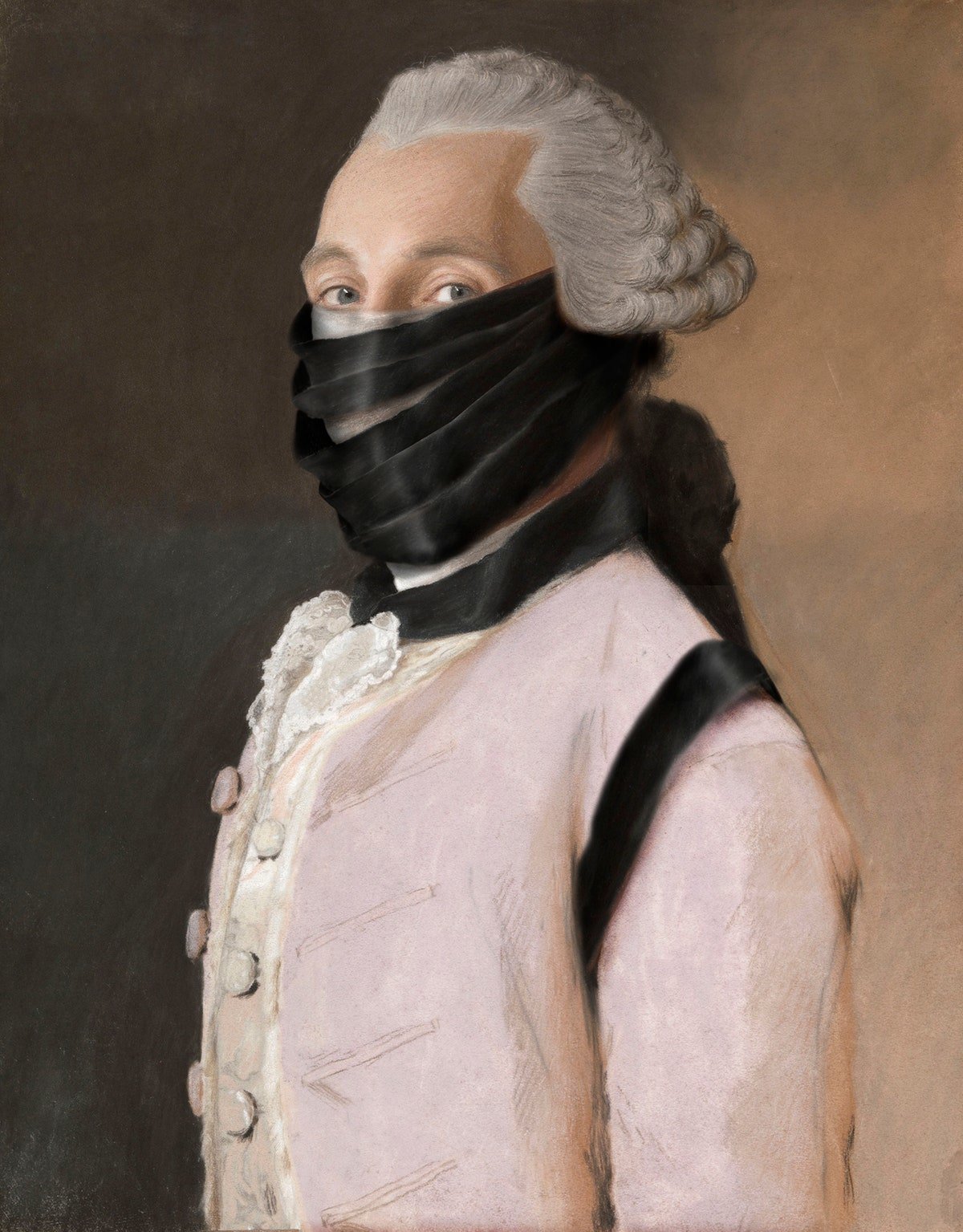
Hidden Liotard IV, Photocollage 2020.
Based on a portrait of Joachim Rendorp by Jean-Étienne Liotard, 1757.