

Sunak could accept four-week delay to ending Covid restrictions in England
Rishi Sunak is willing to accept a delay of up to four weeks to the final stage of England’s reopening roadmap, the Guardian understands, as the government considers extending restrictions beyond 21 June.
Ministers will continue to scrutinise data on cases and hospitalisations over the coming days, with a final decision set to be announced by the prime minister on Monday. From 21 June nightclubs are due to reopen, with the cap on wedding numbers, large-scale events and indoor mixing lifted and guidance on working from home and mask-wearing dropped.
A delay in all these changes would infuriate many Conservative backbenchers. On Tuesday the former Tory minister Steve Baker pressed for the date dubbed “freedom day” to go ahead, calling it the “last chance” to save industries such as hospitality, which is calling for the 2-metre distancing rule to be scrapped.
Sunak, the chancellor, has in the past been regarded as more keen to lift lockdown constraints than some cabinet colleagues. But a Whitehall source said he was not fixated on the 21 June date and was more concerned that when restrictions are lifted, the move can be permanent. “The Treasury’s main thing is that freedoms are irreversible and businesses have clarity,” the source said.
Economic support measures including the furlough scheme are set to taper off gradually, helping to cushion the impact of any delay. “This is exactly why we went long,” the source said.
The Treasury is understood to prefer a clean delay to the 21 June reopening rather than a confusing “halfway house” where some measures are lifted but others kept in place. A two-week delay is also thought to be under consideration.
A delay of up to four weeks would allow second vaccine doses for all over-50s to have been administered and taken effect before reopening, under government plans. It would also coincide with the end of the school summer term, reducing the extent to which outbreaks can be fuelled by children passing the virus on to one another in the classroom. One government source pointed out that many cases of the Delta variant have been among children, who are not yet being vaccinated.
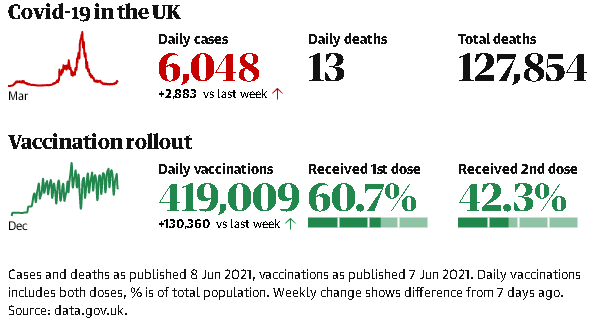
More than 6,000 people were reported on Tuesday to have tested positive for coronavirus, with 126 people admitted to hospital.
Nearly 500,000 jabs were booked in a “Glastonbury-style” rush after the vaccine rollout was expanded to 25 to 29-year-olds in England, the NHS said. NHS England said the National Booking Service had seen 493,000 appointments reserved by midday on Tuesday, five hours after eligibility was widened to the over-25s.
Key scientific modelling committees Spi-B and Spi-M are expected to provide fresh analysis in the coming days about the potential impact of the rapid spread of the Delta variant, which was identified in India.
Matt Hancock, the health secretary, said earlier this week that of 12,383 cases of the Delta variant as of 3 June, 126 were admitted to hospital. Of those, 83 were unvaccinated, 28 had had one dose of vaccine and only three had both doses.
At a cabinet meeting on Tuesday, Johnson told colleagues: “While the relationship between cases and hospitalisations has changed, we must continue to look at the data carefully ahead of making a decision on step four.”
The government’s chief scientific adviser, Patrick Vallance, and the chief medical officer, Chris Whitty, briefed cabinet ministers about the latest data earlier this week. One person with knowledge of the meeting said the pair were “at the optimistic end of Sage”. Some members of the advisory committee have publicly cautioned against further reopening. The source added that Whitty and Vallance had “reserved judgment” and suggested more critical data would be available by the weekend.
Tory backbenchers will put intense pressure on the prime minister to go ahead with the final stage of reopening, despite the rise in cases. Baker, vice-chair of the Covid Recovery Group of backbench MPs, said 21 June represented a “last chance” for industries including hospitality and tourism, that “make life worth living”, and it was time to allow the public to “reconnect with family and friends and regain our mental health”.
He claimed that by that date, all over-50s and vulnerable younger adults should have been given the opportunity to receive two doses of Covid vaccine.
“These groups represent about 99% of Covid deaths and about 80% of hospitalisations,” he said. “As of today, according to announcements made by the government, these groups should all have been offered a chance to have had a second dose. It would be helpful for the government to clarify that this has been achieved.
“If this brilliant milestone isn’t enough to convince ministers that we need to lift all remaining restrictions – especially social distancing requirements – on 21 June, nothing will ever get us out of this.”
Ministers have been encouraged by progress in Bolton, a hotspot for the Delta variant. Surge testing and a rapid vaccine push were put in place four weeks ago, and cases have begun to flatten off. Hancock announced on Tuesday that a similar approach will now be taken across Greater Manchester and Lancashire, with local people also advised to take extra care.