
Strait of Hormuz Reopens Briefly Amid Fragile Middle East Ceasefire as Global Tensions Persist
Temporary Opening of a Critical Global Oil Route
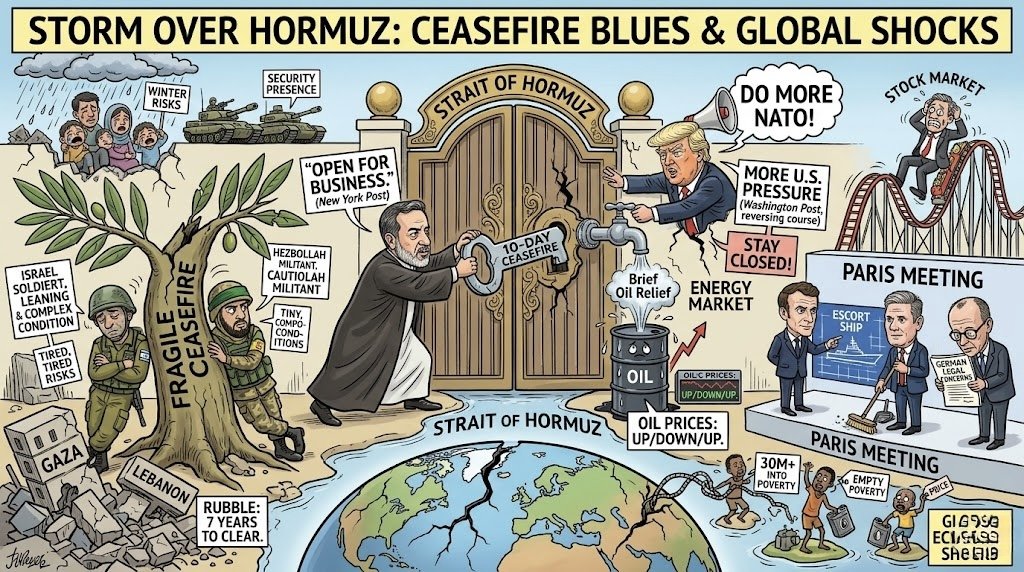
Iran’s Foreign Minister Abbas Araqchi announced that the Strait of Hormuz would remain “completely open for business” during the duration of a newly brokered 10-day ceasefire between Israel and Lebanon.
The strait — one of the world’s most important maritime chokepoints, carrying roughly a fifth of global oil shipments — had been severely disrupted during weeks of escalating conflict involving Iran, Israel, and the United States.
Iran stated that commercial vessels could transit via coordinated maritime routes, while international actors began preparing plans to restore secure navigation.
However, optimism proved short-lived. Within days, Iran reversed course and reimposed restrictions on the strait, citing continued U.S. naval pressure and unresolved tensions.
NATO Allies Prepare Defensive Maritime Mission
As instability around the Strait intensified, a coalition of mainly European and NATO-aligned countries convened in Paris to develop a plan to secure maritime traffic.
The initiative — led by French President Emmanuel Macron and joined by UK Prime Minister Keir Starmer and German Chancellor Friedrich Merz — is expected to include:
- Military escort vessels
- Mine-clearing operations
- Advanced radar and surveillance systems
European leaders emphasized that the mission would be strictly defensive, aimed at ensuring safe passage rather than escalating military involvement.
Germany signaled that its participation would depend on:
- A sustained ceasefire
- A multilateral legal framework
- Potential United Nations authorization
The effort follows pressure from U.S. President Donald Trump, who reportedly urged NATO allies to take a more active role in securing global shipping routes.
Ceasefire Between Israel and Lebanon Offers Limited Relief
The maritime developments are closely tied to a U.S.-brokered 10-day ceasefire between Israel and Lebanon, which came into effect on April 16, 2026.
The agreement aims to pause hostilities and create space for negotiations after weeks of intense fighting between Israeli forces and Hezbollah.
- Israel has agreed to halt offensive operations
- Lebanese authorities are expected to restrain armed groups
- Hezbollah is not a formal signatory but has signaled conditional compliance
Despite the agreement, tensions remain high:
- Israel insists it will maintain a security presence in southern Lebanon
- It reserves the right to carry out preemptive strikes
- Reports of violations and continued clashes have already emerged
President Trump expressed confidence that all parties — including Hezbollah — would respect the ceasefire, though analysts remain skeptical.
Global Markets React — Then Recoil
The initial announcement of the Strait’s reopening led to:
- A sharp drop in oil prices
- Positive movement in global stock markets
But renewed instability quickly reversed market optimism.
Attacks on vessels, military warnings, and conflicting statements from Tehran and Washington have reinforced the perception that the situation remains unpredictable and fragile.
Humanitarian Crisis Deepens Across the Region
While diplomatic efforts focus on ceasefires and trade routes, the humanitarian toll continues to mount:
Lebanon
- More than 2,000 deaths reported since the escalation
- Over 1 million people displaced
Gaza
- Approximately 90% of the population displaced
- Around 320,000 buildings damaged or destroyed
- Severe risks from:
- Structural collapse
- Flooding and exposure
- Unexploded ordnance
- Toxic debris including asbestos
The United Nations estimates that:
- Clearing rubble alone could take up to 7 years
- Full reconstruction may take decades and cost over $40 billion
Winter conditions have further worsened living conditions, with flooding and cold exposure posing life-threatening risks.
Global Economic Fallout Expands
The conflict’s impact is no longer regional.
The United Nations Development Programme warns that ongoing escalation could push more than 30 million people into poverty worldwide, particularly affecting:
- Sub-Saharan Africa
- Small island developing states
- Energy-import-dependent economies
Disruptions to fuel supply chains and rising costs are already being felt globally, reinforcing the broader economic consequences of the crisis.
A Conflict With No Clear Endgame
Despite diplomatic activity, several key issues remain unresolved:
- The role and disarmament of Hezbollah
- Israel’s military presence in Lebanon
- U.S.–Iran tensions and naval confrontations
- Control and security of the Strait of Hormuz
The ceasefire is widely viewed as temporary and fragile, rather than a definitive step toward peace.
Sum Up
The brief reopening of the Strait of Hormuz offered a glimpse of stabilization in a region under extreme strain — but the rapid reversal underscores a deeper reality:
The Middle East remains on edge, where ceasefires are tentative, alliances are shifting, and the global consequences are immediate.
Even if hostilities pause, the structural damage — humanitarian, economic, and geopolitical — will shape the region and the world for years to come.