

Stormont: We need government and we need it now - Sinn Féin
The Windsor Framework was announced on Monday following months of talks.
The Democratic Unionist Party (DUP) is boycotting power-sharing until its concerns about post-Brexit trading arrangements are fixed.
It has said it will not be rushed into deciding whether to back the new Windsor Framework.
On Wednesday evening, the DUP MP Ian Paisley said he did not believe the Windsor Framework met his party's seven tests to support a new deal.
Mr Paisley was speaking in his role as parliamentary chair of the think tank Centre for the Union, which asked the former Attorney General John Larkin to study the framework.
"Does it answer and satisfy all of our seven tests? It is very clear it doesn't," Mr Paisley told BBC NI's The Nolan Show.
The "most obvious" issue, he said, was the role of EU law and the European courts.
Lord Dodds of the DUP has also raised concerns about the use of border posts to administer the movement of goods under the new arrangements.
"The provision of these border control posts actually disrupts the UK single market for goods and replaces it with a Great Britain single market for goods and an all-Ireland single market for goods," he said.
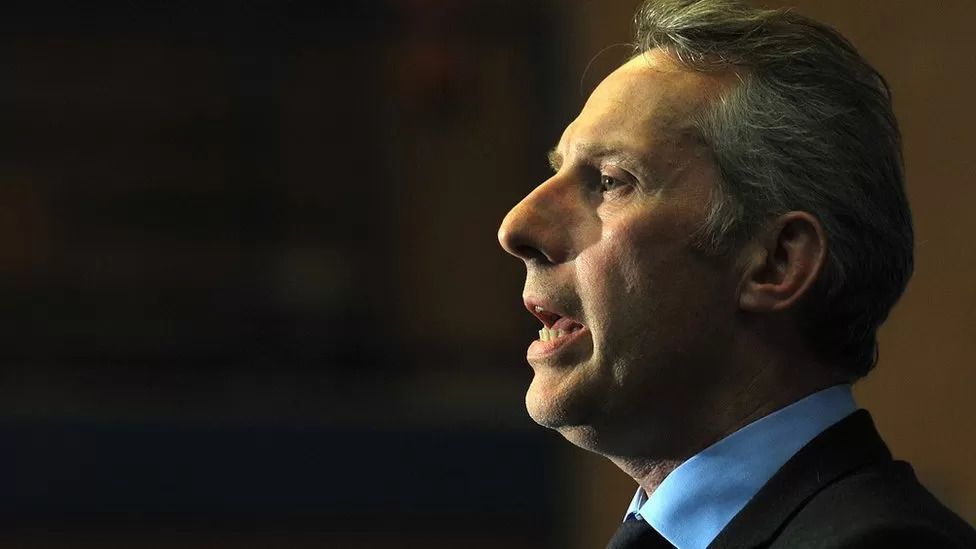 Ian Paisley said he trusted his "gut instinct" that the framework did not meet all of the DUP's tests
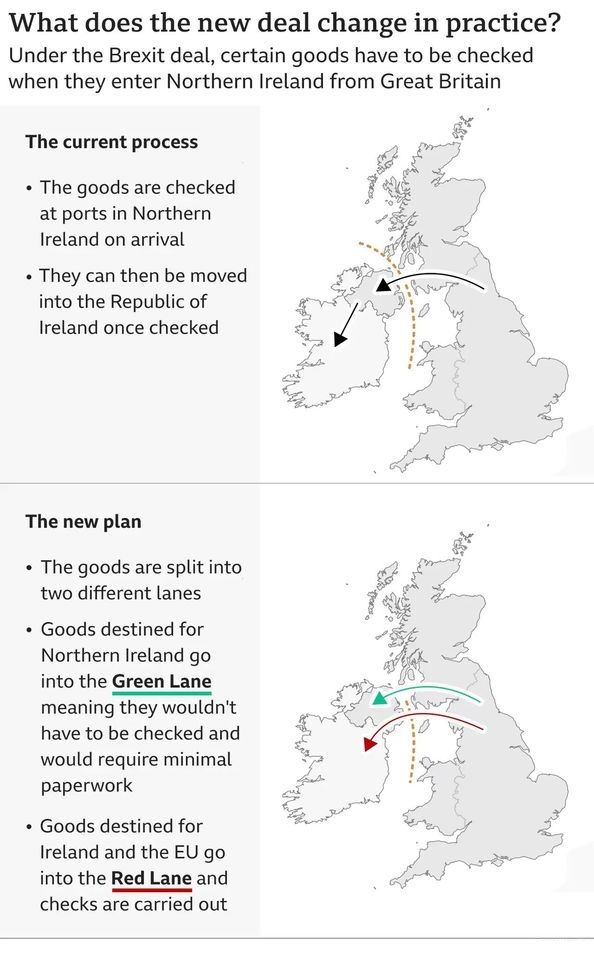
Under the framework, goods moving from Great Britain which are staying in Northern Ireland will use a 'green lane' at Northern Ireland ports, meaning they face minimal paperwork and no routine physical checks.
Goods which are due to travel into the Republic of Ireland will use a 'red lane', meaning they face customs processes and other checks.
Mr Paisley said his party was having an "internal conversation" about the framework and would be seeking its own legal advice over the coming days.
Earlier, Sinn Féin's vice-president Michelle O'Neill said it would be a "missed opportunity" if the DUP decided not to return to devolved government before the 25th anniversary of the Good Friday Agreement next month.
The DUP is the second largest party at Stormont but, as the biggest unionist party, its participation is required for the restoration of power sharing.
The prime minister said the deal put Northern Ireland in an enviable position with unique access to both the European and UK markets, but said he would not rush the DUP into taking a decision on whether to support it.
It is possible the party could take weeks - or even months - before it reaches a collective decision.
The aim of the deal is to address issues with the Northern Ireland Protocol, part of the UK's Withdrawal Agreement with the EU in 2019.
Ms O'Neill's party cautiously welcomed the Windsor Framework and she said now negotiations had concluded Stormont parties should waste no time in getting power-sharing restored.
"I rarely find myself agreeing with a British prime minister but access to both markets has to be grabbed with both hands," she told reporters on Wednesday.
"We are about to attend events in Washington for St Patrick's Day which is about encouraging investment here.
"All efforts have to be focused on looking ahead and celebrating the upcoming anniversary."
Businesses had told her they wanted politicians to maximise the potential of the UK-EU deal and use the anniversary of the Good Friday Agreement to be a real catalyst for economic investment, she added.
Sinn Féin president Mary Lou McDonald said time was of the essence to ensure power-sharing returns and her party was making active preparations to return to government at Stormont.
Alliance Party leader Naomi Long praised the prime minister for achieving a positive outcome for businesses and criticised his predecessor Boris Johnson for how the original negotiations were handled in 2019.
"If we'd had a serious prime minister, willing to engage at that time, we could have had this deal then and not had to go through all the pain that we've had in the interim."
Social Democratic and Labour Party leader Colum Eastwood emphasised Northern Ireland's economic potential through dual market access in the deal.
"To make the most of this we need all of our parties to work together with our business sector and the British and Irish governments so that we can realise our full potential."
Key dates
There are some dates that might play into the DUP's thinking before it decides whether to return to Stormont:
* St Patrick's Day - 17 March
Usually involves delegations from each political party travelling to the US.
When an executive is sitting, it also provides opportunities to promote investment, a point Michelle O'Neill was at pains to point out.
Given it's in a fortnight's time, it seems unlikely the DUP will have made its mind up by then.
* Good Friday Agreement anniversary
10 April marks the 25th anniversary of the deal that helped to end the Troubles and designed the modern power-sharing institutions at Stormont. That isn't to be confused with the public holiday Good Friday, which is on 7 April.
The British and Irish governments would love nothing more than to have Stormont restored by then, given the 20th anniversary programme was muted as devolution was suspended in 2018.
* Local elections - 18 May
The DUP will be weighing up if it is better to be back in government, or still holding out, to boost its performance at the polls.
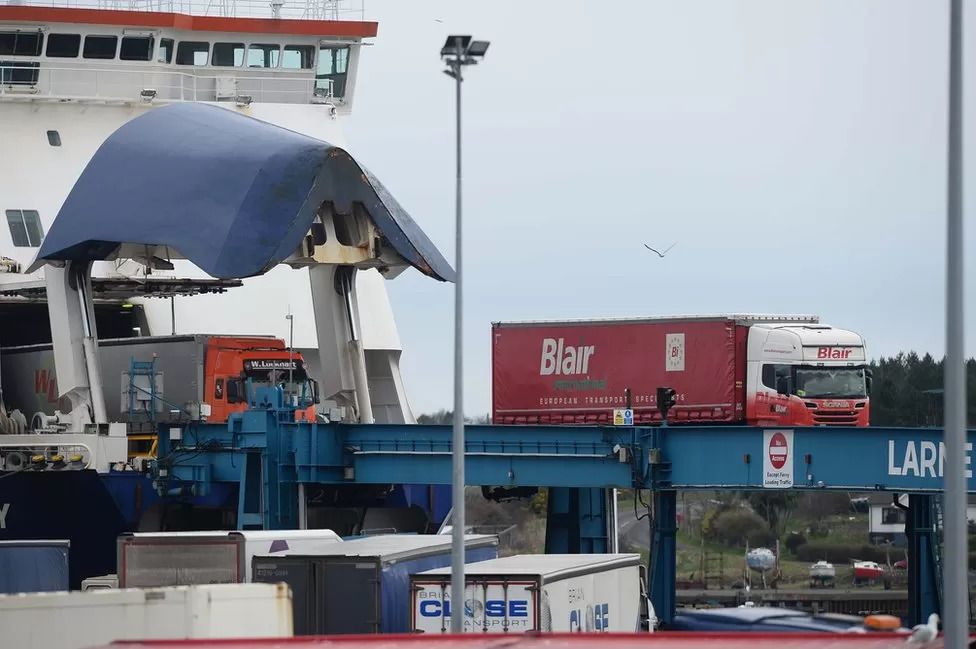 Under the new deal there will be fewer checks on goods entering Northern Ireland from Great Britain
Oversold deal?
Meanwhile, the UK's former top Brexit negotiator Lord Frost said the new deal with the EU will make the Northern Ireland Protocol easier to operate but does not change its fundamentals.
Writing in the Daily Telegraph, Lord Frost said the government had been "overclaiming" some parts of the deal, including the extent to which trade friction was removed between Northern Ireland and Great Britain.
He argued the protocol had been renamed the Windsor Framework, and questioned claims there was now no longer an Irish Sea border as a result of the deal.
The UK's former peace process negotiator Jonathan Powell wrote in the Financial Times that the DUP was right to take its time to assess the deal but "should not get lost in the weeds".
What does the new deal say about trade rules?
Central to the trade aspects of the new deal is the concept of green lanes and red lanes.
British goods which are staying in Northern Ireland will use the green lane at Northern Ireland ports, meaning they will not have to be checked and would require minimal paperwork.
Goods which are due to travel into the Republic of Ireland will use the red lane, meaning they would face customs processes and other checks at Northern Ireland ports.
Andrew McCormick, a Stormont official in charge of Brexit issues who originally developed that concept, said the new deal was better in "practical, constitutional and presentational terms" than either the Brexit backstop or the original protocol.
It was presented much earlier in the Brexit process, in 2018, but at that time the UK government was not keen on the idea.
Writing for the think tank, UK In A Changing Europe, he said the new framework was "a very significant achievement - well beyond expectations on what might have been negotiable in the context set by the previous stances of the UK government and the EU".