London Daily

Focus on the big picture.
Wednesday, Jun 24, 2026

Sir John Curtice: The man who gets elections right

Sir John Curtice: The man who gets elections right

Voters across the UK go to the polls in local and Northern Ireland Assembly elections this Thursday. The man who calls the results, and informs the country about the state of politics based on voting, reveals how he does it.

When Professor Sir John Curtice pronounces on elections, politicians and pundits listen.

Knighted in 2017, he is perhaps the only psephologist in the UK who is routinely, albeit reluctantly, recognised in the street.

"I live with it," he says. "I don't live for it."

As 10pm chimes on the final Thursday of a general election, the last voters finish casting their ballots.

It's then that Sir John, who's been working on general elections since the 1970s, interprets the exit poll - in which voters at about 140 selected polling stations fill in second ballots, indicating which candidate they've chosen.

And that's what he uses to tell the world who is likely to become the next prime minister.

"I don't worry about what happens at the close of voting," he says. "The more nervous period is later on in the night, when we actually see how accurate we've been."

For local elections like this week's in England, Scotland and Wales there are no exit polls - the same applies for the Northern Ireland Assembly elections on the same day.

But Sir John still has to make a call on what the vote means for the next general election.

"Someone wants you to give a reasonably realistic estimate of how the parties would do if voting shares were applied across the country as a whole, and across the four nations," he says.

"We're still trying to get the people an idea of where the story's going. It's quite hard."

The work of Sir John, professor of political science at the University of Strathclyde, and his colleagues starts months before the glamour of election night.

By the time polls open on the day of a general election, hundreds of hours of work finessing methods have gone in, ready for Sir John and his team of five or six experts to analyse exit poll results as they are phoned in.

"We tend to start in the middle of the morning, 11am or 12ish," he says. "No earlier, really, because we have to work until sometimes well into the following day."

The team hand in their mobile phones and sit together in a guarded room in a secret location.

By early afternoon - several hours before the rest of the country - Sir John has a good idea of who is likely to be the next prime minister.

After the usual early-evening surge in voting and exit polls, he and his experts sketch out their broader thoughts on a whiteboard.

"We're beginning to brief the people who really need to know, such as main representatives from TV companies," says Sir John.

"Then we get to the tough end of the business, saying this is what [result] we're going to go for now."

After the exit poll-based prediction is revealed at 10pm there is the wait to see if it is right - or as right as it can be.

Sir John's team leave the sealed room, spending the rest of the night in the TV studio.

This week's elections, lacking exit polls, will not have the amount of prior data that a general election provides.

Brain food? Sir John's team like to eat healthily but a slice of pizza now and then goes down well


"The story is emerging throughout the night," 68-year-old Sir John says. "For last year's local elections I got four hours' sleep [when there was a lull in results] and I got up at 5am to start again, but that doesn't happen for general elections."

For these, he is awake for at least 36 hours straight as he goes through the results, while writing online stories and appearing on radio and TV.

His team choose food from takeaway menus. "We try to have something healthy," says Sir John, "but we had pizzas last year, I think."
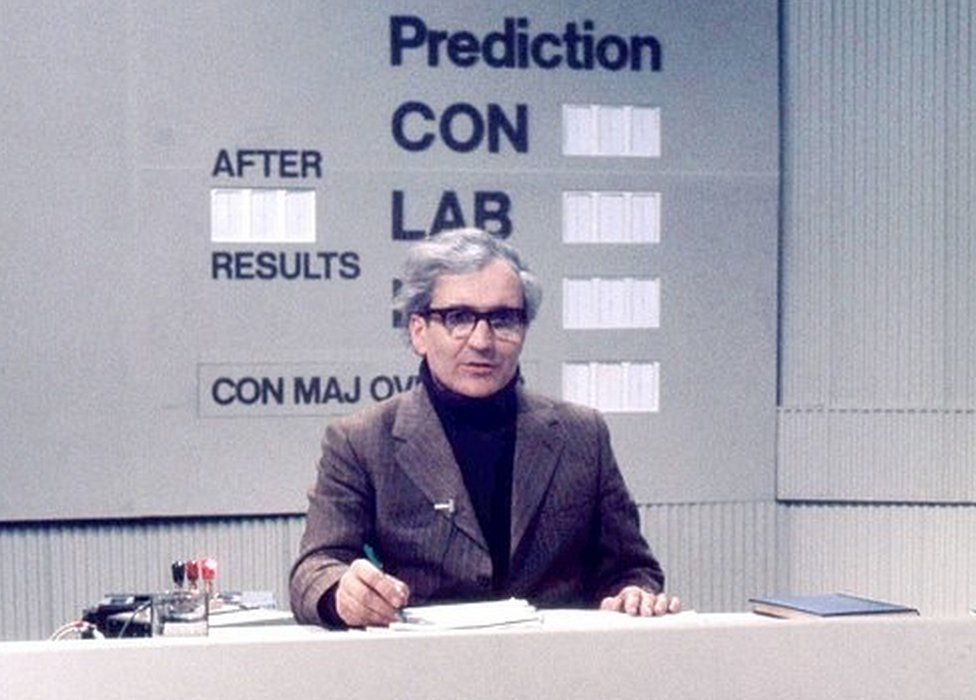
David Butler, the UK pioneering on-screen pollster, was a mentor to Sir John


"It gets more difficult to do the job the longer you're awake," says Sir John. "Lack of sleep destroys your short-term memory, so you have to get as well prepared as you can.

"Most people are not sitting up all night watching this stuff. But we still have to be ready to explain to people in the morning what's happened."

But Sir John resists the temptation to grab 40 winks.

"The way I see it is that, if you've missed a night of sleep, you've missed a night. You don't want to go back to sleep early and ruin sleep patterns. You have to keep going until nine or 10 the next evening."

By mid-morning on Friday, general election results show whether Sir John was right or wrong.

Broadcasters continue for several more hours to ask him for in-depth analysis on why people voted as they did.

And for local elections, he's called on throughout the day to give his developing state of-the-political-nation thoughts.

After that, it's time - finally - for bed.

Newsletter

Related Articles

0:00
0:00
Close
UK Biotechnology Sector Receives Increased Public Funding to Support Regional Growth
Police Chiefs Update National Protest Management Guidelines Amid Rising Demonstration Activity
UK Aviation Regulator Expands Support for Regional Airports to Strengthen Domestic Routes
CMA Launches Investigation Into Retail Pricing Across UK Grocery Sector
UK Energy Operator Warns of Winter Supply Pressures Despite Stable Overall Grid Outlook
UK Research Council Expands Funding for Regional Biotechnology and Life Sciences Clusters
UK Compensation Scheme for Post Office Horizon Scandal Reaches 80 Percent Completion
Police Chiefs Issue Updated National Guidance on Managing Large Public Demonstrations
UK Expands Regional Airport Funding Scheme to Boost Domestic Connectivity
UK Competition Watchdog Launches Inquiry Into Grocery Pricing Practices
National Grid Warns of Tight Energy Management Needs During Upcoming Winter Peak Demand
UK Education Department Introduces National Standards for AI Use in Secondary Schools
UK High Court Clears North Sea Carbon Capture Project After Final Legal Challenge Fails
Northern Ireland Leaders Hold Emergency Talks on Trade Disruption Under Windsor Framework
Welsh Government Moves to Expand Social Housing in Response to Severe Affordability Pressures
UK Economy Sees Unexpected Rise in Business Investment in Second Quarter, ONS Data Shows
Scottish Government Unveils Multi-Billion Pound Investment Plan for Renewable Energy and Grid Expansion
UK and EU Agree Enhanced Defence Cooperation Pact Covering Intelligence and North Sea Security
Prime Minister Orders Independent Review of NHS Performance After Record Waiting Lists
Bank of England Holds Interest Rates at 5 Percent as Services Inflation Remains Persistent
UK Heatwave Disrupts Transport, Healthcare and Public Services as Red Weather Alerts Expand Nationwide
Barclays Warns of Growing Cyber Risk Divide Between Large UK Firms and Micro Businesses
European Defence Plans Including Ukraine Integration Prompt UK Strategic Reassessment
UK Equity Markets React as US–Iran Peace Roadmap Eases Oil Price Pressures
United Kingdom Expands Global Clean Energy Partnerships With Brazil, Morocco and Tanzania
Lord David Frost Urges Incoming UK Leadership to Abandon EU Regulatory Reset Strategy
Housing Groups Support Amendment to Strengthen Fire and Gas Safety Access Powers in Social Housing
South London NHS Estates Staff Ballot on Industrial Action Over Pay Structures in Hospital Maintenance Services
United Kingdom Government Invests £60 Million in AI Research Labs at Oxford and University College London
Barclays Cyber Security Report Highlights Rising Threat Exposure Among UK Small Businesses in AI-Driven Attacks
UK Met Office Heatwave Triggers Transport Warnings as Rail Operators Urge Cancellations Amid Infrastructure Strain
South London NHS Estates Workers Ballot for Strike Action Over Pay Disputes Across Major London Hospitals
Barclays Warns of Severe Cyber Security Gap Between Large Corporations and Small Businesses in the United Kingdom
United Kingdom Government Allocates £60 Million for Artificial Intelligence Research Laboratories at Oxford and UCL
National Health Service Approves Teplizumab Treatment to Delay Onset of Type One Diabetes in First European Rollout
Met Office Issues Rare Red Extreme Heat Warning Across London, South East and West Midlands as Transport and Health Systems Face Disruption
Prime Minister Keir Starmer Resigns After Labour Party Revolt Following Economic Stagnation and Local Election Losses
United Kingdom Economy Contracts for Second Consecutive Month as Private Sector Weakens and Job Loss Fears Rise
Taxpayer Support Grows for Higher Digital Levies on Multinational Tech Companies
Bank of England Signals Caution Over Inflation Despite Easing Energy Prices
Lloyds Banking Group Expands Artificial Intelligence Hiring Amid Sector-Wide Automation Shift
Film Producer Corporate Collapse Leaves Creditors Facing Unrecoverable Losses
UK Ten-Year Brexit Anniversary Highlights Ongoing Political and Economic Uncertainty
Nottingham Maternity Scandal Inquiry Reveals Systemic Failings in NHS Care
Met Office Heatwave Prompts Public Health Warnings Across United Kingdom
Concerns Rise Over Fiscal Stability as Political Uncertainty Weighs on UK Borrowing Costs
UK Taxpayers Back Higher Digital Taxes on Global Technology Firms, Survey Shows
Bank of England Holds Interest Rates Steady Amid Persistent Services Inflation
Reform UK and Opposition Leaders Call for General Election Following Starmer’s Departure
Ten Years After Brexit Referendum, UK Faces Ongoing Political Fragmentation and Economic Debate
×