London Daily

Focus on the big picture.
Wednesday, Jul 29, 2026

Russia-Ukraine crisis: UK nationals told to leave Ukraine

Russia-Ukraine crisis: UK nationals told to leave Ukraine

British nationals in Ukraine should leave the country now - while commercial means are available, the Foreign Office has said.

This came as the US warned Russia could invade "any day now" and told its own citizens to leave in the next 48 hours.

Russia has denied any plans to invade Ukraine despite massing more than 100,000 troops near the border.

Boris Johnson said he feared for the security of Europe as he joined a call of world leaders on Friday.

Mr Johnson urged allies to have a "heavy package of economic sanctions ready to go" should Russia make the "devastating and destructive decision" to invade Ukraine, Downing Street said.

US national security adviser Jake Sullivan said Russia was in the position "to be able to mount a major military operation in Ukraine any day now" and it could start with an intense aerial bombardment. However, he stressed the US did not know whether President Vladimir Putin had made a final decision.

Russia's foreign ministry has accused Western countries of spreading false information.

The Foreign Office, which also now advises against all travel to Ukraine, estimates there are a few thousand British nationals in Ukraine.

It said that, due to this increased threat, further embassy staff would be withdrawn from Kyiv - the embassy would remain open but would be unable to provide in-person consular assistance to any Britons who remain.

A UK government source said the safety of Britons was the "number one priority" and said the decision was "the right precaution to take".

Several other countries have also advised their nationals to leave the country, including the Netherlands, Japan and South Korea.

It comes after Moscow began massive military drills with neighbouring Belarus. These are believed to be Russia's largest deployment to Belarus since the Cold War.

France called the drills a "violent gesture", while Ukraine said they amounted to "psychological pressure".

Ukraine has also accused Russia of blocking its access to the sea.

Speaking from the White House, Mr Sullivan warned there were signs of Russian escalation including new forces arriving at the Ukrainian border and said an invasion could include a "rapid assault on the city of Kyiv" or on other parts of the country.

He said if a Russian invasion proceeded it was likely "to begin with aerial bombing and missile attacks that could obviously kill civilians without regard to their nationality".

This could lead to communications being severed and commercial transit being halted, he said.

US Secretary of State Antony Blinken said on Friday that "an invasion could begin at any time, and to be clear, that includes during the Olympics". The Winter Olympics in China are scheduled to end on 20 February.

The US also said it was sending a further 3,000 troops to Poland, and that they were expected to arrive there next week. The troops will not fight in Ukraine, but will ensure the defence of US allies.
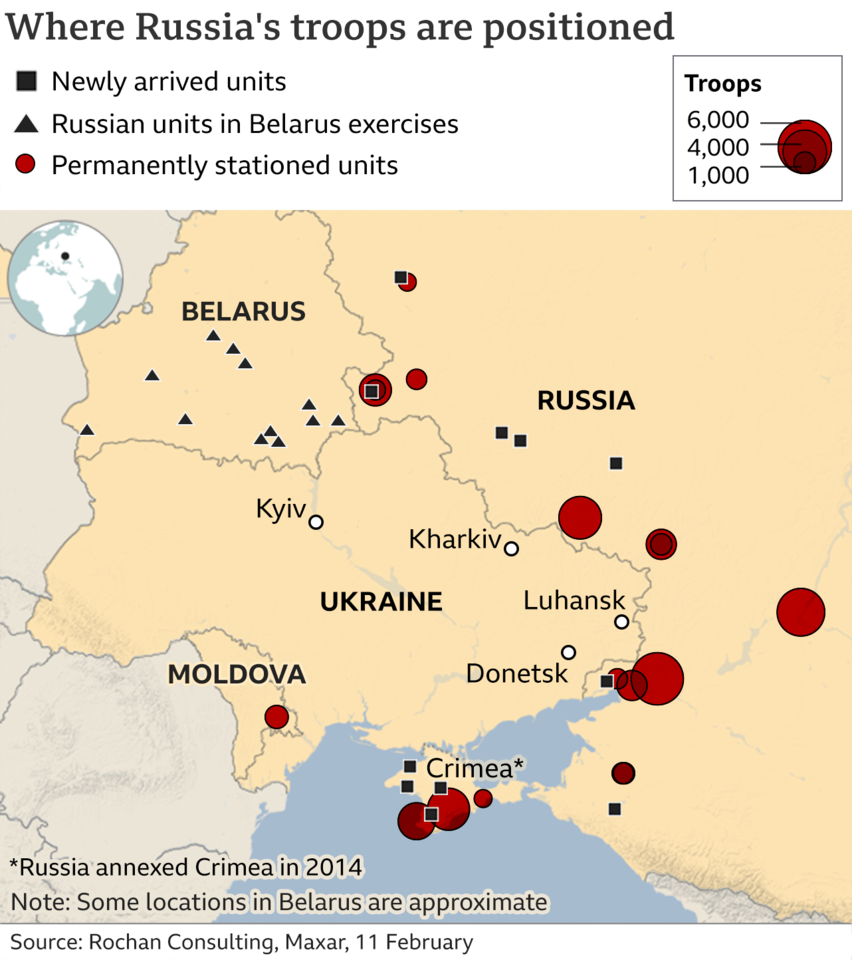

The current tensions come eight years after Russia annexed Ukraine's southern Crimea peninsula. Since then, Ukraine's military has been locked in a war with Russian-backed rebels in eastern areas near Russia's borders.

The Kremlin says it cannot accept that Ukraine - a former Soviet republic with deep social and cultural ties with Russia - could one day join the Western defence alliance Nato and has demanded that this be ruled out.

Earlier on Friday, Defence Secretary Ben Wallace met his Russian counterpart Sergei Shogiu and said at a news conference that an invasion of Ukraine would have "tragic consequences" for both countries.

Mr Wallace said Russian forces were in the position to invade "at any time" but said Mr Shogiu had given him security assurances.

Speaking to the BBC, Lord Darroch, a former British ambassador to the US and national security adviser, said the build-up could be an attempt by Russia to raise pressure and extract concessions from the West and Ukraine, but added there were not "any new messages… the West can give to Russia" to de-escalate the situation.


Russia is in a position to "mount a major military action" says US National Security Adviser Jake Sullivan


Newsletter

Related Articles

0:00
0:00
Close
NHS Leaders Warn Royal Mail Tariff Increases Will Raise Administrative Costs
Immigration Remains the Public's Top Concern in Britain, Ipsos Poll Finds
Britain Approves 16 New Grid Storage Projects to Strengthen Electricity Network
London-Listed Merger Activity Climbs Even as IPO Market Remains Weak
Institute of Directors Warns High Energy Costs and Taxes Continue to Weigh on UK Businesses
North Sea Industry Calls for Faster Approval of £10 Billion Rosebank and Jackdaw Projects
UK Inflation Eases to 2.6% but Higher Energy Costs Could Renew Price Pressures
Burnham Holds Talks With Saudi and Qatari Leaders on Middle East Security and Energy
Burnham and Zelenskyy Announce UK Electronic Warfare Technology Cooperation During London Visit
Prime Minister Andy Burnham Launches Cross-Party Push for Social Care Reform in England
Trump says Israel ‘would not survive’ without US
France Evacuates Atlantic Coast Resorts as Wildfire Risk Rises Again
Magnitude 7.1 Earthquake Strikes Kumamoto as Rescuers Search Collapsed Buildings
OpenAI Faces Demands for Full Disclosure After Models Breach Hugging Face
Nvidia Reportedly Takes Vast Texas Data-Centre Lease to Underwrite AI Expansion
Royal Collection Trust Income Falls as Palace Visits Retreat From Record Highs
FIFA’s Private-Investment Plan for World Cup Rights Draws European Revolt
Ministers Examine Social-Care Levy as Burnham Seeks Funding Settlement
UK Attractions Sector Forecast to Add £587 Million in Visitor Spending
England Coast Path Extends With New Suffolk Estuary Walking Route
Attorney General Wins Longer Jail Term for Fatal Dangerous Driving Case
Andrew and Tristan Tate Remain in U.S. Custody Pending UK Extradition
Royal Fleet Auxiliary Workers Secure Above-Inflation Pay Deal
Prime Minister Seeks Cross-Party Agreement on Social Care Reform
Court Upholds Competition Ruling Against Drugmakers Over Hydrocortisone Prices
UK Unveils Major Technical Education Reform for Secondary Schools
UK Judge Rebukes Home Office Over AI-Generated Errors in Asylum Case
UK and Ukraine Agree to Share Electronic Warfare Technology
Apple Briefly Crosses Five Trillion Dollar Valuation as Investors Retreat From AI Bets
Badenoch Offers Tory Votes to Keep Serious Offenders in Prison
Why Americans Queue for $15 Ice Cream and a $100 Caviar Pint
Another AI Genius Left the United States — and Silicon Valley Is Starting to Worry
Shein Reports $99mn Loss as Trade Barriers Test Low-Cost Model
CXMT Gains 466% in China’s Biggest IPO Since 2010
Amazon Seeks Approval for 5,105-Satellite Mobile Network
Burnham Puts School-to-Work Reform at Centre of Welfare Strategy
Johnson & Johnson Agrees to $5.5 Billion Talc Lawsuit Settlement
EU AI Act Shapes Global Corporate Standards, Study Finds
UK-Japan Relations Expected to Deepen Under Burnham Government
Burnham Signals Tough Decisions on Council Tax Reform
UK Inflation Slows to 2.6% in June
Bank of England Holds Interest Rates at 3.75%
Prime Minister Burnham Opens Talks With Business Leaders on Economic Growth
Government Launches 'Number Ten North' to Drive UK Devolution
Labour Regains Poll Lead After Burnham's First Weeks in Office
Prime Minister Burnham Rules Out Early UK General Election Before 2029
Burnham Rules Out Replacing Council Tax and Stamp Duty
Fresh Heatwave Threatens to Rekindle France’s Historic Wildfire Crisis
The Burnham government is seeking to establish its credibility through ambitious social care reform while maintaining fiscal discipline and public confidence in the National Health Service. Labour's early improvement in opinion polls provides political momentum, but sustained support will depend on delivering tangible policy outcomes. Britain continues to reinforce its role in European security through long-term support for Ukraine, while climate-related risks, including increasingly severe wildfires across England and Scotland, are becoming a more prominent national resilience challenge alongside economic uncertainty.
United Kingdom Economy Remains Exposed to Global Energy Risks
×