London Daily

Focus on the big picture.
Tuesday, Jul 14, 2026

Royal Mail workers begin wave of Christmas strikes

Royal Mail workers begin wave of Christmas strikes

Thousands of postal workers at Royal Mail are on strike over pay and conditions, potentially causing disruption to customers' festive deliveries.

More than 115,000 staff walked out on Friday, with more strikes to follow in the run-up to Christmas.

Recent talks between the CWU union and Royal Mail have broken down.

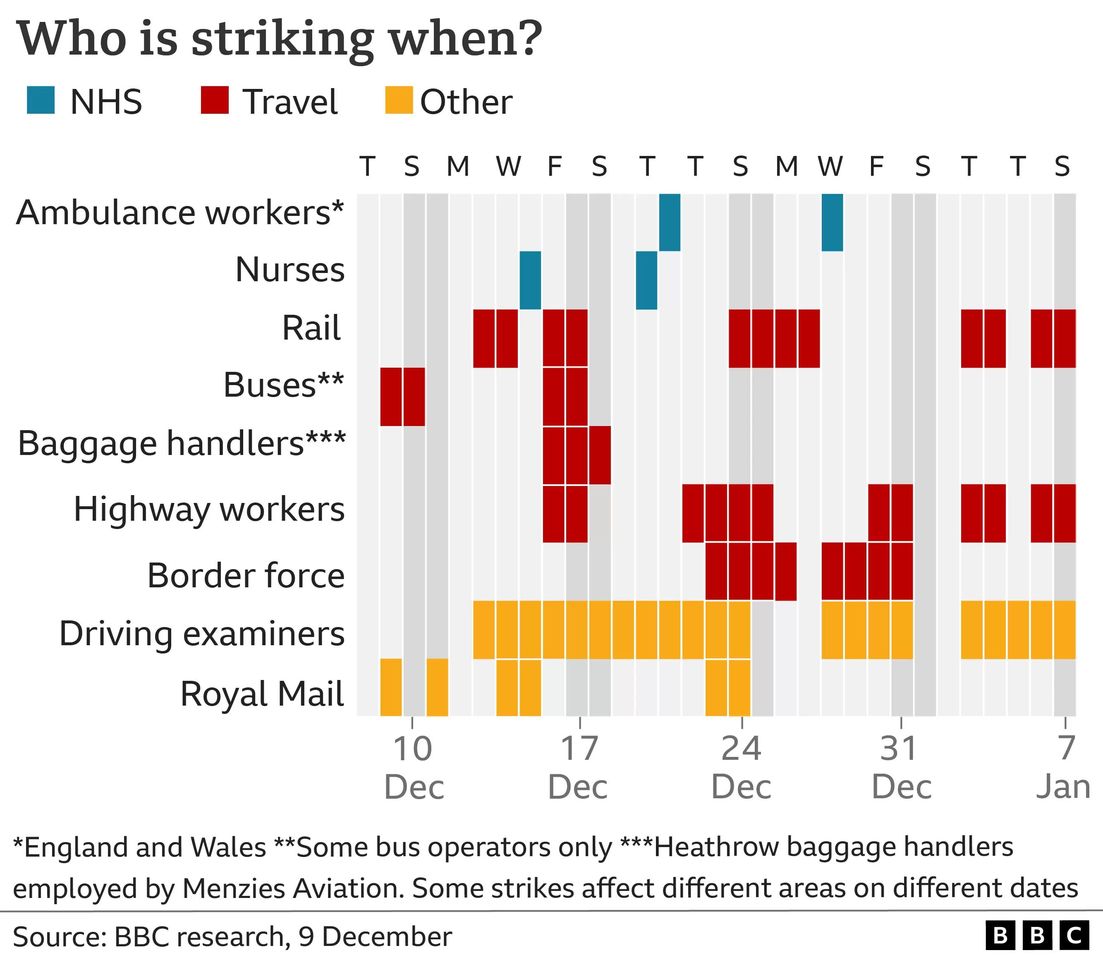
Members of the union are expected to continue striking on Sunday as well as on 14, 15, 23 and 24 December.

Although there are no letter deliveries on Sundays, there are parcel deliveries, and Royal Mail also processes mail on a Sunday for delivery on a Monday.

Last week, Royal Mail advised people to post Christmas mail earlier than usual due to the strikes.

Millions of letters have reportedly been piling up as negotiations have stalled, while it has brought forward the final suggested date for sending second class post to 12 December from 19 December, and for first class to 16 December from 21 December.

The union has said staff want a pay rise that matches the soaring cost of living and has accused management of trying to "force through thousands of compulsory redundancies".

Workers carrying placards demanding the removal of Royal Mail's chief executive Simon Thompson gathered outside the Mount Pleasant Mail Centre in London - the company's largest sorting site in the UK.

One employee Nick, who has worked for Royal Mail for 38 years, told the BBC that although he had walked out during previous strikes, the distance between management and unions appeared to him to be wider in this wave of industrial action.

"It seems to me there's not really a negotiation. It is a take it or leave it deal where they are attacking our terms and conditions."

Inside the sorting office, parcels and letters continued to be sorted by a skeleton crew of 100 people, compared to the 1,000 employees who normally work at the centre.
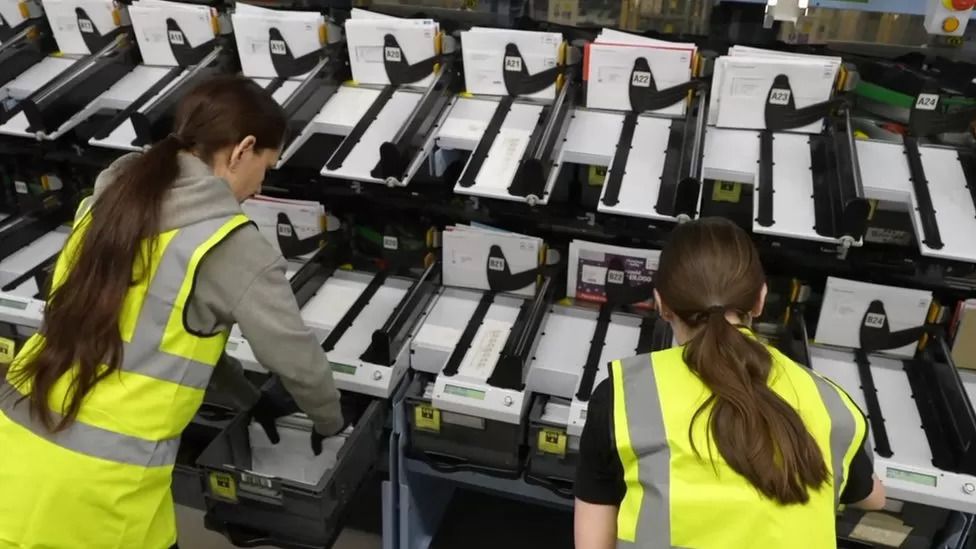

On Friday a skeleton crew continued to work at Royal Mail's Mount Pleasant sorting office

Joy, who has been with Royal Mail for 28 years, told the BBC he had chosen to come to work on a strike day because "I want to please my customers because of the peak time".

He said that firms are worried about business after the height of the pandemic. "They need their letters and their mail ASAP," he said."I want to keep moving the mail."

Members of the CWU also staged a rally on Friday afternoon outside Parliament in central London.

The union's general secretary, Dave Ward, said at the rally that the union was preparing a fresh ballot over further strike action in January.

But speaking during a visit to an RAF base in Lincolnshire, Prime Minister Rishi Sunak said that he was not ruling out extending "tough" new anti-strike laws to prevent walkouts by emergency service workers.

He said the government was "looking at all options" when he was asked about the potential changes to the law to limit the impact of strikes.

The most recent dispute in the postal industry began this summer after Royal Mail rejected demands for a pay rise that matched inflation - the rate at which prices rise - which is currently 11.1%.

Royal Mail has been struggling as it moves from its traditional business of delivering letters, which is no longer profitable, to parcel deliveries.

It wants to cut 10,000 jobs by next August, which will include 6,000 redundancies and thousands of other roles that will not be filled as staff leave.

It also argues that it needs to modernise how the business works to accommodate a rise in parcel deliveries, which would mean changing workers' hours.

Dave Ward, the CWU general secretary, said: "Royal Mail bosses are risking a Christmas meltdown because of their stubborn refusal to treat their employees with respect.

"Postal workers want to get on with serving the communities they belong to, delivering Christmas gifts and tackling the backlog from recent weeks.

"But they know their value, and they will not meekly accept the casualisation of their jobs, the destruction of their conditions and the impoverishment of their families."

Talks have broken down between the union and Royal Mail, a spokesman said, adding that Royal Mail managers are "refusing to budge with their 'best and final' offer".

That offer includes a 9% pay deal over 18 months and "a number of other concessions to terms and agreements", Royal Mail said.

A spokesman said: "We spent three more days at [conciliation service] Acas this week to discuss what needs to happen for the strikes to be lifted.

"In the end, all we received was another request for more pay, without the changes needed to fund the pay offer," he said, adding that the union "knows full well" that the business is losing more than £1m a day.


Newsletter

Related Articles

0:00
0:00
Close
UK Prime Minister Keir Starmer Offers Condolences Following Death of Qatar’s Father Amir
UK Regional Innovation Policy Focuses on Research Clusters Across Scotland, Wales, and Northern England
UK Corporate Transparency Rules Set to Become More Strict Under Modern Slavery Reform Plans
UK Civil Service Estate Strategy Shifts Government Activity Away From London
UK Strengthens National Security Powers Through New Threat Designations
Greater Manchester Police Conduct Drink and Drug Driving Operations After Football Events
UK Government Advances Darlington Economic Campus With Construction Milestone
UK Authorities Increase Football-Related Security Operations After Tournament Fixtures
UK Invests Fifty-One Million Pounds in National Cryogenics Facility and Regional Innovation Hubs
UK Moves Toward Tougher Modern Slavery Reporting Rules With Corporate Penalties
UK Government Reports Forty-Three Million Pounds in Savings From Office Estate Reform
UK Government Expands Civil Service Regional Strategy With Manchester and Darlington Campus Projects
UK Designates Iran’s Islamic Revolutionary Guard Corps as National Security Threat
United Kingdom Financial Markets Monitor Business Response to Economic Policy Changes
Scottish Renewable Energy Expansion Highlights Need for Faster Grid Development
Wales and Regions Strengthen Focus on Economic Development Through Tourism and Investment
Retail Industry Warns High Street Businesses Remain Under Pressure
Police Chiefs Highlight Growing Challenges Managing Protests and Public Order
Agriculture Leaders Seek Clarity on Post-Brexit Farming Support and Environmental Rules
Transport Unions Warn of Further Industrial Action Over Pay and Working Conditions
Welsh Tourism Sector Reports Strong Growth Driven by Domestic and International Visitors
National Infrastructure Review Gains Support as Leaders Seek Faster Project Delivery
Financial Markets Assess Impact of United Kingdom Corporate Tax Policy Changes
Northern Ireland Assembly Debates Cross-Border Trade and Infrastructure Cooperation Plans
Government Opens Consultations on Housing Reform and Planning System Changes
Scottish Government Faces Pressure to Accelerate Offshore Wind and Grid Expansion
National Energy System Operator Warns Grid Investment Is Needed for Future Electricity Demand Growth
United Kingdom Research Council Invests in Artificial Intelligence and Biotechnology Innovation Hubs
United Kingdom Expands Oversight of Skilled Worker Visa Sponsors Amid Migration Debate
Cross-Party MPs Call for National Infrastructure Strategy Review to Accelerate Economic Growth
Prime Minister Announces One Billion Pound NHS Funding Package Ahead of Winter Pressures
Bank of England Signals Cautious Approach to Interest Rates as Inflation Remains Above Forecasts
World Cup Visitors Turn American Big-Box Stores Into Souvenir Stops
Netflix Weighs Always-On Channels, Bundles and Short-Form Video
Passenger Is Pulled Partly Outside Ryanair Jet After Window Fails Mid-Flight
Innovation-led growth strategy
Public service reform pressure
Defence and industrial security
Labour leadership transition and economic reset
Northern England Pushes for Greater Influence in Britain’s Future Economic Model
UK Technology Strategy Focuses on Life Sciences, Digital Innovation and Research Investment
Britain and United States Maintain Focus on Pharmaceuticals Cooperation and Industrial Growth
UK Public Services Face Continued Pressure as Government Promises Visible Improvements
Regional Economic Power Becomes Key Theme in Britain’s Next Political Phase
Britain Expands Support for Small Businesses as Firms Seek Better Access to Finance
UK Economy Remains Central Political Challenge as Cost of Living and Growth Concerns Persist
National Health Service Introduces New Workplace Reviews to Improve Conditions for Healthcare Staff
UK Life Sciences Sector Secures More Than Three Billion Pounds in Investment to Support Innovation
Britain Strengthens Defence Strategy as Security Concerns Reshape Military and Industrial Policy
Andy Burnham Promises Stronger UK Defence Industry and Expanded Domestic Production
×