Rishi Sunak hails new NI Brexit deal but DUP concerns remain
Many Conservative MPs, including those who supported Brexit, gave their backing to the agreement.
And the DUP, whose support will be key to restoring power-sharing in Northern Ireland, said there had been "significant progress".
But the party warned that "key issues of concern" remain.
DUP leader Sir Jeffrey Donaldson said his party would now study the legal text, before reaching a decision on whether to support the deal.
The party has boycotted the devolved government until its concerns over the Northern Ireland Protocol are resolved and some Tory MPs have said they will only support an agreement if it has the backing of the DUP.
Sinn Féin, which is the largest party in the Northern Ireland Assembly, welcomed the deal, although it said it still needed to examine the details.
The party's vice-president, Michelle O'Neill, repeated her call for the DUP to return to devolved government, adding: "We always said that with pragmatism, solutions could be found."
After months of negotiation and speculation surrounding a possible deal, it was finally unveiled during a day of carefully choreographed events.
Word began to emerge from inside government at around 14:00 GMT that a deal on an issue which has vexed four prime ministers had finally been done.
The PM confirmed the breakthrough soon after during a joint press conference in Windsor with European Commission President Ursula von der Leyen.
There was a notable warmth between the PM and Mrs von der Leyen as they outlined their agreement on Monday, with the EU chief referring to the prime minister as "dear Rishi" and hailing a "new chapter" of a "stronger EU-UK relationship".
She went on to have tea with King Charles at Windsor Castle. The pair were pictured smiling and chatting, but there was concern from some MPs that the meeting would draw the monarch into a contentious political issue.
As Mr Sunak travelled back to London to address the Commons, the details of the long-awaited deal were landing well with some MPs who might have been expected to cause the PM political problems.
Northern Ireland Office Minister and arch-Brexiteer Steve Baker said Mr Sunak had "pulled a blinder".
He had been considering resigning "as late as yesterday", he revealed, but added that the agreement "should be good enough for any reasonable unionists".
During a Commons debate, former Prime Minister Theresa May urged MPs to back the deal - but two other former PMs, Boris Johnson and Liz Truss, did not attend.
Number 10 will be pleased by the response from the US, where outstanding issues over the arrangements in Northern Ireland have been seen as an obstacle in any potential trade talks between London and Washington.
US President Joe Biden said the deal was "an essential step to ensuring that the hard-earned peace and progress of the Belfast/Good Friday Agreement is preserved and strengthened".
The agreement, named the Windsor Framework, changes the Northern Ireland Protocol, which was signed by Mr Johnson and came into force in 2021.
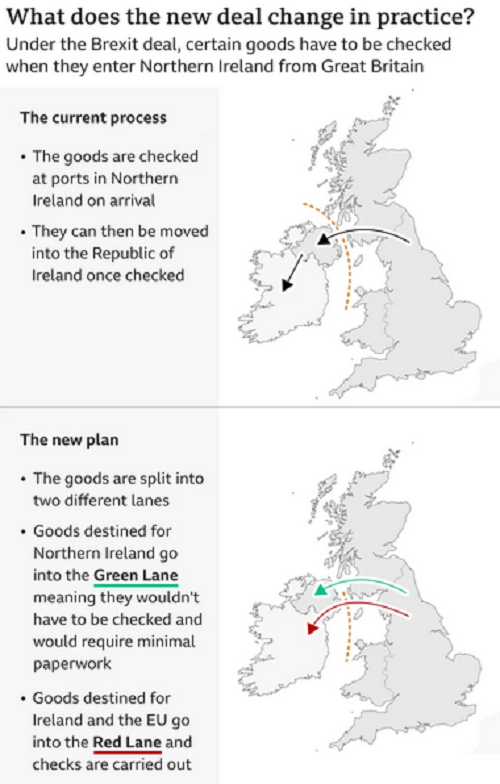
The protocol aimed to ensure free movement of goods across the Irish land border by conducting checks between Northern Ireland and Great Britain instead.
But under the treaty, Northern Ireland had to keep following some EU rules.
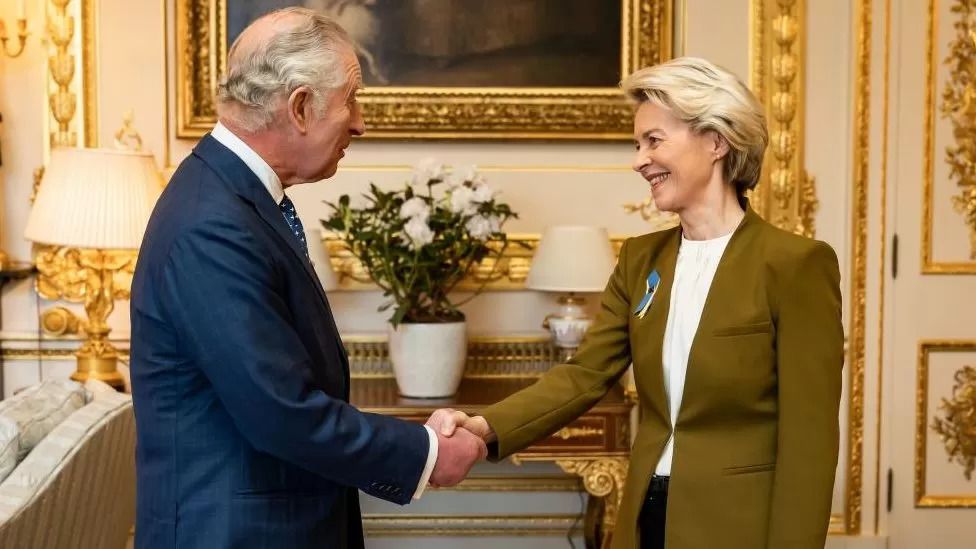 Ursula von der Leyen met King Charles at Windsor Castle after the deal was announced
Mr Sunak said the new deal "delivers smooth-flowing trade within the whole United Kingdom, protects Northern Ireland's place in our union and safeguards sovereignty for the people of Northern Ireland".
Under the agreement:
* Goods from Britain destined for Northern Ireland will travel through a new "green lane", with a separate "red lane" for goods at risk of moving on to the EU
* Products coming into Northern Ireland through the green lane will see checks and paperwork significantly reduced, while red lane goods will still be subject to normal checks
* A "Stormont brake" allows the Northern Ireland Assembly to raise an objection to "significantly different" EU rules which would apply in Northern Ireland
* UK VAT and excise rules will apply to Northern Ireland for alcoholic drinks for immediate consumption and immovable goods such as heat pumps. Previously EU VAT rules could be applied in Northern Ireland
But there is no guarantee that it will result in the return of a power-sharing devolved government for Northern Ireland. In a statement, the DUP said "significant progress has been secured across a number of areas" but concerns remain.
"There can be no disguising the fact that in some sectors of our economy EU law remains applicable in Northern Ireland," it said.
The party said it would now want to study the detail of the deal and underpinning legal texts, and would seek "further clarification, reworking or change as required".
The nationalist Social Democratic and Labour Party, and the Alliance Party, which is neither nationalist or unionist, welcomed the deal, although both said they had concerns about the Stormont brake clause.
But the Traditional Unionist Voice Party said the agreement was "much spin, not a lot of substance" and meant the protocol "effectively stays".
The Ulster Unionist Party said it would study the detail but would not give cover to other parties.
Several Brexit-supporting MPs have responded positively to the agreement.
Former Brexit Secretary David Davis said the prime minister had "pulled off a formidable negotiating success" and "secured the best possible deal".
Former Business Secretary Andrea Leadsom said there had been "huge progress", adding: "It all now depends on whether the communities in NI feel it's the right solution."
However, other Tory MPs were more cautious, with prominent Eurosceptic Sir Bill Cash saying "the devil as ever lies in the detail".
DUP MP Ian Paisley said the deal had "fallen short" in a number of key areas, including the continued role of the European Court of Justice as the final arbiter in disputes over EU rules.
"My gut instinct is it doesn't cut the mustard," he told BBC Newsnight.
Mr Sunak said Parliament would get a vote on the agreement at the "appropriate time" but that MPs needed a chance to consider the detail.
Labour has said it will support a deal but the government will be reluctant to rely on opposition votes.
Leader Sir Keir Starmer said the deal was not "perfect" but "now that it has been agreed we all have an obligation to make it work".
Mr Sunak also confirmed the government was dropping the controversial Northern Ireland Protocol Bill, which was introduced under Mr Johnson when he was prime minister and would have given the UK the power to unilaterally scrap parts of the old deal.
He said the bill was now no longer needed and the original legal justification for it had "fallen away".