London Daily

Focus on the big picture.
Friday, May 29, 2026

Record 5.6m people in England waiting for hospital treatment

Record 5.6m people in England waiting for hospital treatment

Number highest since records began in 2007, while 293,000 have been waiting more than a year

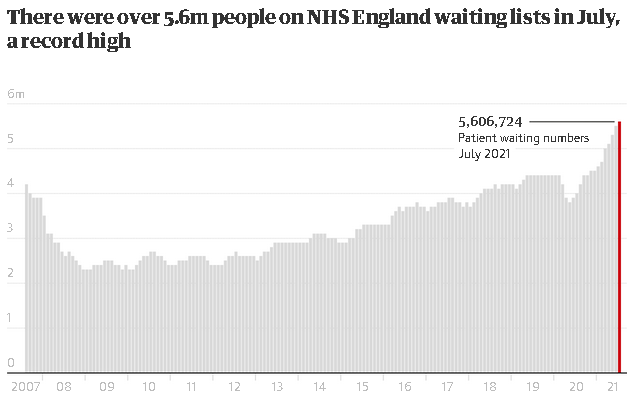
The number of people waiting for hospital treatment in England has hit a record high of 5.61 million, as the NHS struggles to clear the growing backlog of care caused by Covid-19.

It means 1.4 million more patients are waiting for procedures such as a hip or knee replacement or cataract removal than when the pandemic struck in March 2020, forcing the suspension of much NHS care such as diagnostic tests and surgery.

The waiting list is now growing in size by about 150,000 a month as more people who did not seek or could not access NHS treatment over the last 18 months visit a GP and are referred to hospital.

The NHS England performance statistics released today showed that 1.8 million of the 5,606,724 people who were waiting for care in July had already waited at least 18 months. That is more than double the 860,309 people who were in that situation in March 2020.

Hospitals – which are facing staff shortages and unprecedented demand for care – are failing to fulfil the promise enshrined in the NHS constitution to treat 92% of those on the Referral to Treatment (RTT) waiting list within 18 weeks. One NHS leader said the new data showed that “certain parts of the health service are under almost impossible pressure”.

The latest rise in the backlog comes two days after Boris Johnson identified it as the main reason for giving the NHS in England about £10bn a year extra funding over the next three years, using income from the 1.25-percentage-point rise in national insurance dubbed the “health and social care levy”, and said it would pay for “the biggest catch-up programme in the history of the NHS”.

Amid warnings that the waiting list could hit 10 million this year and 13 million soon after that, the prime minister acknowledged that “waiting lists will get worse before they get better”.

He pledged to increase hospital capacity by 10% and enable 9m more appointments, scans and operations to take place, and said 30% more patients who needed non-urgent care such as cancer screening would be able to get it by 2024-25. However, he gave no details of the “plan” that has apparently been drawn up with NHS England to achieve these ambitious targets.

The British Medical Association has called the backlog “gargantuan and unprecedented”. Doctors fear that some patients’ health will deteriorate, potentially to the point where treatment is ineffective, and even that some may die as a result of long delays. The ballooning waiting list is linked to Britain’s low numbers of doctors and hospital beds relative to EU nations, the BMA said.

Responding to Thursday’s grim new figures, Tim Mitchell, a vice-president of the Royal College of Surgeons of England, said: “Behind these eye-watering statistics are patients waiting in pain for hip and knee replacements and for heart, brain and other operations. Without surgery, many would be left unable to work or carry out everyday activities, their quality of life greatly diminished.”

The data also showed that 7,980 patients have been waiting for more than two years for treatment. This is 39% up on the 5,727 such cases the previous month. The 7,980 include people waiting for trauma and orthopaedic treatment, such as a joint replacement (1,732), general surgery such as a gallbladder removal or hernia repair (982), and ear, nose and throat treatment (842).

NHS Providers and the NHS Confederation, which represent the 213 health service trusts in England, warned this week that it could take up to seven years to clear the backlog. The Health Foundation estimates that the NHS will need to spend £16.8bn on “recovery” of pre-pandemic waiting times by the end of this parliament in December 2024.

Thursday’s figures also showed that:

*  Just 66.2% of people arriving at hospital-based A&Es in August were seen within four hours, the lowest percentage ever – the target is 95%.

*  The median waiting time for people awaiting a referral in July for treatment rose to 10.9 weeks – up from 10.4 weeks the previous month.

*  he number of cancer patients having their first treatment within two months of referral by their GP was 72% in July – well below the 85% expected.

NHS England pointed to the fact that hospitals undertook 3.9m diagnostic tests and began treating 2.6 million people in June and July, even though they were also looking after thousands of Covid patients.

“Caring for 450,000 patients with the virus has inevitably had a knock-on effect on less urgent care and left a backlog. But staff are working around the clock to make the best possible use of government investment to treat as many people as possible,” said Prof Stephen Powis, NHS’s England’s national medical director.

Newsletter

Related Articles

0:00
0:00
Close
Japanese Technology Firm Fujitsu Launches Advanced Artificial Intelligence Tool for Corporate Disclosures
South Africa Officially Launches Nationwide Campaign for Highly Contested Local Government Elections
United Kingdom Commits Additional Funding for Unexploded Ordnance Clearance in Laos
Singapore Announces Stringent New Greenhouse Gas Regulations for Commercial Cooling Systems
Cambodia and Thailand Hold High-Level Border Security Talks at United Nations Headquarters
Myanmar Military Government and China Sign Major Agreement to Upgrade Media and Cultural Cooperation
Knife Attack at Swiss Train Station Leaves Three Injured in Suspected Act of Domestic Terrorism
Transnational Extortion Gang Threatens Canadian Police With Army of One Thousand Armed Operatives
Australia Imposes Forty-Two-Day Quarantine on Cruise Ship Passengers Following Deadly Hantavirus Outbreak
International Monetary Fund Unlocks Seven Hundred Million United States Dollars for Sri Lanka Following Economic Reforms
Australia Launches Record One Point Four Billion Dollar Lawsuit Against Chemical Giant 3M Over Contamination
China and Canada Foreign Ministers Meet in Ottawa in Effort to Stabilize Strained Diplomatic Ties
Indonesia Demands Urgent United Nations Security Council Reform Amid Escalating Global Conflicts
Extreme Weather Patterns Trigger Severe Drought in Madagascar and Destructive Flooding in East Africa
Indian State of Karnataka Faces Political Upheaval as Chief Minister Siddaramaiah Abruptly Resigns
Philippines and Japan Reaffirm Defense Ties as Crucial for Indo-Pacific Regional Stability
Norway Joins French Nuclear Deterrence Initiative in Major Shift for European Security Architecture
Global Critical Mineral Alliances Expand as Western Nations Move to Counter Chinese Supply Dominance
United States Imposes Fifty Percent Tariffs on Mexican Steel and Aluminum Ahead of Trade Pact Review
European Union and China Head Toward Major Trade Conflict Over Clean Technology Exports
United States Economic Growth Severely Downgraded to One Point Six Percent as Stagflation Fears Mount
World Health Organization Warns Central African Ebola Epidemic is Outpacing Containment Efforts
United States Treasury Department Conditions Sanctions Relief on Reopening of the Strait of Hormuz
Iranian Air Defenses Intercept and Destroy United States Military Drone Over Bushehr Province
Iranian Armed Forces Launch Ballistic Missiles Toward Unspecified Targets Prompting Regional Condemnation
United Nations Secretary-General Warns Global Order Facing Highest Level of Conflict Since 1945
Israel Issues Sweeping Evacuation Orders in Southern Lebanon Amid Intensified Hezbollah Conflict
Russia Announces Systemic Military Strikes Targeting Ukrainian Defense and Energy Infrastructure
United States and Iranian Negotiators Reach Draft Agreement to Extend Ceasefire and Resume Nuclear Talks
United Nations Security Council Deeply Divided Over United States Capture of Venezuelan President
US and Iran Exchange Direct Military Strikes Amid Fragile Gulf Ceasefire
World Health Organization Warns of Catastrophic Ebola Outbreak in DR Congo
Russia Threatens New Wave of Strikes on Ukrainian Infrastructure and Embassies
Scientists Warn Atlantic Ocean Currents Could Collapse Faster Than Projected
Anthropic Reaches $900 Billion Valuation in Historic AI Funding Round
Washington Imposes Crippling Sanctions on Iranian Maritime Authority
Japan and the Philippines Initiate Strategic Intelligence-Sharing Pact
Microsoft Deploys Autonomous Computer-Using AI Agents to Global Markets
Anthropic Secures $45 Billion Compute Infrastructure Agreement With SpaceX
U.S. Director of National Intelligence Resigns Amid Administration Shakeup
Micron Technology Crosses Trillion-Dollar Valuation Amid Unprecedented Hardware Demand
Canada and Germany Finalize Historic Long-Term LNG Export Agreement
China Expands International Travel Restrictions on Domestic AI Researchers
Japan Approves Sweeping Overhaul of National Intelligence Apparatus
Global Airlines Scramble Logistics as Middle East Airspace Remains Fractured
Japan's Naphtha Imports Plunge 47 Percent Amid Strait of Hormuz Closure
Global Crude Prices Retreat Below $96 as Gulf Tensions Momentarily Ease
Generative AI Outperforms Human Baselines in Landmark Global Creativity Study
NASA Partners With Private Aerospace to Unveil Permanent Lunar Base Architecture
South Korean Equity Markets Surge on Next-Generation Memory Chip Frenzy
×