London Daily

Focus on the big picture.
Thursday, Oct 29, 2026

Public consent for test and trace in England at risk, says Jeremy Hunt

Scrap self-isolation for people fully vaccinated, former health secretary urges amid ‘pingdemic’ chaos

The government “risks losing social consent” for its test-and-trace programme if it does not immediately allow fully vaccinated people to avoid isolation, the former health secretary Jeremy Hunt has said. His comments came as it was revealed that a record 618,903 people in England and Wales were sent self-isolation alerts in the week to 15 July.

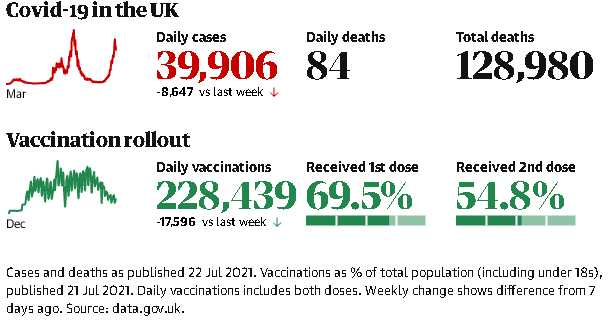
Conservative MPs were in open revolt on Thursday as reports and pictures emerged of empty supermarket shelves, blamed on the hundreds of thousands of people “pinged” or contacted by NHS test and trace and told to stay at home because of the rapidly rising number of Covid cases, which are at their highest level since January.

Businesses are to be told on Thursday whether their staff qualify for “critical worker” status, enabling them to leave self-isolation in England if they are fully vaccinated to avert major disruption to food supplies. Industries from petrol stations to the postal service have also reported being affected by absences.

Speaking in the Commons after a statement from the vaccines minister, Nadhim Zahawi, and amid reports of people deleting the NHS Covid app in droves to avoid being alerted, Hunt said: “Does he not think it’s time for the government to listen to public opinion and scrap the 10-day isolation requirement immediately for people who have been double jabbed in favour of having to isolate until they have done a negative PCR test? Otherwise we risk losing social consent for this very, very important weapon against the virus.”

Mark Harper, who chairs the Covid Recovery Group of Tory backbenchers, backed the plan to allow fully vaccinated people who are alerted to take a PCR test rather than self-isolate, to be moved forward from 16 August. “The danger is, large numbers of people will either delete or stop listening to the app, and then when we get to 16 August they won’t be getting the advice to get a PCR test, and we will actually have made ourselves less safe,” he said.

Kwasi Kwarteng, the business secretary, said he was “very concerned” by some of the scenes inside shops. He told BBC Radio 4’s Today programme: “It’s not a universal thing. I don’t want people to get the impression that every shelf in every supermarket is bare, that’s not the case. But we are certainly concerned about instances of shortages.”

The government has promised for days to publish further guidance about which firms can ask workers to leave isolation if they are fully inoculated to prevent chaos to councils and companies, given the rapidly dwindling workforce they are able to draw on.

The “narrow” list would be released on Thursday, Kwarteng said, suggesting it would not be a list of professions or companies eligible to apply to the government, but rather a breakdown of which sectors would be affected and which among them “might be exempt”.

He did not rule out workers in the food industry, including supermarkets, being eligible, urging people not to panic buy and saying: “I’m not panicking, I’m looking at the evidence.”

Current isolation rules for most the population were not scrapped on 19 July as some expected, meaning those who have had both Covid jabs must still quarantine if they are identified as a “close contact” of someone who has tested positive for the virus. This has recently included Boris Johnson and the chancellor, Rishi Sunak, after the double-vaccinated health secretary, Sajid Javid, tested positive for Covid.

Kwarteng said that when the rules changed on 16 August that would make an “enormous” difference, helping restore more of people’s freedoms and unlocking parts of the economy.

Downing Street said on Tuesday that companies would have to apply directly to the relevant Whitehall department that covers them for authorisation to bring staff back to work, but gave no indication of how long this process would take.

Make UK – the manufacturers’ association – said more than one in 10 businesses were saying some production had stopped. Almost a quarter of businesses reported up to 10% of staff were isolating, and almost one in 10 said it was up to 25%.

Stephen Phipson, Make UK’s chief executive, said: “The impact on manufacturing continues to rapidly increase and there remains an inconsistency of government policy that allows non-vaccinated people in nightclubs, while those who have had both jabs are asked to isolate. We would urge government to address this by bringing forward the planned August date in order to keep the economy open.”

The delay in giving businesses certainty about which workers will qualify for critical worker status has been criticised by industry leaders, including the managing director of the supermarket chain Iceland, Richard Walker. He said his company and others were seeing an “exponential” increase in workers taking time off since 19 July, telling the BBC: “We are taking matters into our own hands in terms of recruitment because we simply don’t have time to wait for the government to sort this out.”

Walker said that while there was not currently a crisis in supply and “dramatic pictures” in the media represented isolated incidents, a crisis could arise if ministers did not act fast.

“The people who should be panicking are the government, and the sooner they clear up this mess and get retail workers and HGV drivers on to the key worker list, the better,” he said.

Newsletter

Related Articles

0:00
0:00
Close
Automotive Manufacturers Urge Government Action as High Energy Costs and Global Supply Chain Disruptions Threaten Production
Metropolitan Police Issue Formal Apology Following Inadvertent Release of Confidential Information During High-Profile Investigation
Scottish Finance Secretary Shona Robison Unveils Devolved Budget Highlighting Housing and Public Service Adjustments
Energy Regulator Office of Gas and Electricity Markets Prepares to Remove Household Gas Standing Charges Following Treasury Mandate
Treasury Confirms Reversal of Planned Cash Individual Savings Account Allowance Reduction Protecting Twenty Thousand Pound Limit
Office for Budget Responsibility Revisions Predict Moderate United Kingdom Economic Growth with Elevated Inflation Pressures
Chancellor John Healey Delivers First Autumn Budget in Parliament Highlighting Temporary Bank Surcharge and Cost-of-Living Support
Met Office Issues Extended Forecast Highlighting Stable High Pressure Weather Patterns Across the United Kingdom
Scottish Finance Secretary Shona Robison Outlines Changes to Tax Thresholds and Residential Property Levies in Edinburgh
Financial Markets and Government Bond Yields Remain Stable Following Muted Reaction to Autumn Budget Measures
Defence Committee Chair Tan Dhesi Criticizes Budget for Delaying Critical Defence Spending Decisions to Next Year
International Monetary Fund Forecasts United Kingdom Economic Growth at One Point Three Percent for Year
Office for Budget Responsibility Assesses Fiscal Headroom Reduced to Fifteen Billion Pounds Following Global Energy Shocks
Chancellor John Healey Delivers First Autumn Budget Introducing Household Energy Support and Bank Tax Hikes
Aberdeen City Council Co-Leader Faces Binding Vote Challenge as Local Councillors Launch High Court Legal Battle
Housebuilding Across Scotland Falls to Eleven-Year Low Despite Government Declarations of a Housing Emergency
Former Prime Minister Gordon Brown Organizes National Innovation Summit in Manchester to Boost Regional Competitiveness
UK Government Faces Mounting Criticism Over Lack of Environmental Consultation During Artificial Intelligence Datacentre Expansion Talks
Greggs Announces Closure of Four Major Manufacturing Facilities Across Britain Resulting in Seven Hundred Forty Job Losses
British Retail Consortium Warns That Cumulative Employment and Regulatory Costs Threaten High Street Price Stability
Lloyds Banking Group Chief Executive Charlie Nunn Warns That Increased Bank Taxes Could Deter Long-Term Economic Investment
Ipsos Polling Reveals Seven in Ten Britons Expect Personal Tax Increases Amid Deep Public Economic Pessimism
Chancellor John Healey Delivers First Autumn Budget in Parliament Amid Tight Fiscal Constraints and Slower Growth Forecasts
United Kingdom Finance Monthly Review Highlights Rising Long-Term Borrowing Costs and Persistent Energy Price Pressures Across British Markets
Royal Marines Pioneer Rapid Autonomous Drone Operations During Major High North Exercise Involving NATO Allies
House of Commons Justice Committee Urges Chancellor to Align Prison and Courts Reform Ambitions With Concrete Budgetary Resources
Government Investigates Rapid Artificial Intelligence Datacentre Expansion Strategy Following Scrutiny Over Power Grid Demands and Planning Backlogs
His Majesty's Inspectorate of Constabulary Warns Third-Party Supplier Breaches Threaten United Kingdom Police and Fire Service Data
Number of British Businesses in Financial Distress Reaches Highest Level in Two Decades Ahead of Fiscal Announcement
Chancellor John Healey Prepares Autumn Budget Amid Intense Market Scrutiny Over Fiscal Headroom and Spending Pressures
Education or Indoctrination? The Growing Debate Over Religious Participation in British Schools
Germany's Vanishing Shopfronts: The Silent Collapse of the Businesses That Built Its Cities
Northern Ireland Executive Reaches Agreement on Public Transport Modernization and Cross-Border Rail Infrastructure Funding
Department for Energy Security and Net Zero Approves New North Sea Carbon Capture and Storage Industrial Clusters
Office for National Statistics Reports Stabilization in Private Rental Growth Across Major English and Welsh Regional Cities
United Kingdom Automotive Manufacturing Output Rises Moderately as Electric Vehicle Assembly Lines Expand in the Midlands
Competition and Markets Authority Launches Formal Inquiry Into Cloud Computing Infrastructure and Artificial Intelligence Partnerships
Scottish Government Finalizes Emergency Budget Adjustments Following Multi-Year Public Sector Funding Shortfalls
National Health Service England Announces Major Emergency Care Overhaul to Alleviate Severe Winter Capacity Pressures
Chancellor Rachel Reeves Prepares Autumn Budget Amid Intensifying Scrutiny Over Public Spending and Fiscal Rules
Bank of England Signals Cautious Approach to Further Interest Rate Cuts as Persistent Wage Growth and Inflation Pressures Remain
Transport for London Unveils Expanded Zero-Emission Bus Fleet to Meet Capital Air Quality Targets
Higher Education Institutions Face Deepening Financial Strain Amid Declining International Student Enrolment
Automotive Industry Leaders Criticize Government Tax Policies and Urge Action on Retail Consumer Confidence
Environment Agency Issues Flood Alerts Across Scottish and English Waterways Following Heavy Rainfall
Independent Audit Highlights Persistent Security Vulnerabilities Across Legacy Government Digital Portals
Northern Ireland Political Leaders Clash Over Westminster Funding Allocations Ahead of Autumn Budget
Ethnic Minorities in England Face Significant Disparities in Routine Breast Cancer Diagnosis Rates
National Police Chiefs Report Alarming Surge in Domestic Abuse Cases Fuelled by Expanding Illegal Cocaine Market
Government Announces Two Hundred and Twenty Million Pound Pothole Funding Boost for Local Highway Authorities
×