London Daily

Focus on the big picture.
Tuesday, Jun 23, 2026

Protests against Germany's Covid restrictions turn violent as Europe moves to stem Omicron

Protests against Germany's Covid restrictions turn violent as Europe moves to stem Omicron

Protesters tossed bottles and fireworks at police in eastern Germany on Monday night in some of the most violent demonstrations against public health measures in Europe since the Covid-19 pandemic began.

Hundreds of people gathered in various cities and towns on Sunday and Monday to voice their opposition to stricter social distancing rules that went into effect Tuesday across Germany. Gatherings are now limited to 10 people for those vaccinated or recovered from Covid-19, while households with unvaccinated people must not meet with more than two other people from one other household at a time.

Some 500 people marched to the city center in the city of Bautzen, in Saxony, late into the night Monday in violation of public health regulations, some of them carrying anti-vaccination signs. Twelve police officers were injured and twelve emergency vehicles were damaged as protesters clashed with police.

Scuffles broke out in several parts of the state, Saxony police said, while television footage showed demonstrators throwing objects and shouting insults at officers.

Twenty-three people were criminally charged and another 183 were hit with less-serious administrative violations, police said.
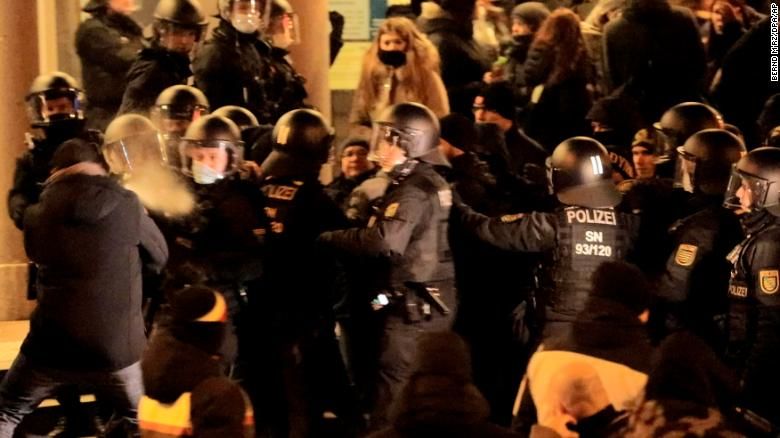
Protesters scuffle with police officers during a demonstration in Bautzen on Monday.


The protests in Germany come as Europe prepares for a surge in new coronavirus cases heading into the New Year holiday. While there remain pockets of communities opposed to Covid-19 vaccines and social distancing measures throughout the continent, anti-vaxxers have become increasingly violent in eastern Germany, which has been the scene of many protests and where the uptake of vaccines is lower than the national average in most states.

Similar scenes of violence played out on Sunday in various places, including the Bavarian town of Schweinfurt, where hundreds of protesters also violated public health regulations to gather. Eight police were injured after being punched and kicked there, authorities said.

A 27-year-old woman was criminally charged after she was accused of trying to break police cordon in the town with her 4-year-old child in tow, both of whom were pepper sprayed, authorities said.

Politicians and media outlets have reportedly received packages containing raw meat and threats from alleged anti-vaxxers, and, earlier this month, authorities uncovered a purported plot to assassinate Saxony Governor Michael Kretschmer. Kretschmer has been pushing for people in his state to get vaccinated and receive booster shots. Six people were arrested and questioned in relation to the allegations but later released.

Germany's vaccination rate lags behind its neighbors in Western Europe, with 70.9% of the population having received both of their doses. Saxony's vaccination rate, at 63%, is the lowest of any German state. German health authorities have said that more people need to be vaccinated to protect the country from a new wave of cases driven by the increase of the Omicron variant across Europe during the holiday season.

Germany earlier this month put in place a nationwide lockdown for unvaccinated people, banning them from accessing all but the most essential businesses.

New Chancellor Olaf Scholz supports mandatory vaccinations and wants a law drafted that could be voted on by the parliament in late February. Parliament is due to meet in early January to begin discussions.

Governments across Europe have in recent days enacted new measures to limit public gatherings, fearing that Omicron could overwhelm hospitals given how fast it's spreading, especially among the unvaccinated.

Germany's Constitutional Court also ruled that legislators need to set triage rules if intensive care units fill up with coronavirus patients. The German Intensive Care and Emergency has said that only one sixth of all ICU beds in the country are available.

After reporting a record-breaking 104,611 Covid-19 infections on Christmas Day, France enacted a series of restrictions Monday limiting where people can eat, mandating more work from home options when possible, and curtailing the size of public gatherings. However, the government stopped short of putting in place curfews or lockdowns and will let local leaders to decide whether they need to implement outdoor mask mandates.

Italy will close all nightclubs and bars in January, while Portugal closed schools, bars and clubs until January 10. Spanish authorities have reinstated a nationwide outdoor mask mandate and six northern regional governments have agreed to coordinate early closing hours for restaurants, bars and nightclubs -- a move affects 14 million people, about 29% of Spain's population.

Madrid, however, will be one of Europe's few major cities to ring in the New Year with a large celebration. Barcelona and Valencia have canceled their fireworks displays in a bid to get people to stay at home. Berlin, London, Paris, Rome and Venice have also axed their traditional festivities.

Newsletter

Related Articles

0:00
0:00
Close
UK Heatwave Disrupts Transport, Healthcare and Public Services as Red Weather Alerts Expand Nationwide
Barclays Warns of Growing Cyber Risk Divide Between Large UK Firms and Micro Businesses
European Defence Plans Including Ukraine Integration Prompt UK Strategic Reassessment
UK Equity Markets React as US–Iran Peace Roadmap Eases Oil Price Pressures
United Kingdom Expands Global Clean Energy Partnerships With Brazil, Morocco and Tanzania
Lord David Frost Urges Incoming UK Leadership to Abandon EU Regulatory Reset Strategy
Housing Groups Support Amendment to Strengthen Fire and Gas Safety Access Powers in Social Housing
South London NHS Estates Staff Ballot on Industrial Action Over Pay Structures in Hospital Maintenance Services
United Kingdom Government Invests £60 Million in AI Research Labs at Oxford and University College London
Barclays Cyber Security Report Highlights Rising Threat Exposure Among UK Small Businesses in AI-Driven Attacks
UK Met Office Heatwave Triggers Transport Warnings as Rail Operators Urge Cancellations Amid Infrastructure Strain
South London NHS Estates Workers Ballot for Strike Action Over Pay Disputes Across Major London Hospitals
Barclays Warns of Severe Cyber Security Gap Between Large Corporations and Small Businesses in the United Kingdom
United Kingdom Government Allocates £60 Million for Artificial Intelligence Research Laboratories at Oxford and UCL
National Health Service Approves Teplizumab Treatment to Delay Onset of Type One Diabetes in First European Rollout
Met Office Issues Rare Red Extreme Heat Warning Across London, South East and West Midlands as Transport and Health Systems Face Disruption
Prime Minister Keir Starmer Resigns After Labour Party Revolt Following Economic Stagnation and Local Election Losses
United Kingdom Economy Contracts for Second Consecutive Month as Private Sector Weakens and Job Loss Fears Rise
Taxpayer Support Grows for Higher Digital Levies on Multinational Tech Companies
Bank of England Signals Caution Over Inflation Despite Easing Energy Prices
Lloyds Banking Group Expands Artificial Intelligence Hiring Amid Sector-Wide Automation Shift
Film Producer Corporate Collapse Leaves Creditors Facing Unrecoverable Losses
UK Ten-Year Brexit Anniversary Highlights Ongoing Political and Economic Uncertainty
Nottingham Maternity Scandal Inquiry Reveals Systemic Failings in NHS Care
Met Office Heatwave Prompts Public Health Warnings Across United Kingdom
Concerns Rise Over Fiscal Stability as Political Uncertainty Weighs on UK Borrowing Costs
UK Taxpayers Back Higher Digital Taxes on Global Technology Firms, Survey Shows
Bank of England Holds Interest Rates Steady Amid Persistent Services Inflation
Reform UK and Opposition Leaders Call for General Election Following Starmer’s Departure
Ten Years After Brexit Referendum, UK Faces Ongoing Political Fragmentation and Economic Debate
Nottingham University Hospitals Maternity Inquiry Exposes Severe NHS Failures
Met Office Issues Heat Health Alerts as United Kingdom Faces Record-Breaking Temperatures
Andy Burnham Emerges as Front-Runner for Labour Leadership After Starmer’s Resignation
Keir Starmer Resigns as UK Enters New Phase of Political Leadership Transition
UK Expands Alcohol Ban Enforcement Using Tagging Technology Ahead of World Cup
UK Invests £50 Million in Critical Minerals Supply Chain Security
UK Appoints Special Envoy on Preventing Sexual Violence in Conflict
UK Introduces Fines for Landlords of Unsafe Rental Properties
Reform UK Leads Opinion Polls as Immigration Debate Reshapes UK Politics
Police Investigate Edinburgh Attacks as Potential Hate Crimes
King Charles to Publish Personal Tax and Royal Household Financial Records
Nottingham University Hospitals Maternity Inquiry Report Set for Publication
Heat-Health Alerts Issued Across London and Southern England Amid Rising Temperatures
UK Economy Shows Pressure From Middle East Conflict Despite Modest Growth
Brexit Anniversary Reignites Debate Over UK Economic and Political Direction
UK Parliament Continues Legislative Work Amid Leadership Transition
Financial Markets Hold Steady After UK Leadership Shake-Up
Andy Burnham Enters Labour Leadership Race With Strong Parliamentary Backing
Keir Starmer Resigns as UK Prime Minister After Two Years in Office
Reform UK MP Lee Anderson to Raise Pension Concerns Over British Coal Staff Superannuation Scheme
×