

Produce evidence Matt Hancock lied on Covid, Dominic Cummings to be told
Dominic Cummings will be asked by senior MPs this week to produce evidence that Matt Hancock lied repeatedly about policy on Covid-19 before the health secretary’s appearance in front of a parliamentary committee early next month.
Jeremy Hunt and Greg Clark, the chairs of the joint select committee which took seven hours of explosive testimony from Cummings last week, will write to the former adviser to the prime minister in the next few days asking that he produce the evidence within the next fortnight.
A source close to the committee said: “You cannot simply go around making accusations that cabinet ministers lied in front of a select committee without backing it up with evidence. We will ask that he provides any evidence to the committee and if he does we will decide whether to publish it before the health secretary comes before the committee.”
The two committee chairs are also expected to request that Hancock, who is due to appear within two weeks, agree to an open-ended session with no time limit, so that MPs can fully explore Cummings’s allegations against him and other issues relating to the handling of Covid-19.
In his appearance before the committee Cummings accused the health secretary of “lying to everybody on multiple occasions” and said he should have been sacked on 15 to 20 occasions. Hancock has denied all the allegations.
Cummings claimed that Hancock, when pressured to explain the shortage of personal protective equipment (PPE) last April, had wrongly accused the head of NHS England Simon Stevens and the Treasury of blocking his efforts to commission more equipment.
Cummings said that the then cabinet secretary Mark Sedwill investigated Hancock’s claims and found them to be false, which he said led Cummings and Sedwill to ask the prime minister to sack him.
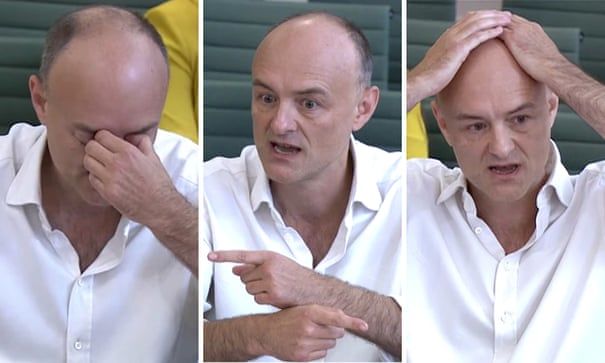 Dominic Cummings giving evidence to MPs on government’s Covid response.
Cummings said: “In April last year, just before the prime minister and I were diagnosed with having Covid ourselves, the secretary of state for health told us in the cabinet room: ‘Everything is fine on PPE, we’ve got it all covered.’
“When I came back [from being unwell], almost the first meeting I had in the cabinet room was about the disaster over PPE, and how we were actually completely short and hospitals all over the country were running out.
“The secretary of state said in the meeting: ‘This is the fault of Simon Stevens, of the chancellor of the exchequer, it’s not my fault, they’ve blocked approvals of all sorts of things.’ I said to the cabinet secretary, ‘Please investigate this and find out if it’s true.’ The cabinet secretary came back to me and said, ‘it’s completely untrue. I have lost confidence in the secretary of state’s honesty in these meetings.’ The cabinet secretary said that to me and he said that to the prime minister.”
Cummings also said Hancock lied by saying that all people moving from hospital to care homes would be tested for Covid-19 before doing so, only for this not happen and for Covid to spread through homes like wildfire.
Under questioning from the Labour MP Graham Stringer, Cummings said: “When we realised in April that this had happened, the prime minister said a less polite version of: ‘What on earth are you telling me?’ – when he came back after being ill – ‘What on earth has happened with all these people in care homes?’ Hancock told us in the cabinet room that people were going to be tested before they went back to care homes. What the hell happened?”
The former adviser added: “We were told categorically in March that people would be tested before they went back to care homes. We only subsequently found out that that had not happened. Now, all the government rhetoric was, ‘We have put a shield around care homes’ and blah, blah, blah. It was complete nonsense. Quite the opposite of putting a shield around them, we sent people with Covid back to the care homes.”
Cummings also said that Hancock had been wrong to deny that the government had followed a policy of “herd immunity” early in the pandemic.
Committee members told the Observer that while Cummings had said he would provide the committee with physical evidence including text and WhatsApp messages he had yet to do so. “He left nothing behind, which was slightly surprising,” said a committee source.
“We were very specific at the hearing that the allegations against Matt Hancock needed to be backed up. He did say he would give evidence then he slightly backtracked.”
“He clearly thinks he has got something around care homes. He did come armed with lots of papers but he just did not leave anything behind.”
An Opinium poll for the Observer today shows that while the public distrust Cummings, a majority believe many of the serious claims he made during his extraordinary select committee appearance last week.
Only 20% said they trusted Cummings – who made a controversial lockdown-busting trip to the north of England last summer – to tell the truth, compared with 71% who said they did not trust him.
Just 14% think Cummings should have had a senior advisory job in government, compared with 61% who think he should not have held such a post.
However, 60% believed it was true, as Cummings claimed, that at the start of the pandemic, Johnson regarded coronavirus as a scare story and described it as “the new swine flu”. Only 24% believed it was untrue. Two-thirds (66%) believed the government was following a herd immunity strategy at the start of the pandemic, with 20% seeing it as untrue.
Almost half (49%) believed that health secretary Matt Hancock lied to colleagues about older people being tested before they were moved from hospitals to care homes. Hancock denies this claim.
Most (52%) believed that Johnson was so distracted by his personal life in March 2020 that he was unable to concentrate on the decisions that need to be taken about Covid – while 34% believed this was untrue.

