

Priti Patel: ‘Sarah Everard’s murder is a scandal. The police must change’
"This is not acceptable,” says Priti Patel, who like most of the country is upset and furious about the horrifying revelations of the past week.
“I say this not just as Home Secretary but as a woman.” But before we can ask Patel any questions about how a police officer abused his power and abducted, raped and murdered Sarah Everard, or the subsequent calls across the political spectrum for change in how the police investigate violence against women and sex offences, she wants to tell us about the day she found out the 33-year-old had gone missing in south London back in March.
“Some of this is quite personal,” says the Home Secretary. “I sat in this room when we heard about Sarah going missing and it felt like every day dragged on before we could get any information. I remember sitting at this huge table, asking the Commissioner of the Met for more information. In my view there is no way someone can just disappear off the streets. Between March 3 and March 9, when that man was arrested, it felt like a lifetime.” Is she saying the Met was too slow? “I asked questions from day one because it seemed so odd. Why was it so difficult to find information? I feel very strongly about this.”
Patel calls Wayne Couzens, who yesterday was sentenced to life imprisonment for murdering Everard, a monster who abused his authority”, refusing to say his name. She invited Everard’s family to meet her and says, “the saddest part of my work is meeting families and I chose to do that because I think it is the right thing to find out how they are being supported and how we can help. It has been very upsetting.”
But people are demanding answers of Patel too. Yesterday, senior MP Harriet Harman wrote to Patel with a seven-point plan to rebuild women’s confidence in the police, calling for the Metropolitan Police Commissioner Dame Cressida Dick to resign. It later emerged that five serving officers, including three from the Met Police, allegedly shared grossly offensive material with Wayne Couzens on WhatsApp before he murdered Everard. Couzens had previously been reported more than once for indecent exposure, including an incident just days before Everard’s disappearance, and was nicknamed “the rapist” by former colleagues at the Civil Nuclear Constabulary.
“I do not shy away from difficult questions,” says Patel, 49. She apologises for sitting so far away from us, behind her desk at the Home Office with her ministerial red box acting as a barrier, but says it is because she is coming down with a cold, annoyed that it’s happening right before Conservative Party Conference starts on Sunday. She’s stocked up on lemon and ginger teabags, which are on her desk next to a stuffed toy horse. There’s a strong horse theme, with some metal paperweight ones too, alongside with a The Only Way is Essex mug. Briefly, she speaks about Keir Starmer’s Labour Party Conference speech (“the hard left showed him the red card, the whole thing is fascinating”), before realising that we’re short on time and getting to the point.
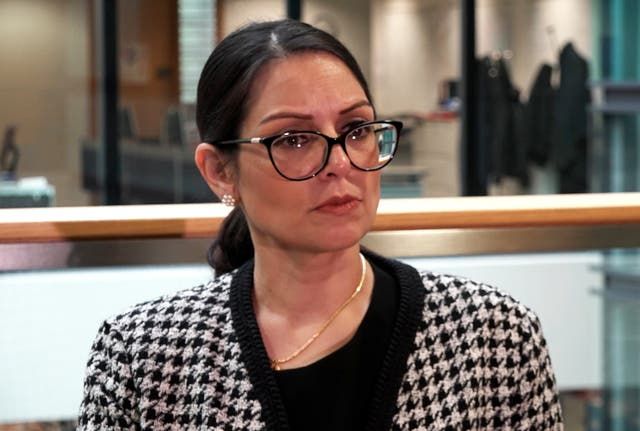 Priti Patel is reportedly not keen on filling the worker gap with staff from outside the UK
Since Everard’s death, at least 78 other women have been killed, including 28-year-old Sabina Nessa. The teacher was killed as she walked to meet a friend in south-east London last month, and Patel nods when I mention her name. As Everard’s murderer was being sentenced yesterday at the Old Bailey, the man accused of murdering Nessa was sitting in a courtroom in the same building. Two London women, killed barely six months apart, by strangers. A UN report found that four in five young women in the UK have suffered sexual harassment but just 1.4 per cent of rapes reported to the police result in a charge or summons, with many going on to reoffend.
“I have had friends who have been victims and suffered domestic abuse, one of my friends is a victim of FGM,” says Patel. “I am the first ever female Asian Home Secretary. I understand some of the cultural issues that women face; some things they can’t talk about, which is why our work is based around changing attitudes, going after perpetrators and making the police more accountable. But also I’m afraid, and I feel very strongly about this, it is about some of these awful ingrained societal attitudes, sexism, misogyny. I didn’t grow up with some of those prevalent attitudes we see today.”
 Commissioner Dame Cressida Dick (left)
with Home Secretary Priti Patel during a June visit to the new
Counter-Terrorism Operations Centre (CTOC) in West Brompton, London
Commissioner Dame Cressida Dick (left)
with Home Secretary Priti Patel during a June visit to the new
Counter-Terrorism Operations Centre (CTOC) in West Brompton, London
Her words about how “enough is enough” echo Starmer’s comments that Everard’s case must be a “watershed moment” — just as the killing of Stephen Lawrence was — and serve as a turning point in how we treat violence against women and girls. “Lawrence’s murder was a wake-up call around policing and accountability,” says Patel, who has been Home Secretary since 2019. “My work isn’t just about calling it out. This can’t just be about a piece of paper. It’s about how it comes to life. That’s a responsibility for all of us in Government.”
Patel nods in recognition when I talk about being told at school to take care coming home at night, to carry my keys in my hand so I could fight back if attacked. She remembers being given a rape alarm at school. “This is awful actually, I don’t even like talking about this,” she says. “We were given these new devices and I thought: ‘what is this about?’ The onus being on us; the onus now has to be on the perpetrators and wider society - being very clear around policing for example.”
Her words are powerful but are they sufficient? Last week, Patel refused to say if she would affect all the implementations of Her Majesty’s Inspectorate of Police report that said violence against women and girls was not a properly managed priority for police or government.
Yesterday, Minister of State for Crime and Policing Kit Malthouse said its up to local areas to decide if Violence Against Women and Girls is a “serious crime”. Labour MP Jess Phillips had said his words are “an insult, imagine saying that about terrorism”.
What action is Patel taking? “I don’t need to run off a list, but for the first time ever having a top police officer leading police accountability around violence against women and girls (VAWG) is really important.” Maggie Blythe of Hampshire police started as National VAWG Police lead this month and Patel spoke to her first thing yesterday morning. “It is all about raising the bar – why is there inconsistency across different police forces in how women are treated and how experiences are reported, ranging from domestic violence to rape, harassment?” Surely that question is at least partly Patel’s responsibility? “There is more that will happen with training, but also about forces understanding this is about driving accountability and change and confidence in the safety of women and girls.”
How can we trust the police now? “We can trust them. Police officers are sickened by what happened. Thank God [what happened to Sarah] doesn’t happen regularly.” However, this was not an isolated incident – there were just under 600 complaints of sexual misconduct allegations made against Metropolitan Police officers between 2012 and 2018 and in last year, two Metropolitan police officers were charged with misconduct in public office after allegedly taking selfies at the crime scene of the murder of sisters Bibaa Henry and Nicole Smallman and circulating them on WhatsApp. Yesterday, Ex-Met Chief Superintendent Parm Sandhu was damning about the fears of female police officers: “The police service is very sexist and misogynistic,” she told The World At One. “A lot of women will not report their colleagues.”
“I do not shy away from difficult conversations with all levels of policing, believe you me,”Patel says. “[What happened to Sarah] is an absolute scandal and the police will have to make some changes.”
She brings up the vigil for Everard, where police handcuffed and held down women. “I was vocal around the vigil, I commissioned the inspectorate about the conduct and handling of the police. We police by consent in this country and we should not lose sight of that.”
Patel says she “has experienced sexism and racism, that is a terrible fact”, including “what is now called street harassment”. “I think we have all experienced that,” she states. “There is a lot of work taking place when it comes to attitudes, being bold and calling out what you instinctively know is wrong. It’s pretty black and white to me what is and is not acceptable.”
She and her husband, marketing director Alex Sawyer, have a son, Freddie, who is 13, and “wouldn’t want him to contemplate any of the things we are talking about”. “I bring him up understanding how to speak to people and respect everybody.”
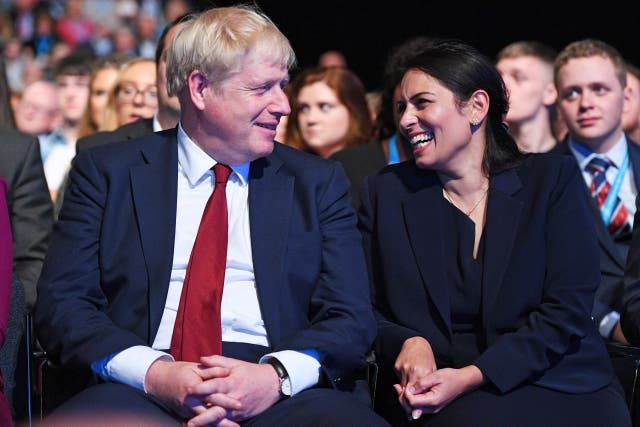 Prime Minister Boris Johnson with Home Secretary Priti Patel
Patel’s parents came to the UK 12 years before she was born, from Uganda. Her paternal grandparents are from India. She grew up in Hertfordshire, where her parents, who are Hindu, ran the popular Chocolate Box newsagents and her father ran as a UKIP candidate in 2013.
Patel was elected as MP for Witham in 2010. “I had a career in the private sector [working for PR consulting firm Weber Shandwick and at Diegeo] but it wasn’t until I entered a very senior role in British politics that I experienced more sexism and racism,” she says, adding that she does not want it to define her. “I think that’s why people do it, to run me down – they have no other arguments. I have one of the most senior jobs in the country in our government and that kind of stuff cannot distract me from the very senior responsibilities and duties I have to the British public.”
In 2016, Theresa May appointed her as International Development Secretary, controversial given her ardent Euroscepticism and longstanding opposition of international development and aid spending. A year later it emerged that she had held meetings in Israel without telling the foreign office where aid money had been discussed. She said that she paid for the trip and the then-foreign secretary Boris Johnson knew about it but she faced calls to resign, which she eventually did. She returned in 2019 when Boris Johnson appointed her home secretary. The PM stood by her last year when a Cabinet Office inquiry found evidence that she had breached the ministerial code regarding allegations of bullying. Amber Rudd, who had her job until 2018 says Patel is “charming, thoughtful, amusing and kind” but was not surprised by the bullying allegations, “she does shout and swear at people and I don’t think we should accept it.”
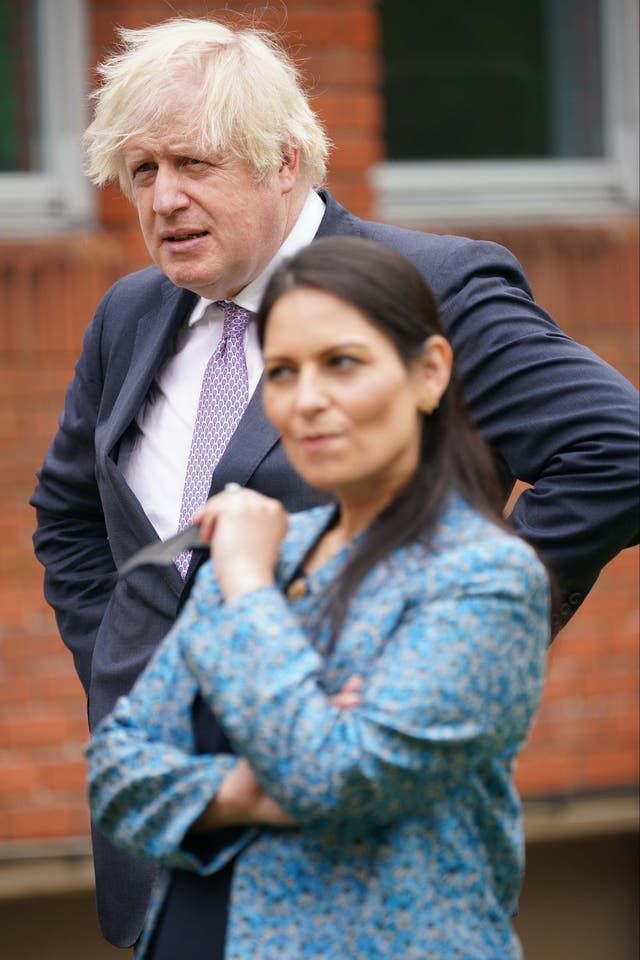
Prime Minister Boris Johnson with Home Secretary Priti Patel
She realises she is late for a meeting with the criminal justice task force at Number 10 and apologises for just giving us under 20 minutes, then gathers up her papers, pushing up her glasses and pacing towards the Prime Minister’s office. Yesterday, the PM said that no woman should have to fear harassment or violence. Now it is up to him and his government to make things happen.