London Daily

Focus on the big picture.
Saturday, Jul 18, 2026

Pound rises as Liz Truss announces resignation

Pound rises as Liz Truss announces resignation

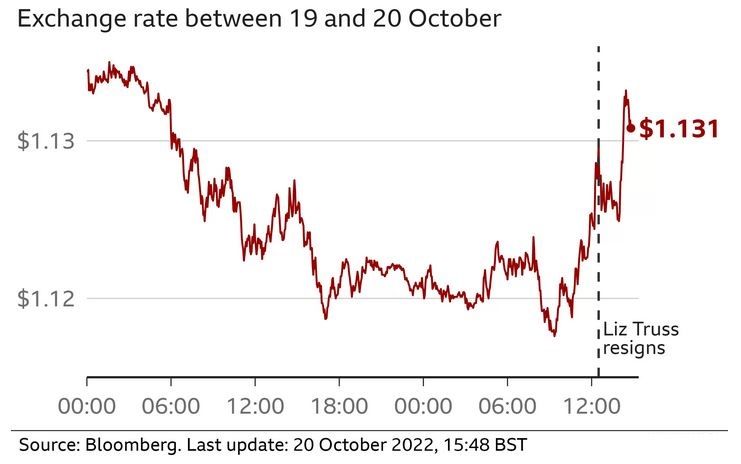
The pound rose against the dollar and government borrowing costs dipped as the markets reacted to Prime Minister Liz Truss's resignation.

Sterling hit $1.13 as the Ms Truss made her announcement and rose higher in the afternoon before falling back to $1.12.

One analyst said investors were "relieved" by the news, despite a lot of uncertainty remaining.

Business groups said the new prime minister would have to act quickly to restore confidence.

A fall in the value of the pound increases the price of goods and services imported in to the UK from overseas - because when the pound is weak against the dollar or euro, for example, it costs more for companies in the UK to buy things such as food, raw materials or parts from abroad.

A weaker pound can push rising costs higher as well if companies choose to pass on higher prices to customers. For people planning a trip overseas, changes in the pound affect how far money can go abroad.

While the pound plunged to a record low against the dollar last month, government borrowing costs rose sharply in the aftermath of the government promising huge tax cuts in its mini-budget without saying how it would pay for them.

But these costs fell back after the Bank of England stepped in with an emergency support programme, and after Jeremy Hunt reversed nearly all the mini-budget measures when he became chancellor.

Mr Hunt is due to announce plans for spending and tax on 31 October in his economic plan, which the Treasury confirmed was set to go ahead, although there are reports it could be delayed due to the Conservative leadership contest.

"Although the resignation of Liz Truss as prime minister leaves the UK without a leader when it faces huge economic, fiscal and financial market challenges, the markets appear to be relieved," said Paul Dales, chief UK economist at Capital Economics.

"But more needs to be done and the new prime minister and their chancellor have a big task to navigate the economy through the cost of living crisis, cost of borrowing crisis and the cost of credibility crisis."

Simon French, chief economist at Panmure Gordon, said the market reaction had been "fairly muted", with investors waiting for the "detail of what comes next".

Ms Truss said her successor would be elected in a Tory leadership contest, to be completed in the next week. Her resignation came after a key minister quit and Tory MPs rebelled in a chaotic parliamentary vote on Wednesday.

Mr French said the markets could rally "more aggressively" if a clear favourite emerged for PM. "The sooner you get there the more likely the person who has won will have the support to do the difficult stuff."

The head of the CBI business lobby group, Tony Danker, said: "The politics of recent weeks have undermined the confidence of people, businesses, markets and global investors in Britain.

"[The next prime minister] will need to deliver a credible fiscal plan for the medium term as soon as possible, and a plan for the long-term growth of our economy."

The interest rate - or yield - on UK government bonds for borrowing over a 10-year period climbed above 4% at one point on Thursday morning, but then fell back steadily as speculation grew about the possible departure of Ms Truss.

Typically, the government agrees to repay the investor on a certain date in the future when a bond "matures". In the meantime, it pays interest on the loan.

However, the mini-budget hit confidence in bonds, and it led to investors demanding a much higher rate of interest in return for investing in them. Some bonds halved in value.

Following the PM's statement, the yield edged higher again to about 3.8%, but still remained below the level seen at the start of the day.

Ahead of Liz Truss's resignation, Bill Blain of Shard Capital had told the BBC that the markets had been "watching in a kind of stunned, open-mouthed horror" at political events.

"The problem we've got is that the last couple of weeks has really destroyed the image of political competency and that's one of the key elements to make any economy work," he said.

Newsletter

Related Articles

0:00
0:00
Close
Ukrainian Drone Barrage Kills Eight and Strikes Russian Logistics Network
The Monaco Bombing Has Become a Test of Ukraine’s Intelligence Accountability
Leadership Change and Strategic Rivalry Redraw the Political Map
Energy Risk, Uneven Growth and the New Geography of Global Capital
The AI Race Enters Its Infrastructure Era
Security and resilience remain long-term national priorities
Britain balances growth ambitions with public finance pressures
Regional devolution becomes a defining theme of the next Labour era
Industrial strategy returns to the centre of British economic policy
Political Instability Remains a Challenge for UK Investment Confidence
Brexit Economic Debate Continues as Public Concerns Over Long-Term Impact Remain
UK Climate Risks Rise as Met Office Warns Extreme Weather Is Becoming More Common
Housing Shortages and Regional Inequality Become Key Priorities Under Incoming Labour Leadership
National Health Service Reform Remains One of Britain’s Biggest Political Challenges
Bank of England Remains at Centre of UK Economic Debate Over Inflation and Growth
UK Economy Shows Recovery Signs but Households and Businesses Remain Under Pressure
Britain Deepens European Defence Cooperation as NATO Allies Seek Stronger Security Capabilities
United Kingdom Expands Sanctions Against Russian Cyber Networks Over Security Threats
UK Industrial Strategy Faces Test After Government Takes Control of British Steel
British Businesses Seek Policy Clarity as Andy Burnham Prepares to Lead Labour Government
Andy Burnham’s Labour Leadership Signals Major Shift Toward Regional Power and Devolution
British Steel Nationalisation Creates New UK-China Tensions Over Control of Strategic Industry
For 36 Years, He Scammed About 300 Luxury Hotels — Until He Was Caught
England's World Cup Exit Expected to Cost Hospitality and Retail £334 Million
Former ICC Prosecutor Aide Speaks Publicly About Allegations Against Karim Khan
Opposition Raises Questions Over June Heatwave Power Grid Pressures
Mastercard Explores Sale of Majority Stake in UK Payments Operator Vocalink
Boeing Forecasts Global Commercial Aircraft Fleet Will Double by 2045
London GP Surgeries Receive £18 Million to Expand Primary Care Capacity
Health Advisers Recommend Nationwide Meningitis B Vaccination for Teenagers
OECD Warns UK Economy Faces Slower Growth and Weak Productivity
Treasury Places Major Global Cloud Providers Under Direct Financial Oversight
Financial Markets Rally as Shabana Mahmood Emerges as Leading Treasury Candidate
Incoming Government Prepares Thames Water Nationalisation and New North Sea Drilling Approvals
UK Government Plans Deep Cuts to Bilateral Aid for African Nations
United States and Iran Exchange Direct Strikes for Seventh Consecutive Night
Incoming Prime Minister Andy Burnham Confirmed as Labour Leader Ahead of Downing Street Handover
Britain Nationalises British Steel to Protect Scunthorpe Production and Strategic Supply
Andy Burnham Takes Labour Leadership and Prepares to Become Britain’s Seventh Prime Minister in a Decade
Tech Companies Want to Move Computing Off Your Screen and Onto Your Body
White House Teleprompter Operator Earned More Than $100,000 From Bets Linked to the President's Speeches
French Prime Minister Survives No-Confidence Vote After Controversial Budget Cuts
European Commission Opens Excessive Deficit Procedure Against France
French Senate Blocks Key Immigration Reform Measures
French Government Pushes EU Action Against Ultra-Fast Fashion Imports
French Parliament Debates Expanded Autonomy Powers for Corsica
France Reopens Autonomy Talks With New Caledonia After Months of Unrest
Bordeaux Wine Producers Seek Three Hundred Million Euro Aid Package After Export Collapse
French Farmers Block Spain Border Crossings Over Imported Food Competition
Cannes Film Festival Bans Fully Artificial Intelligence-Generated Films From Competition
×