

Pfizer/BioNTech tax windfall brings Mainz an early Christmas present
The Pfizer/BioNTech jab is having an unexpected side-effect on the German municipality where scientists first developed it: for the first time in three decades the city of Mainz expects to become debt-free thanks to the tax revenues generated by the company’s global success.
Mainz’s decision to use its financial windfall to also slash corporate tax rates in the hope of attracting industry, especially biotech companies, however, is drawing criticism from neighbouring cities and economists.
The city of about 217,000 inhabitants in the western state of Rhineland-Palatinate, has been carrying a crippling debt burden since the early 90s when authorities took out a loan that grew to €1.3bn (£1.1bn). Over the first year of the pandemic, the Rhine river city’s debt pile accrued a further €30m in interest alone.
But the success of BioNTech, whose founders Uğur Şahin and Özlem Türeci worked with the pharmaceutical giant Pfizer for trials and manufacturing of their Comirnaty vaccine in 2020, has transformed Mainz’s fortunes.
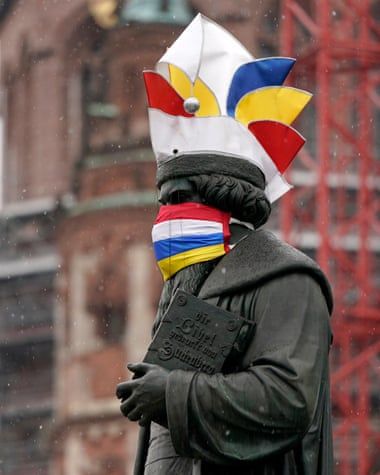 The costumed and masked statue of Johannes Gutenberg in Mainz city centre.
Instead of an expected 2021 budgetary overspend of €36m, the city senate this winter announced a budget surplus of €1.09bn. With another surplus of €490.8m expected in 2022, Mainz hopes to clear its remaining debt within a year.
Owing to German tax secrecy laws, BioNTech has not been officially named as the source of what Mainz’s senate calls the city’s “Cinderella story”. But the handsome wealth of the company that created the first vaccine authorised in the west is no secret. In January-September 2021, BioNTech made €10.3bn in pre-tax profits, of which it paid €3.2bn in tax – though the company has several sites in Germany and has not said to which municipalities the money went.
Before the Covid-19 pandemic, Mainz’s main gift to the world was the printing press, whose inventor, Johannes Gutenberg, developed a method of printing from movable type in the city in about 1440.
Mainz’s mayor, Michael Ebling, said the game-changing development of BioNTech’s mRNA vaccine was of equally outstanding importance. He told the Guardian he wanted to use the tax money to settle his city’s debts, rather than invest in spectacular infrastructure projects. “Christmas may be upon us, but for the city of Mainz now is not the time to draw up long wishlists,” Ebling said. “The tax windfall will certainly make it easier to honour the other achievements that our city has given to the world.”
As well as promoting Mainz’s role in the printing revolution, the mayor said he would nourish its reputation as an innovator in football: the Liverpool coach Jürgen Klopp and Chelsea’s Thomas Tuchel first made their names managing the local Bundesliga club Mainz 05. “We can renovate the Gutenberg museum of printing, and our football pitches will remain in such a state that every player can play a clean pass,” he said.
 A Mainz 05 fan at a Bundesliga match on 14 December. The club will benefit from the city’s BioNTech windfall.
Ebling’s biggest plan, however, is to build on the vaccine makers’ success and turn Mainz into a global biotech hub: a 12-hectare (30-acre) plot near BioNTech’s headquarters, the university clinic and the German Cancer Research Centre has been earmarked for development.
Over the next 10 years, the city hopes to create 5,000 new jobs, in part by luring companies through much lower corporate tax rates, which German municipalities are able to set themselves on top of the federal corporate tax rate of 3.5%. Mainz plans to cut its corporate tax rate from 440 to 310 percentage points, by far the lowest among German cities with more than 50,000 inhabitants.
The senate says the cut is a gift not only to science startups looking for a new home, but to smaller companies that have suffered in the pandemic. A spokesperson denied the reduced tax rate was designed to stop BioNTech relocating to other low-tax regions.
But in Wiesbaden, notionally Mainz’s richer brother across the Rhine, local politicians have criticised Mainz as “extremely lacking in solidarity”, while economists predicted the move could trigger a race to the bottom among German cities.
“It’s understandable that Mainz has lowered the tax rate, but I would share local politicians’ criticism of the extent to which they are slashing the rate,” said René Geissler, a professor of public management at the Technical University of Applied Sciences in Wildau. “It’s a bit of a bombshell.”
“It will create enormous pressure on other cities to follow suit,” he added, questioning whether the plan would necessarily pay dividends. For startups, he said, a low tax rate was often far less important when choosing their headquarters than proximity to research institutions or companies working in the same field, conditions Mainz already offers.