

Opposition parties ‘can oust Tories’ if they cooperate on seats
The Tories would be stripped of their majority and unable to form a government if opposition parties cooperated in fewer than a quarter of England’s parliamentary seats, according to a major new analysis.
The study by Best for Britain, which campaigns for a more internationalist government, found that if Labour, the Liberal Democrats and Greens could agree to field one unity candidate in each of only 154 English battleground seats, the Conservatives would end up with just 254 English MPs, seven fewer than Labour, which would have 261 English MPs. The Liberal Democrats would win 16 English seats and the Green party one.
The figures emerged from the same kind of polling technique – multilevel regression and post-stratification (MRP) – that correctly predicted the election of Donald Trump as US president in 2016, and the surprise win for Jeremy Corbyn’s Labour party in Canterbury in 2017.
The MRP method involves using a large poll (in this case Best for Britain surveyed 12,816 people across the country) and adding vast amounts of other information, from censuses and Official for National Statistics data, to predict how people in different areas, across social divides and income and age groups, would vote.
If the opposition parties were to field single unity candidates, the MRP-polling exercise found, the Tories would be left 40 seats short of a majority even if they succeeded in holding on to their 20 Scottish and Welsh seats and gained the backing of the DUP, which currently has eight seats in the House of Commons.
Among the high-profile Tory casualties would be Jacob Rees-Mogg in North East Somerset: he would lose narrowly, with the seat flipping to Labour, the analysis found.
The same fate would befall Iain Duncan Smith, who would also be ousted by Labour in Chingford and Woodford Green, while deputy prime minister Dominic Raab would lose to the Liberal Democrats in Esher and Walton. Boris Johnson would also be run close by Labour in Uxbridge and South Ruislip, with his victory margin being trimmed to 3% by Labour, from 15% in 2019.
While advocates of such alliances insist they are the only way centre-left parties can dislodge the Tories, opposition party leaders have always been loth to entertain anything more than very informal agreements, such as scaling back operations in unwinnable seats. They fear standing back would be seen as a sign of weakness and lack of national ambition.
Labour opponents of so-called progressive alliances interpret the party’s own rule as saying it must under its constitution stand candidates in all parliamentary seats, in either general elections or byelections, except in exceptional circumstances. But this is disputed by advocates of co-operation who say no such rule exists.
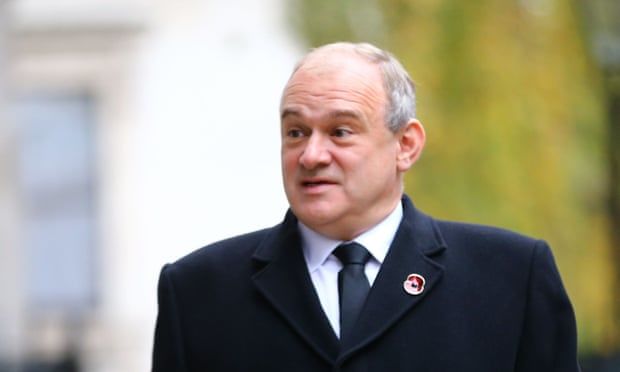 Ed Davey has said the Lib Dems will not fight Labour at the Old Bexley and Sidcup byelection.
Last week, Lib Dem leader Ed Davey sounded a more positive note about cooperation. He told the Observer that his party would target only one of two forthcoming byelections in Conservative-held seats.
While rejecting formal “deals or arrangements”, he suggested his party would not be putting significant resources into the London seat of Old Bexley and Sidcup, where voters go to the polls on Thursday, and Labour is the main challenger. He said the Lib Dems would instead concentrate on next month’s byelection in North Shropshire, the safe Tory seat vacated by Owen Paterson following his official rebuke over lobbying.
Naomi Smith, chief executive of Best for Britain, said parties on the left should abandon their reluctance to work together: “In 2017 and 2019, parties on the right chose not to fight each other in key marginals, and will likely to do so again. This polling shows that opposition parties must do the same as … there is no other route to power. Refusal by Labour and the Lib Dem leadership to cooperate, form government and deliver change is failing the people and communities these parties seek to represent.
“In 1997, Labour’s NEC and the Lib Dem higher-ups chose not to stand against the anti-sleaze candidate Martin Bell who beat the Conservative MP embroiled in scandal. Sleaze and corruption are back with a vengeance and opposition party cooperation should be too.
“As the saying goes, you can’t fatten a calf on market day and work to coordinate this strategy needs to begin now.”
Best for Britain argues such cooperation would only be necessary for one general election if a new government then introduced voting reform.