

Obama's economic failures drive Biden's push to 'go big' with stimulus
Biden insists on the unprecedented spending spree, even though fully $1 trillion remains unspent from the first two COVID stimulus bills passed last year. Wait 'til voters find out.
Why go down that risky path? Because liberal economists like Paul Krugman have convinced him that the sluggish economy that dogged the Obama-Biden years was caused by inadequate government stimulus spending. The $800 billion American Recover and Reinvestment Act passed in 2009, they argue, was too dinky. That's their excuse for the slowest post-recession recovery in the country's post-war history.
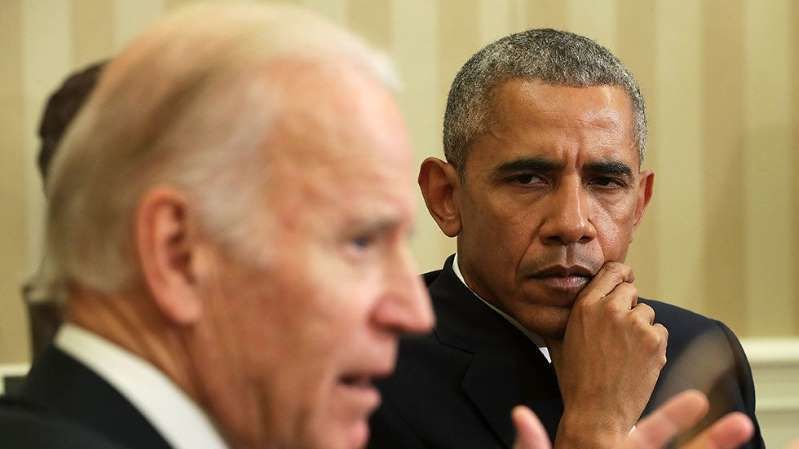 Obama's economic failures drive Biden's push to 'go big' with stimulus
Biden recently explained: "When this nation hit the Great Recession that Barack and I inherited in 2009...There was a big recovery package, roughly $800 billion.... it wasn't enough. It wasn't quite big enough. It stemmed the crisis, but the recovery could have been faster and even bigger."
Biden's got it wrong. It wasn't the size of the stimulus that held us back. It was Obama's damaging blizzard of regulations that created uncertainty, put hiring on hold and dampened the recovery that should have been delivered by the biggest spending boondoggle in our history.
In early 2015, six years into his presidency, only 38 percent of the nation thought Obama's policies had made the economy better - the highest rating he earned during that time.
As for the stimulus, as one account noted at the time, "Adjusted for inflation, [the stimulus] was nearly five times more expensive than the Works Progress Administration. It was bigger than the Louisiana Purchase, the Manhattan Project, the moon race and the Marshall Plan."
Green shoots began to pop up after the financial crisis, and the stimulus bill initially boosted optimism. Biden, charged with overseeing the budget-buster, promised early on that the $800 billion spending marathon would "literally drop kick us out of the recession." That's how big it was.
But Obama's first move as president was not to encourage hiring and growth but to embroil the nation in a bitter brawl over health care. The dogfight over ObamaCare consumed our politics for the first year of Obama's presidency, with the Affordable Care Act ultimately becoming law in March 2010.
During that period, employers wrestled with emerging mandates over the costs of providing health care coverage; the makers of medical devices faced new taxes and fees and other industries, like hospitals and pharmaceuticals, faced changes too.
So complex and poorly written was ObamaCare that what started out as a 906-page bill grew to more than 20,000 pages of regulations three years later.
The impact from the ACA and other regulations passed by the Obama-Biden White House was to deflate, especially, small business optimism. Surveys conducted by the National Federation of Independent Businesses show that the expectations of mom-and-pop firms, responsible for roughly half the country's employment, were mired at near-recession levels until President Trump was elected in 2016, when optimism soared.
It wasn't just the Affordable Care Act that set managers on their heels. In 2010, Congress passed the Dodd-Frank Wall Street Reform and Consumer Protection Act, which responded to the financial crisis by instigating a slew of new rules for financial institutions.
In addition, Obama empowered agencies such as the Equal Employment Opportunity Commission (EEOC) to pursue charges of "systemic racism." In 2012, lawsuits brought by the EEOC against private companies "secured more than $365.4 million in monetary benefits," the "highest level of monetary relief ever obtained by the Commission..."
As one protesting lawyer declared, "[The EEOC] pursued this small business, with no previous dealings with the EEOC, like it was a Fortune 500 Company...Heaven help the small business that becomes the target of the EEOC."
The same lament was heard from those hounded by the Consumer Financial Protection Bureau.
In 2012, with the economy again hovering on the brink of recession, surveys from the NFIB and the National Association of Manufacturing showed that 69 percent of small business owners agreed that, "President Obama's Executive Branch and regulatory policies have hurt American small businesses and manufacturers." Worse, over half said they would not start a business today "given what they know now and in the current environment."
Having seemingly not learned a thing from those years, President Biden has begun his administration by ordering a slew of job-killing mandates, like the cancellation of the Keystone Pipeline and restrictions on oil and gas drilling, which will dampen whatever boost we might expect from his $1.9 trillion package.
Biden has promised to raise taxes, which will further slow hiring, as will Democrats' efforts to raise the minimum wage to $15 per hour. The Congressional Budget Office just released a report showing that hike alone would eliminate 1.4 million jobs.
Our economy today is in much better shape than it was in 2008, and much further along the path to recovery. In addition, most of the joblessness and income shortfalls of today are the consequence of government-mandated shutdowns, not any underlying weakness in demand.
Businesses and schools should quickly reopen as the COVID vaccines roll out; out-of-work employees in the restaurant industry or airlines, for instance, will go back to work once we achieve herd immunity and those businesses resume operating. That's the stimulus the country actually needs.
Biden's pitch for a $1.9 trillion bill is not about restoring jobs and growth. It is about Democrats' determination to keep control of Congress in 2022. Democrats seem to forget that Obama-Biden received a "shellacking" in the 2010 midterms, mainly because unemployment was 9.8 percent and inching higher. The $800 billion stimulus didn't save them then; Biden's $1.9 trillion won't save them in 2022.