

‘Not in this town’: artwork about Britain’s ‘nuclear colonialism’ removed
An Australian artist has accused a group of Conservative councillors of using “bullying strategies” to silence and censor her work after an installation she created to highlight Britain’s “identity as a colonial nuclear state” was removed from a park in Essex.
The councillors threatened to “take action against the work” if it was not removed, according to Metal, the arts organisation that commissioned and then removed the installation from Gunners Park in Southend.
Gabriella Hirst’s An English Garden consisted of benches and a row of flowerbeds planted with Atom Bomb roses, a rare variety of rose created at the height of the cold war arms race in 1953, alongside Cliffs of Dover irises.
A plaque on the bench explained this and highlighted the assembly, at a site nearby, of Britain’s first atomic bomb and the devastation caused by its detonation on unceded Indigenous land in Australia. The plaque also stated that Britain continues to proliferate nuclear arms, following the government’s decision to lift a 30-year ban on the development of new nuclear weapons this year, and increase its nuclear armament by 40%. It described the country as having an “historical and ongoing identity as a colonial nuclear state”.
On social media, Hirst said she and Metal, which had co-commissioned the installation with artists’ charity the Old Waterworks, had been given a 48-hour ultimatum to remove the work before the councillors planned to intervene to censor the “offending” plaque. She added that the councillors had threatened to subject them to a national media campaign that would frame the work as “a direct far-leftwing attack on our history, our people and our democratically elected government”. She wrote: “Seemingly, said government and its global-scale nuclear arsenal was not considered robust enough to endure the airing of historical facts and critique via a rose garden art installation.”
James Moyies, one of the Conservative councillors for Southend who objected, told the Observer the plaque was “offensive”. His two main objections to it were: “Using public money on public land to display a left-wing rant which accused our current government of investing in industries of hate, rather than care”; and “attacking our country as currently being a colonial nuclear state”. “The rest of the text has other contentious statements that I do not like, but these were the two main reasons that it had to be altered or removed.”
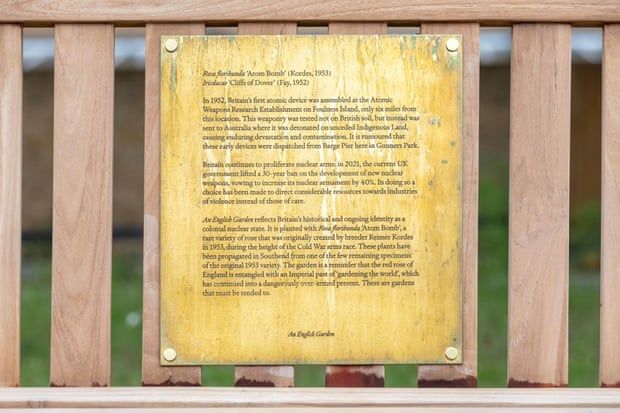 The plaque that fired objections by a group of Tory councillors.
Moyies, a Brexiter who was a regional director of the Vote Leave campaign in 2016, added that if Metal had not complied with his request, “I planned to take action by sticking a piece of laminated paper with a different message next to the offensive plaque. I planned to get national coverage.” He said he felt the issue had been resolved “amicably”.
Metal said in a statement that it decided to remove the work after being subjected to “intense pressure” over a 48-hour period by the group of councillors. The Old Waterworks said it was “shocked, dismayed and incredibly disappointed” by the councillors’ actions but understood Metal’s decision.
Colette Bailey, artistic director of Metal, told the Observer she thinks what the councillors did amounts to censorship: “The threat of bringing media attention to their profound misreading and misinterpretation of the work was part of their campaign to increase the pressure on the commissioning and artistic partners.”
She said the launch of such a media campaign would have highlighted the councillors’ “fundamental misreading” of the work and distort its “actual meaning”, and decided on removal to protect the mental health and wellbeing of her staff from issues that might arise from the councillors’ actions.
In response, Moyies said: “The notion that anyone needed their wellbeing or mental health protecting is nonsense. It was a few benches and flower beds, in a meadowland park, with an offensive plaque.”
Hirst, who said she understood Metal’s decision but did not agree with it, said the work critically reflected on Britain’s nuclear and colonial legacy. “When correspondence between Metal and the councillors was forwarded to me, I was incredulous at the bullying strategies used to silence my artwork,” she told the Observer. “It is alarming that a space of critique and contemplation could be removed at the behest of a small number of councillors, to silence a statement they find disturbing. I’m astounded at the implication that art should not be able to scrutinise topics such as British colonialism and nuclear armament.”
She added that veterans who were present during the British nuclear testing programme in the 1950s and 60s have voiced their outrage at the work’s censorship: “I’m not alone in finding the realities, histories and future of nuclear weaponry overwhelming and frightening. And for me, this artwork, including its signage, benches, plants – everything that was part of this installation – is an expression of trying to work through a big topic via a rose bed, to hold space for working through topics which are still shrouded in fear and secrecy, even today.”
Ian Gilbert, the Labour leader of Southend council, said the council had not funded the exhibition and did not manage the park. “Fundamentally, it’s not a council decision, which is why I think it’s so inappropriate that [opposition] councillors have brought this pressure to bear.”
He regrets that Metal felt it was necessary to remove the work and said the council plans to meet the organisation and discuss a way forward. “I don’t believe in censorship of art, and I think you’re on a slippery slope if you believe that artists aren’t allowed to say anything that’s critical of the government of the day.”
Moyies denied the allegations of threatening or bullying behaviour and said he had not been in direct contact with Hirst. He added that the land is owned by the council but leased to Essex Wildlife Trust.