

NGOs slam Europe for allowing migrant deaths in the Mediterranean
More than 45,000 migrants have arrived in Italy so far this year, marking the highest number since 2017. In response, the country's centre-right coalition has declared a state of emergency and repeated calls for more solidarity within the European Union to tackle these migratory flows.
In this latest episode of Euronews Witness, Monica Pinna takes us to Italy's southernmost border, the small island of Lampedusa, to find out what the Italian government, Europe, and NGOs are doing to address this migration crisis which shows no sign of slowing.
Minors facing the greatest threat
Italy’s far-right Prime Minister, Giorgia Meloni, came to power in October 2022 vowing to take a hard line against illegal immigration and push for Europe to work together to address the migration influx.
Her centre-right coalition has now launched a state of emergency to deal with the increase in migratory flows. The measure aims to accelerate reception procedures, but also speed-up expulsions.
Theoretically, this should alleviate some of the pressures felt by hotspots like Lampedusa. But this centre is systematically on the verge of collapse.
Migrants who arrive there are supposed to stay for just a few days in order to be identified and sent to reception or repatriation centres. But arrivals often end up staying for much longer.
The centre is conceived to accommodate 400 migrants, but at times it hosts more than three thousand people.
According to NGOs, Italy's reception system is poorly managed, and it is minors who are faced with the greatest risks.
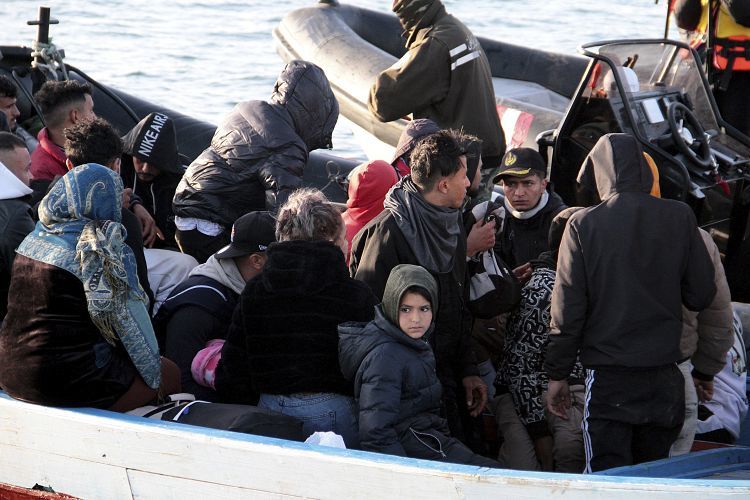
"The age of the people arriving has progressively considerably decreased," Lisa Bjelogrlich, from Save the Children told Euronews.
"From 2018 onwards the amount of available accommodation has decreased. The reception system for minors currently fails to meet their needs and has been depleted of resources," she added.
Search and rescue operations, and 'the criminalisation of NGOs'
Last February, the sinking of a migrant vessel from Turkey which issued an unanswered distress call off the coast of Calabria took the lives of 90 migrants.
This event prompted the Italian government to pass the Cutro Decree, which aims to clamp down on traffickers but also further tighten rules on migration and asylum.
"The war on sea rescue NGOs, and the abandoning of rescue operations in the Mediterranean has become increasingly evident with the centre-right government," revealed Giusi Ncolini, the former mayor of Lampedusa. "And it is increasingly clear that, in order not to prevent them from arriving, they prefer to let them die."
Since the Cutro disaster, shipwrecks continue to occur at an alarming rate.
“The withdrawal of European actors and the criminalisation of NGOs committed to search and rescue missions, created a huge vacuum in rescue operations,” said Tamino Böhm, the head of airborne operations at NGO, Sea-Watch, whose teams fly over a vast area of the central Mediterranean each day in search of boats in distress.
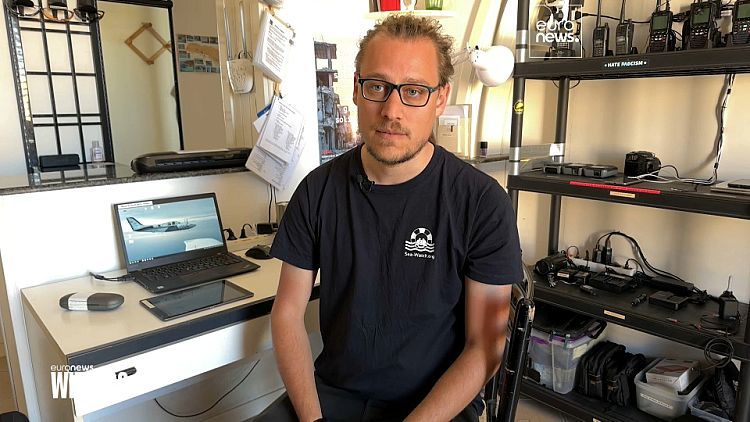
"There are still no state-funded, state-organised search and rescue in the central Mediterranean Sea. Very often we spot boats in distress and then there's no one to rescue and give assistance to the people,” he added.
In January, Rome issued further restrictive measures to limit humanitarian operations. NGOs failing to comply now face heavy sanctions.
A rescue ship funded by the street artist Banksy was detained for 20 days for rescuing more than 180 people in four separate rescue missions. This breaches a new ruling that states teams can carry out just one rescue operation at a time before returning to an assigned port.
How is Europe responding to the migration crisis?
NGOs have slammed Europe for failing to come together and coordinate to rescue migrants at sea. What's more, first-entry countries like Italy, Malta, Greece and Cyprus have denounced what they see as the derisory percentage of migrants being relocated in Europe.
"We see that people remain at sea many hours after our SOS, even days," said Chiara Denaro from Alarm Phone, an international volunteer network that collects distress calls from migrant boats.
"The Maltese authorities are very reluctant to launch rescue operations and to take over the coordination of operations," she added.
Italy has been providing funds, means and training to the Libyan Coast Guard since 2017. Malta followed on the basis of EU-funded cooperation agreements to combat illegal immigration and "strengthen border security."
In five years, about 100,000 people have been intercepted at sea and brought back to Libya in conditions that the UN and NGOs say represents a violation of human rights.
The number of migrants that have arrived in Italy since January 1st is 45,510 according to government figures published on May 15.
The most recent estimate for the number of missing migrants in the Central Mediterranean is 959, according to data from the Missing Migrants Project.