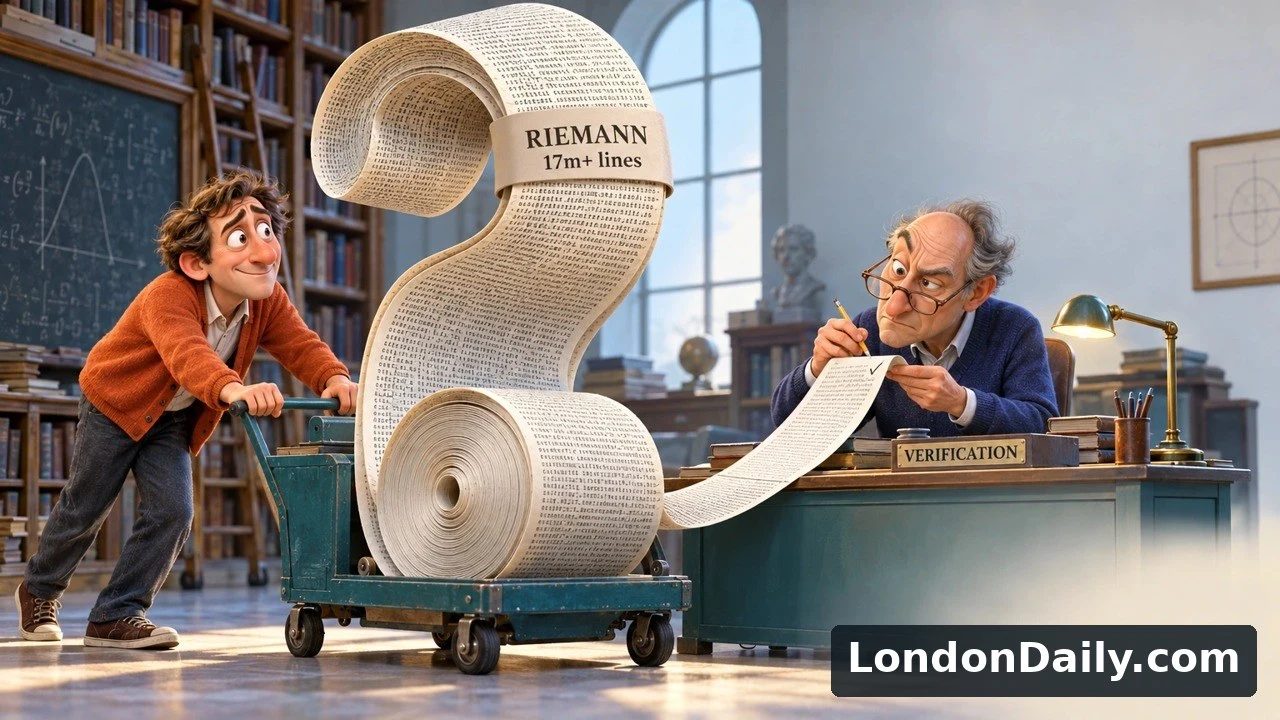
Levent Alpöge, a researcher at Anthropic, claims to have solved the Riemann hypothesis using the company’s Claude chatbot, potentially resolving a 167-year-old mathematics problem. His proposed proof, containing more than 17 million lines of mathematical code, still awaits verification.
The Turkish-American mathematics expert announced the claim on Friday. The hypothesis concerns the distribution of prime numbers and whether they follow a precise underlying pattern. Proposed by German mathematician Bernhard Riemann in 1859, it has defeated generations of mathematicians.
It is one of seven Millennium Prize Problems, each carrying a $1m (£763,000) reward for a solution. A confirmed proof would therefore represent both a major mathematical achievement and a significant demonstration of AI’s scientific capabilities. For now, the distinction between announcing a solution and establishing its correctness remains crucial.
“An astounding amount of mathematics is present in the argument, far more than I had imagined would be necessary,” Alpöge said. “In a time of revolution in mathematics, I hope the argument provides a glimpse towards the miracles that lie ahead.”
The announcement drew astonishment from prominent mathematicians. Yang-Hui He, of the London Institute for Mathematical Sciences, said: “I thought it was inconceivable that it would be proven in my lifetime. All mathematicians see this as the Holy Grail of mathematics.”
Professor Jon Keating, a mathematical physicist at Oxford University, said: “This is the greatest shock in my lifetime.” He described the claim as an enormous leap beyond other AI advances in mathematics this year.
Alpöge said he had informed Anthropic chief executive Dario Amodei on Sunday night that he believed he had solved the problem, days before the company launched its record-breaking $2tn stock market listing in New York. He described the hypothesis as the “sacred object in mathematics for me since my childhood”.
The claim comes as AI laboratories announce advances in mathematics, biology and physics and commit substantial sums to scientific problems. Such announcements have also brought disputes: in September, Professor Tristan Buckmaster accused OpenAI of pressuring him to collaborate when he was close to his own breakthrough, after the company announced a solution to the 90-year-old Navier-Stokes problem.
Anthropic has previously warned that its AI is approaching the point of improving itself autonomously. That is a separate claim from the correctness of this proof. Mathematicians and rival AI laboratories are expected to examine Alpöge’s argument; their assessment will determine whether the announced breakthrough withstands scrutiny.








Join the conversation