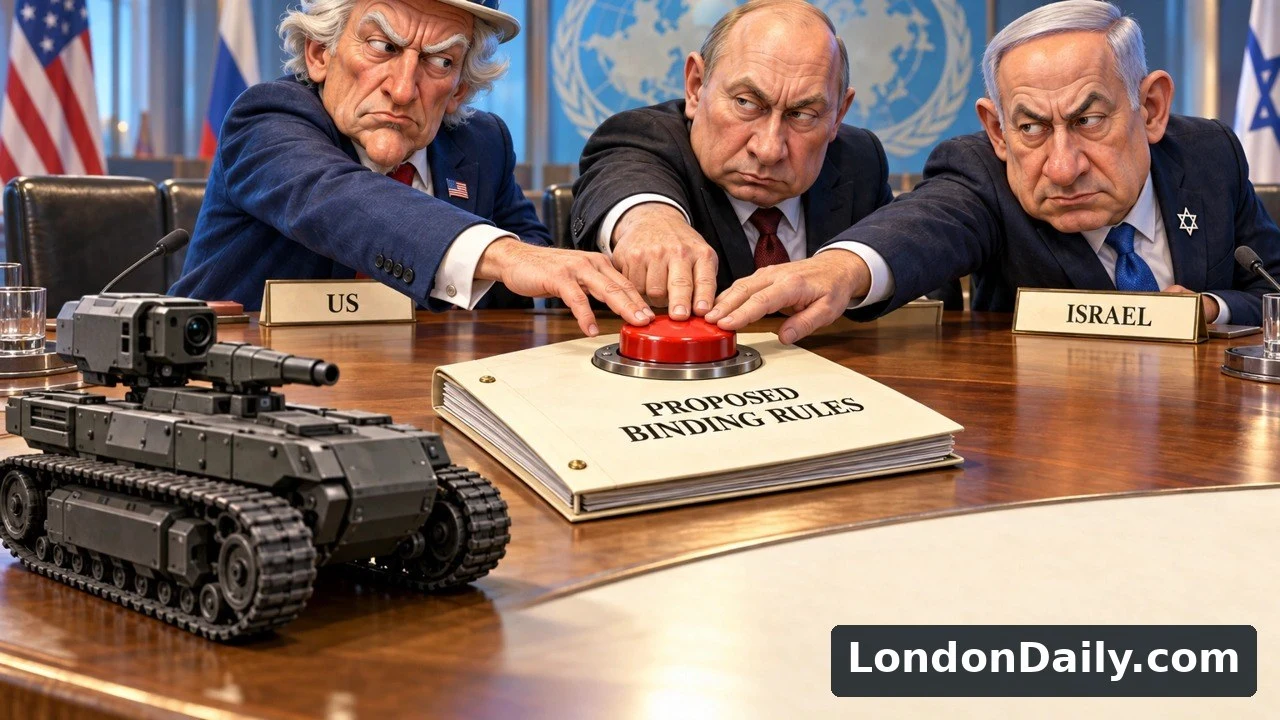
The United States, Russia and Israel have signalled opposition to legally binding rules on autonomous weapons ahead of United Nations talks in Geneva this week, while more than 50 countries seek a timetable towards enforceable international controls.
The meeting, held under the Convention on Certain Conventional Weapons, will address technology that can use artificial intelligence to select targets through algorithms. Such technology is already being used in Gaza and parts of Ukraine, making the negotiations more than an exercise in anticipating future warfare.
UN Secretary-General Antonio Guterres has described allowing autonomous weapons to kill without human input as ‘crossing a moral red line’. The central concern is the removal of human intervention from decisions involving lethal force, rather than simply the presence of artificial intelligence in military equipment.
UN human rights chief Volker Türk has urged states to agree binding international rules urgently to protect human lives. Nicole van Rooijen, of the campaign group Stop Killer Robots, says a majority of states worldwide favour a legally binding treaty. She warns that failing to act could allow technological development to shape the rules governing these weapons.
The opposition signalled by Washington, Moscow and Israel concerns legally binding controls; it does not, by itself, establish their position on every possible safeguard. Nevertheless, it presents a significant obstacle to the ambitions of countries seeking enforceable rules.
The talks also come amid wider concerns about the misuse of AI for weapons development. Last month, Anthropic, which operates Claude, said it had blocked an attempt to develop biological weapons using its technology. Its latest threat intelligence report also described attempted misuse by Russia-based cybercriminals and Iranian propaganda actors, alongside attempts to develop software for conventional weapons and their targeting and control systems.
Those accounts concern attempts to misuse AI, not proof that functioning weapons resulted. In Geneva, the immediate objective is similarly narrower than a completed settlement: no treaty or laws will be enacted this week, but the conference could lay the groundwork for future legislation.








Join the conversation