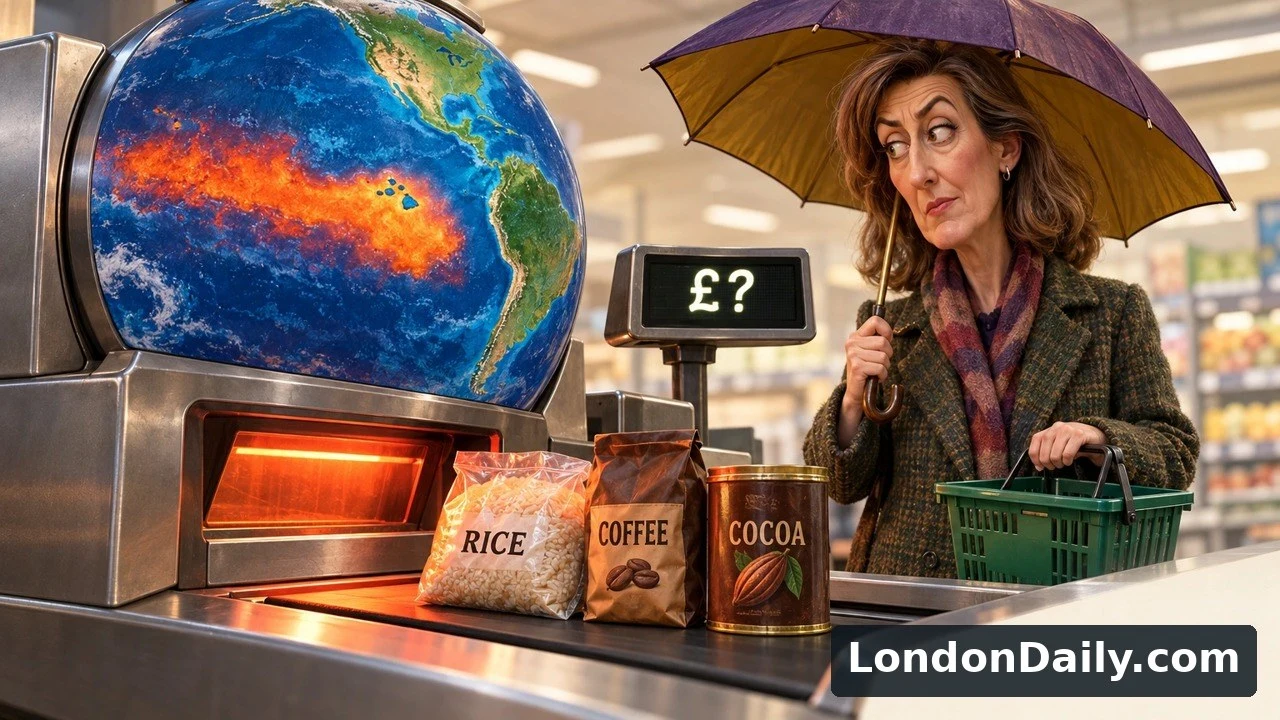
Sea surface temperatures nearly 10°C above normal near the Galápagos Islands and Peru have prompted US meteorologist Ryan Maue to describe El Niño as ‘mega’, amid warnings of possible severe weather and disruption to food supplies. The implications for Britain remain difficult to predict.
Maue shared a map using European Centre for Medium-Range Weather Forecasts data, showing a broad band of exceptionally warm Pacific water alongside cooler-than-average surrounding areas. ‘This is now a mega El Niño,’ he wrote on X, describing an event that had been developing as a ‘super El Niño’ since the previous month.
One possible consequence is disruption to the Arctic polar vortex, the winds circling the North Pole. That could allow colder air to move south into Europe and North America, potentially bringing heavy snow and blizzard conditions. Stormier weather and flooding are also possible UK risks, rather than established forecasts.
Government guidance makes that distinction explicit: ‘UK weather systems tend to be less directly affected by El Niño but given the potentially unprecedented nature of this El Niño, these effects are uncertain.’ Londoners had previously been urged to keep enough food for three days in case conditions deteriorated.
Heavy rain, flooding and extreme winds have already affected parts of America’s west coast. Disruption to marine food chains could also leave wildlife, including sea lions and penguins, struggling to find food.
For British households, another possible consequence comes through overseas harvests. Volatile weather could reduce crop yields and constrain supplies. Government guidance identifies rice, cocoa and coffee among products that could become more expensive, while stressing that the precise effects remain difficult to predict.
El Niño is the warm phase of the El Niño Southern Oscillation, a climate cycle that shifts between warmer and cooler conditions every two to seven years. During its warm phase, it releases heat into the atmosphere, raising the planet’s average temperature.
Earlier in the month, the World Meteorological Organisation warned that the event had begun to ‘supercharge’ the weather. At Climate Update 2026, UN Secretary-General António Guterres said a supersized El Niño was colliding with human-made climate change. He argued that those least responsible were suffering first and worst, and called for faster emissions cuts, a just transition from fossil fuels and greater financial support and protection for vulnerable countries.
For Britain, the unresolved distinction is between possible local weather disruption and exposure through global food supplies. Neither the winter conditions nor the scale of any price rises can yet be specified.








Join the conversation