

Net zero targets 'may mean higher taxes'
That's according to leading economist Lord Nicholas Stern, who says both public and private investment in new technologies is needed.
The UK is also being urged to follow the US in stimulating green technology by a former boss of oil giant BP.
But the government said the UK is "leading the way" on climate change.
Lord Stern told the BBC: "We must have growth and we must drive down emissions, and it's investment in the new technologies that's going to get us there."
He added: "I'm not arguing for delaying investment in health and education. We have to pursue those at the same time.
"If we have to tax a little bit more, so be it. If we have to borrow a bit more for the really tremendous investments, then we should do that."
His words come as the country grapples with a cost of living crisis and the UK is facing the highest taxes relative to income since the Second World War.
The government is also under pressure, from some quarters, to cut taxes.
However, Lord Stern says more public investment could help jobs and the environment.
Lord Stern wrote a ground-breaking report in 2006 on climate change for the government, then led by Prime Minister Tony Blair. He delivered an updated version for former Prime Minister Boris Johnson in 2021.
He is optimistic that a tipping point in key green technologies - including energy generation, car batteries and fertilizer manufacture - is achievable within a few years, with artificial intelligence playing a key role.
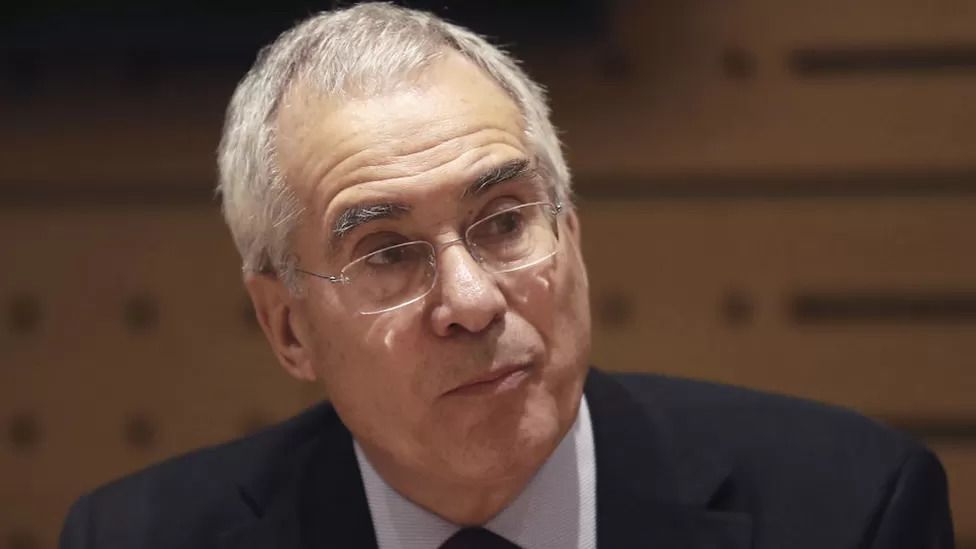 Lord Stern reckons taxes will have to rise to support the UK's journey to net zero
Lord Browne, a former chief executive of BP who now heads up a private equity fund that invests in firms that reduce greenhouse gases, wants more state help for businesses.
He is urging government to take inspiration from across the Atlantic.
President Biden's Inflation Reduction Act involves subsidies and tax credits for producing electric vehicles, renewable electricity, sustainable aviation fuel and hydrogen as well as money off for consumers who buy US-made electric cars.
"I will give the US an A-grade for the Inflation Reduction Act, that's pretty dramatic," Lord Browne says. "It's nothing like enough, but it's a great start and it's made people notice."
But some UK Ministers, including former Business Secretary Grant Shapps, who now heads up the new Department for Energy Security and Net Zero, have been critical of President Biden's move.
They have been concerned that it gives US businesses an unfair advantage.
Such subsidies are typically financed by tax revenue or borrowing.
However, Lord Browne says there is already one source of tax cash that could be channelled better.
He supports the current windfall tax on North Sea oil and gas production, saying it is only right that producers should pay over a slice of the unforeseen profits earned on assets that are ultimately owned by the nation.
He would like to see those revenues earmarked to help renewable specialists who are developing new energies.
But Lord Brown is concerned that with so many issues to consider, such as securing the UK's energy supply, environmental concerns may have slipped from the forefront of policymakers' minds.
"Government ministers are preoccupied with very simple things, which is a rediscovery of inflation and rediscovery of security," he said.
"It is first keeping the lights on, energy security. Secondly, affordability. And third is climate. Now, you should be able to do all three things at once but it's very theoretical to say that people do focus on three objectives simultaneously. They just don't in life."
Speaking at the COP 27 climate meeting last year, however, Prime Minister Rishi Sunak said that the energy crisis was a reason to accelerate the energy transition.
In a statement, the government claimed the UK is "leading the world on tackling climate change with policies having supported 68,000 green jobs since 2020."
Appetite for change?
Last week saw the creation of the Department for Energy Security and Net Zero.
The latter was among the 129 recommendations made in a review of the UK's progress towards net zero commissioned by previous Prime Minister Liz Truss, which urged the government to take a bolder approach.
But ramping up that role in climate action might need some difficult conversations.
Pollsters Ipsos found that while people are still very concerned about climate change, they are now more focused on inflation, the economy and public services.
And when it tested several policy areas - including paying environmental levies for frequent flights or other products and phasing out fossil fuel heating - the level of support dropped.
Voters are keen to do the right thing - but maybe less enthusiastic about funding change, especially at the moment.