Old Russian-Flagged Tanker Becomes Focus of Geopolitical Tensions After U.S. Seizure in Atlantic
The capture of the rusting Marinera — reflagged, pursued and monitored by multiple nations — underscores the strategic struggle over sanctions enforcement and global oil routes
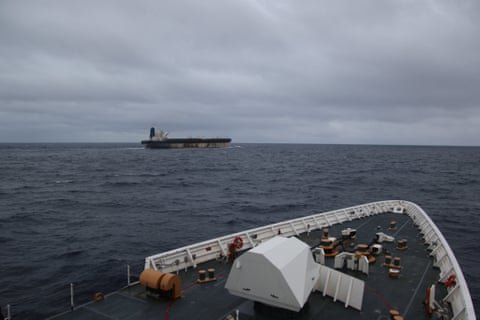
A decrepit oil tanker now renamed Marinera has become the centre of an unusual international standoff after being seized by United States forces in the North Atlantic following an extended pursuit involving British and allied surveillance.
Originally sailing as Bella 1, the 300-metre vessel was reflagged under Russia’s jurisdiction mid-voyage amid an intensified U.S. campaign to enforce sanctions against illicit oil shipments tied to Venezuela, Iran and Russia — a network often referred to by analysts as the “shadow fleet,” a term used for ships that conceal sanctioned cargoes and evade interdiction.
Recent developments show that British aircraft and naval assets supported the U.S. mission through surveillance and logistical assistance, contributing to the strategic operation aimed at disrupting sanctions-evasion activity.
The tanker’s transformation into a geopolitical flashpoint began when it attempted to avoid U.S. interdiction after leaving the Gulf of Oman bound for Venezuela, following routes typically used by vessels seeking to transport crude in defiance of Western sanctions.
In late December, the crew reportedly painted a Russian flag on the vessel’s hull and had it formally registered under Russia in an attempt to claim protection and complicate U.S. efforts to board or seize the ship.
To many observers, this tactic reflected a broader trend of so-called flag hopping and registry shopping among sanctioned vessels seeking to escape enforcement.
The United States, which in December 2025 imposed a naval blockade on sanctioned tankers trading with Venezuela as part of “Operation Southern Spear,” tracked the Marinera for more than two weeks across the Atlantic.
During that time, aircraft from the U.S. and Royal Air Force reconnaissance planes monitored the tanker’s movements while at least one Russian submarine was reported to have trailed its course in a show of naval support for the vessel.
Such actions heightened international attention because they suggested Moscow was testing the limits of Western enforcement of sanctions and challenging the scope of maritime interdiction operations.
When American forces ultimately boarded the Marinera in waters between Iceland and the United Kingdom early in January 2026, the operation marked one of the most striking examples of Western measures to clamp down on what officials describe as a sanctions-busting network of ageing tankers.
U.S. officials justified the seizure on the grounds of violations of sanctions targeting activities that support illicit oil exports, asserting that the tanker’s prior voyage and reflagging were designed to mask its true operations.
Russia condemned the action as “outright piracy” under the United Nations Convention on the Law of the Sea, demanding that its nationals be treated humanely and repatriated.
The episode has drawn attention not only because of the unusual dynamics of maritime law and flag state protections but because it illustrates the broader geopolitical and economic contest over sanctions enforcement, energy markets and naval reach.
As analysts note, a growing number of sanctioned vessels have adopted similar tactics to avoid interception, posing challenges for Western authorities seeking to uphold multilateral sanctions regimes while navigating the legal complexities of international waters and registry rules.
The tanker’s dramatic odyssey across the Atlantic and its eventual capture highlight the evolving nature of global strategic competition on the high seas.
Originally sailing as Bella 1, the 300-metre vessel was reflagged under Russia’s jurisdiction mid-voyage amid an intensified U.S. campaign to enforce sanctions against illicit oil shipments tied to Venezuela, Iran and Russia — a network often referred to by analysts as the “shadow fleet,” a term used for ships that conceal sanctioned cargoes and evade interdiction.
Recent developments show that British aircraft and naval assets supported the U.S. mission through surveillance and logistical assistance, contributing to the strategic operation aimed at disrupting sanctions-evasion activity.
The tanker’s transformation into a geopolitical flashpoint began when it attempted to avoid U.S. interdiction after leaving the Gulf of Oman bound for Venezuela, following routes typically used by vessels seeking to transport crude in defiance of Western sanctions.
In late December, the crew reportedly painted a Russian flag on the vessel’s hull and had it formally registered under Russia in an attempt to claim protection and complicate U.S. efforts to board or seize the ship.
To many observers, this tactic reflected a broader trend of so-called flag hopping and registry shopping among sanctioned vessels seeking to escape enforcement.
The United States, which in December 2025 imposed a naval blockade on sanctioned tankers trading with Venezuela as part of “Operation Southern Spear,” tracked the Marinera for more than two weeks across the Atlantic.
During that time, aircraft from the U.S. and Royal Air Force reconnaissance planes monitored the tanker’s movements while at least one Russian submarine was reported to have trailed its course in a show of naval support for the vessel.
Such actions heightened international attention because they suggested Moscow was testing the limits of Western enforcement of sanctions and challenging the scope of maritime interdiction operations.
When American forces ultimately boarded the Marinera in waters between Iceland and the United Kingdom early in January 2026, the operation marked one of the most striking examples of Western measures to clamp down on what officials describe as a sanctions-busting network of ageing tankers.
U.S. officials justified the seizure on the grounds of violations of sanctions targeting activities that support illicit oil exports, asserting that the tanker’s prior voyage and reflagging were designed to mask its true operations.
Russia condemned the action as “outright piracy” under the United Nations Convention on the Law of the Sea, demanding that its nationals be treated humanely and repatriated.
The episode has drawn attention not only because of the unusual dynamics of maritime law and flag state protections but because it illustrates the broader geopolitical and economic contest over sanctions enforcement, energy markets and naval reach.
As analysts note, a growing number of sanctioned vessels have adopted similar tactics to avoid interception, posing challenges for Western authorities seeking to uphold multilateral sanctions regimes while navigating the legal complexities of international waters and registry rules.
The tanker’s dramatic odyssey across the Atlantic and its eventual capture highlight the evolving nature of global strategic competition on the high seas.