

NATO allies put forces on standby as tensions rise over Ukraine crisis
The developments underscore growing fears of a possible Russian incursion, following months of military maneuvering by Moscow that has set off a tit-for-tat series of escalations with NATO, a military alliance of Western powers.
Russia has been building up forces and equipment near its border with Ukraine since last year, and is sending troops into neighboring Belarus for joint exercises next month that Ukrainian officials fear could serve as a "full-fledged theater of operations" from which to launch an attack.
US intelligence officials have said they don't know whether Russian President Vladimir Putin has decided to invade Ukraine.
The Kremlin has repeatedly denied it is planning to do so, but has argued that NATO support for the country constitutes a growing threat on Russia's western flank.
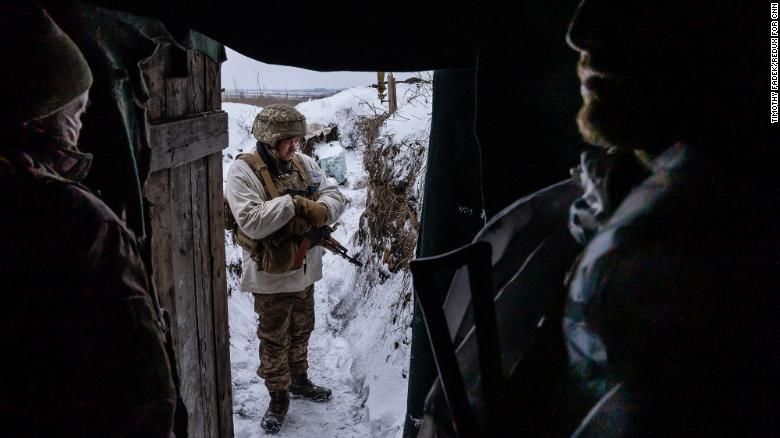 Ukrainian soldiers in a front line trench near pro-Russian separatists take shelter from the extreme cold.
After high-level talks between Moscow and Washington wrapped earlier this month without any breakthroughs over the tens of thousands of Russian troops amassed on Ukraine's border, prospects of de-escalation and future diplomacy have been cast into doubt. Now the Biden administration is weighing whether to deploy as many as 5,000 US troops, according to a senior defense official, to shore up NATO allies in Eastern Europe and the Baltics.
On Monday, both NATO and Russia pointed the finger at each other for the ratcheting tensions.
"Tensions are escalating due to concrete actions taken by the US and NATO," Kremlin spokesman Dmitry Peskov said, referring to NATO's announcement.
"I mean the informational hysteria that we are witnessing -- it is generously framed by a huge amount of false information, just lies and fakes," Peskov added.
NATO Secretary General Jens Stoltenberg said in a Monday statement that the alliance would continue to take necessary measures "to protect and defend all Allies, including by reinforcing the eastern part of the Alliance." He added: "We will always respond to any deterioration of our security environment, including through strengthening our collective defence."
The NATO statement said that in recent days, a flurry of member states had announced deployments to the region. They include Denmark sending a frigate to the Baltic Sea and four F-16 fighter jets to Lithuania, the Netherlands deploying two F-35 fighter aircraft to Bulgaria, France expressing its readiness to send troops to Romania and the US considering increasing its military presence in the East.
Stoltenberg cautioned in a news conference on Monday that the moves were defensive and proportionate -- and that NATO was "not threatening Russia."
There was no suggestion in the statement that the troops would be used to assist Ukraine, which is not a NATO member.
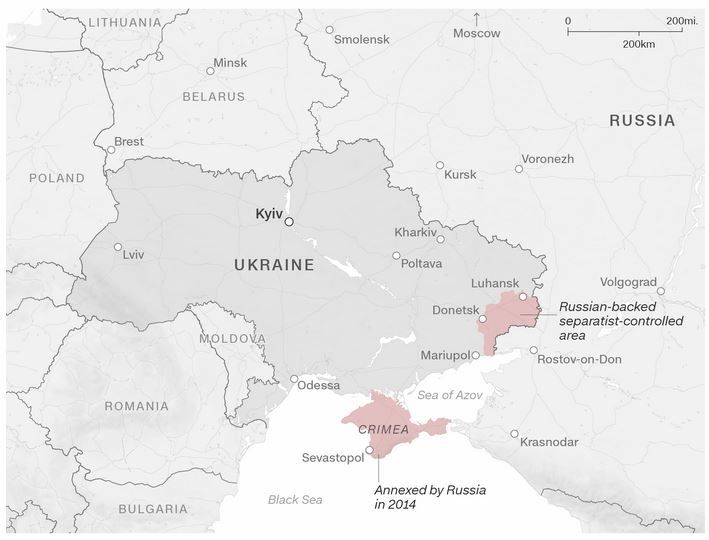
NATO, Europe and the US have been united in their opposition to any further Russian incursion in Ukraine, promising to lend support to Ukraine and hand down "massive costs" for Moscow in the event they make a move. But the shape of that response and what steps they might take are still unclear.
US Secretary of State Antony Blinken on Sunday warned that "a single additional Russian force" entering Ukraine "in an aggressive way" would result in a severe response by the US and its allies. His comments came after US President Joe Biden muddled the message of severe consequences last week, saying at a news conference that a "minor incursion" might not trigger the same response from NATO as an invasion. The President later clarified that any Russian troops crossing Ukraine's border would constitute an invasion.
CNN reported last week that the US military goal would be to "meet the capability" NATO allies in the region are asking for, a defense official said. On Monday, Pentagon spokesman John Kirby said that as many as 8,500 US troops have been put on heightened preparedness to deploy.
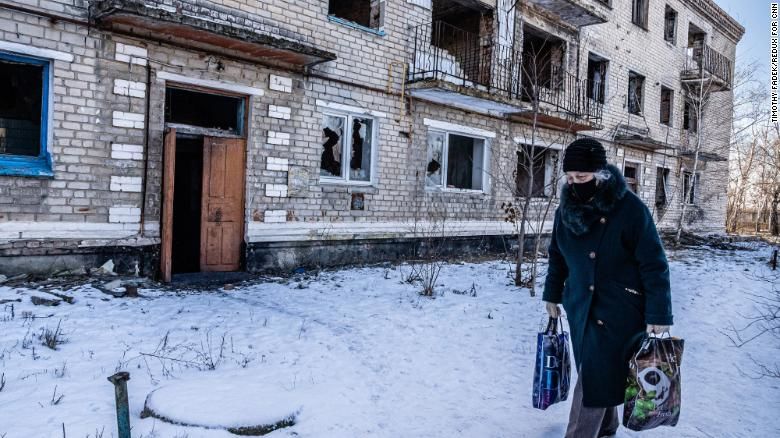 Local residents Marinka, Ukraine, walk past an apartment building
destroyed during fighting in 2015 between the Ukrainian army and
Russian-backed separatists. Fighting is still ongoing.
Local residents Marinka, Ukraine, walk past an apartment building
destroyed during fighting in 2015 between the Ukrainian army and
Russian-backed separatists. Fighting is still ongoing.
The mobilization of Western forces comes amid a significant uptick in Russia's military movements, not only on Ukraine's border -- where the Ukrainian Defense Ministry says there are now 127,000 Russian troops stationed -- but elsewhere in Europe. The Russian Defense Ministry announced last week that 140 ships and 10,000 servicemen would take part in sweeping exercises from the Pacific to the Atlantic, including off Ireland's southwest coast in February.
The ministry said the main purpose of the drills is to protect Russia's national interests in the world's oceans, TASS state news agency reported.
Ireland's Foreign Affairs Minister Simon Coveney told reporters on Monday that he had raised concerns with Moscow about Russia's plans. "This isn't the time to increase military activity and tension in the context of what's happening with and in Ukraine at the moment," Coveney said.
Coveney and other European Union foreign ministers met in Brussels to discuss the security situation in Ukraine and what action to take should Russia cross into Ukrainian territory; Blinken joined by video link following talks with Lavrov in Geneva. EU foreign ministers want to send a clear message to Russia that if it decides to invade Ukraine it will be hit by the "most comprehensive" package of sanctions and restrictions ever prepared by the EU, Coveney said.
But while NATO countries ramp up readiness and the EU discusses heightened security concerns, Ukraine's own government has not, at least outwardly, signaled the same sense of urgency. In a call with the President of the European Council Charles Michel on Monday, Ukrainian President Volodymyr Zelensky said the country will not succumb to provocations, but would "keep calm."
Zelensky and his government have previously downplayed the danger of a Russian invasion, noting that the threat has existed for years and has not become greater in recent months. The conflict between Ukraine and Russia has been rumbling since 2014, when Russia annexed Crimea and fomented a rebellion in Ukraine's east. Despite a cease fire in 2015, the two sides have not seen a stable peace.
Ukraine on Monday criticized the US' decision to withdraw diplomats' families and reduce staff levels at the US Embassy in Kyiv, with Oleg Nikolenko, spokesman for the Ukrainian Foreign Ministry, saying in a tweet: "We believe such a step to be a premature one & an instance of excessive caution."
But other countries are also taking precautions in Kyiv, Ukraine's capital. The UK Foreign Office also announced Monday that some British Embassy staff and dependents were being withdrawn from Kyiv in response to "growing threats from Russia." UK Prime Minister Boris Johnson said Monday that the intelligence around the situation in Ukraine was "gloomy" but that war was not inevitable.
Speaking to reporters at the EU Foreign Affairs Council in Brussels on Monday, the bloc's chief diplomat Josep Borrell said Europe will seek to simmer tensions between Russia and Ukraine through diplomacy first but warned Moscow it is prepared to take action if necessary. He also urged for calm, stressing the need to avoid "alarmist reactions that could that could lead to an escalation. We don't want people to have a breakdown on this."
Borrell added that the EU had no current plans to evacuate diplomatic staff and their families from Ukraine.