

Ministers ask Hunt for £300m to avert mass British Steel job losses
Ministers are urging the chancellor to provide £300m of taxpayers' money to avert the closure of British Steel’s two blast furnaces – a move that would trigger the loss of thousands of industrial jobs in northern England.
Sky News has learnt that Grant Shapps, the business secretary, and Michael Gove, the levelling-up secretary, wrote to Jeremy Hunt this month to warn that the demise of British Steel could cost the government up to £1bn in decommissioning and other liabilities.
In their letter, a copy of which has been seen by Sky News, Mr Hunt was asked to consider the economic case for supporting both British Steel, which is owned by a Chinese conglomerate, and the wider UK steel industry.
"Every other G20 nation has maintained domestic steel production and, while we do not think that this should come at any cost, we do believe it is in HMG's interest to offer well-designed and targeted funding which unlocks private investment, achieves a good outcome for taxpayers, and enables transformed, decarbonised and viable domestic steel production to continue in the UK in the long-term," Mr Shapps and Mr Gove wrote.
"We do not want to become reliant on steel sources elsewhere in the same way that energy security has become self-evidently important.
"Moreover, our steel requirement will increase by 20% due to large domestic infrastructure projects already committed to in the UK."
One industry source briefed on the discussions in Whitehall said the chancellor had instructed Treasury officials to scrutinise the request.
The letter to Mr Hunt warned that British Steel "does not have a viable business without government support".
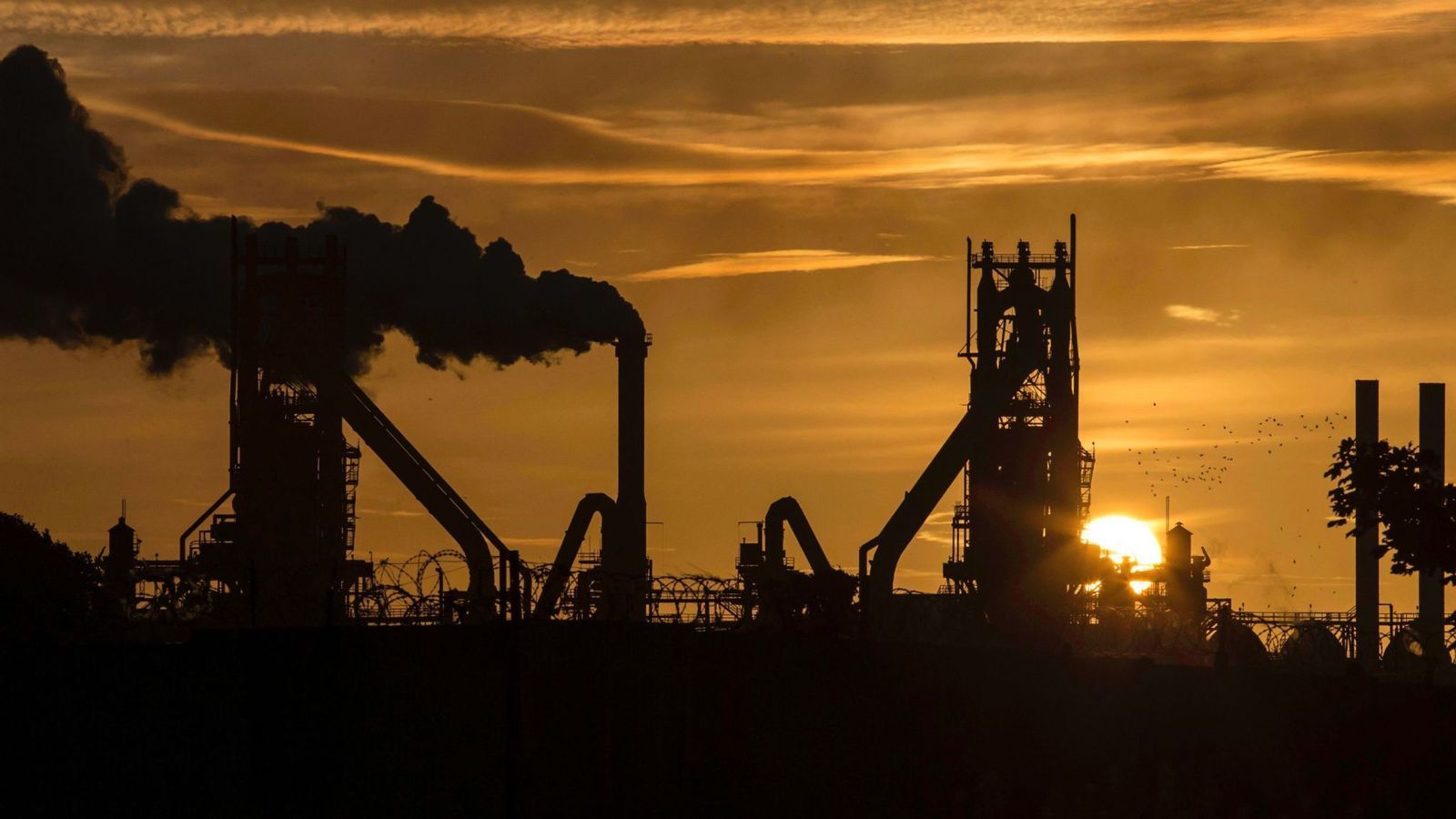 The British Steel plant in Scunthorpe
"The local economic impact of closing both blast furnaces is estimated to be in the region of £360m to £640m, with a further £500m to £1bn liability for HMG through compulsory liquidation, insolvency and land liabilities (though £40m could potentially be raised through asset recovery".
"Given the magnitude of the liabilities due to fall on HMG in the event of blast furnace closure, and following the PM's steer, we would like officials to test whether net government support in the region of £300m for British Steel could prevent closure, protect jobs and create a cleaner viable long-term future for steel production in the United Kingdom."
The fate of British Steel, which was bought by Jingye Group out of a previous insolvency process less than three years ago, has become increasingly unclear in recent months as the current owners have indicated that they would not maintain its operations without taxpayer funding.
British Steel employs about 4,000 people, with thousands more jobs in its supply chain dependent upon the company.
According to the letter to Mr Hunt, British Steel has already informed the government that it could close one of the Scunthorpe blast furnaces as soon as next month, with the loss of 1,700 jobs.
This would be "followed by the second blast furnace closing later in 2023, creating cumulative direct job losses of around 3,000", Mr Shapps and Mr Gove wrote.
The plea to Mr Hunt followed a round of talks between Mr Shapps and Jingye earlier in December about supporting Britain's second-largest steel producer.
Mr Shapps' predecessor, Jacob Rees-Mogg - who lasted just weeks as business secretary under Liz Truss - opened formal talks with Jingye in October about the provision of government funding to help British Steel decarbonise.
One of the pre-conditions set by Whitehall for the discussions was that Jingye would not cut jobs at British Steel while the discussions were ongoing, although the recent letter to Mr Hunt said that ministers "cannot guarantee the company will choose to support jobs in the short term".
Tata Steel, which is the biggest player in the UK steel sector, has also requested financial help from the government.
Responding to an enquiry from Sky News, a government spokesman said: "The government is committed to securing a sustainable and competitive future for the UK steel sector and we are working closely with industry to achieve this.
"We recognise that businesses are feeling the impact of high global energy prices, including steel producers, which is why we announced the Energy Bill Relief Scheme to bring down costs.
"This is in addition to extensive support we have provided to the steel sector as a whole to help with energy costs, worth more than £800m since 2013."
The request for financial support from Jingye poses a political headache for ministers, given the scale of the potential job losses which might result from a refusal to provide taxpayer aid.
An agreement to provide substantial taxpayer funding to a Chinese-owned business, however, would inevitably provoke outrage among Tory critics of Beijing.
China's role in global steel production, after years of international trade rows about dumping, would make any subsidies even more contentious.
In May 2019, the Official Receiver was appointed to take control of the company after negotiations over an emergency £30m government loan fell apart.
British Steel had been formed in 2016 when India's Tata Steel sold the business for £1 to Greybull Capital, an investment firm.
As part of the deal that secured ownership of British Steel for Jingye, the Chinese group said it would invest £1.2bn in modernising the business during the following decade.
Jingye's purchase of the company, which completed in the spring of 2020, was hailed by Boris Johnson, the then prime minister, as assuring the future of steel production in Britain's industrial heartlands.
British Steel has previously said of its negotiations with Whitehall: "We are continuing formal talks with the UK Government to help us overcome the global challenges we currently face.
"The government understands the significant impact the economic slowdown, rising inflation and exceptionally high energy and carbon prices are having on businesses like ours and we look forward to working together to build a sustainable future."