Michelle O’Neill Signals Growing Strain on UK Union at Sinn Féin Conference
Northern Ireland First Minister uses party ard fheis to argue constitutional pressures are intensifying amid ongoing debate over Irish unity and post-Brexit governance
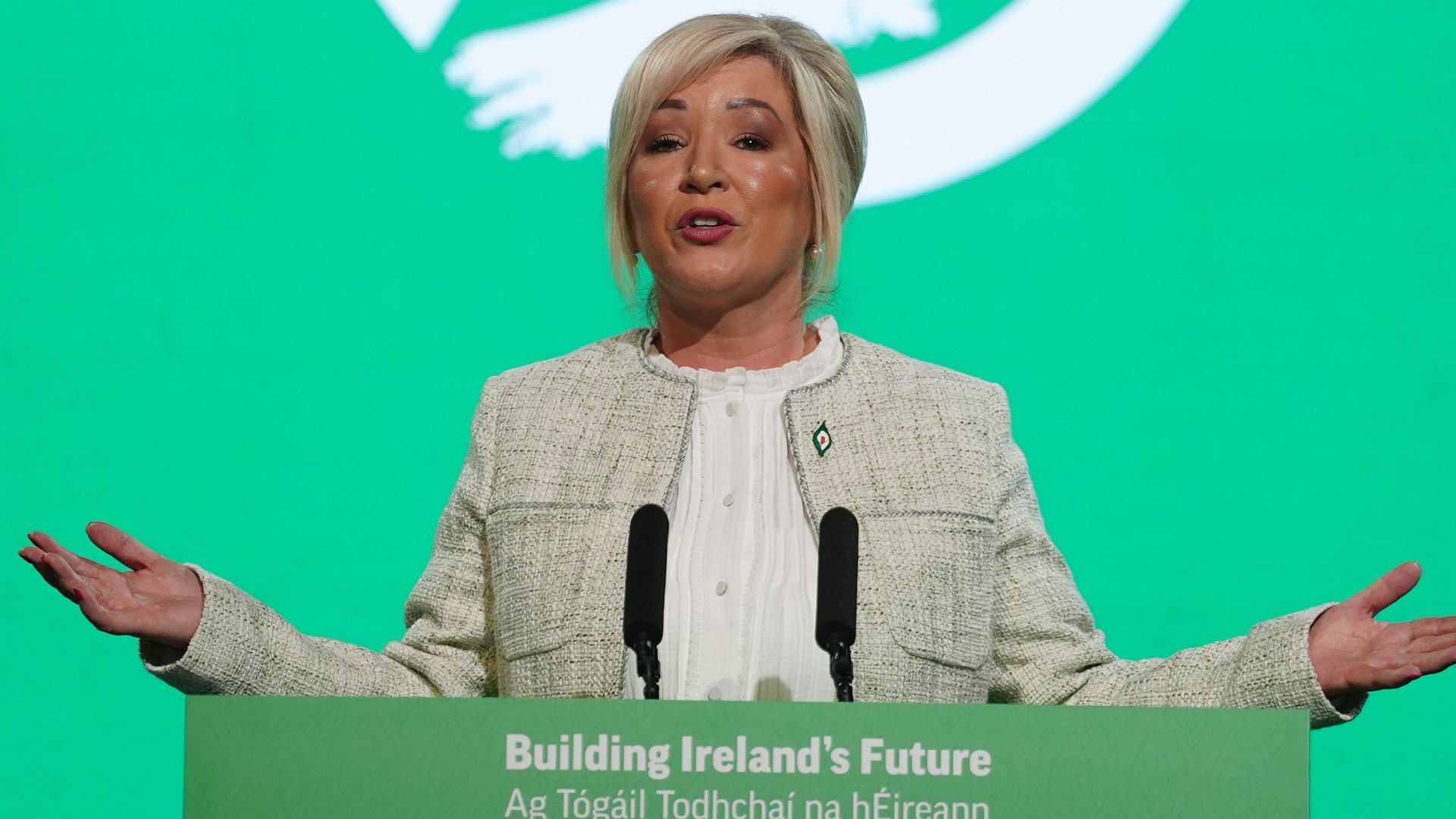
An internal political messaging event driven by party leadership positioning has sharpened debate over the constitutional future of the United Kingdom after Sinn Féin leader Michelle O’Neill described the UK union as “cracking at the seams” during the party’s ard fheis, the organisation’s annual conference.
What is confirmed is that Michelle O’Neill, who serves as First Minister of Northern Ireland and is a senior figure in Sinn Féin, used the party gathering to argue that structural pressures are increasingly challenging the stability of the United Kingdom.
The remarks were delivered in the context of broader political discussion within Northern Ireland about governance arrangements, constitutional identity, and the long-term question of Irish unity.
The Sinn Féin ard fheis functions as a key internal policy and messaging forum, where party leadership sets strategic direction and frames political priorities.
In this context, O’Neill’s comments reflect a long-standing Sinn Féin position advocating for Irish reunification, while also responding to current political dynamics within Northern Ireland’s devolved government structure.
The key issue underlying the statement is the ongoing constitutional tension within Northern Ireland’s post-Brexit settlement.
The region operates under a power-sharing arrangement requiring cooperation between nationalist and unionist parties, while simultaneously remaining part of the United Kingdom under the 1998 peace framework.
Brexit added further complexity by introducing new trade and regulatory arrangements between Northern Ireland, Great Britain, and the European Union.
Unionist parties reject the framing that the UK is weakening, arguing instead that constitutional arrangements remain stable and that any change in Northern Ireland’s status must be based on democratic consent through a referendum.
They view Sinn Féin’s messaging as part of a broader political strategy aimed at advancing the case for Irish unity rather than a reflection of institutional instability.
Nationalist parties, including Sinn Féin, argue that demographic change, evolving political identity, and economic integration on the island of Ireland are gradually reshaping constitutional expectations.
They point to opinion polling and cross-community discussions as indicators of shifting long-term trends, while emphasizing that any constitutional change would be determined through democratic processes.
The broader context includes ongoing debates over governance in Northern Ireland, where power-sharing institutions have experienced periods of suspension and political disagreement.
These disruptions have contributed to perceptions of instability, which both sides interpret differently depending on constitutional perspective.
O’Neill’s comments therefore sit within a wider political narrative rather than representing a sudden institutional development.
They reflect competing interpretations of the same political reality: one side viewing current arrangements as under strain, the other viewing them as resilient but politically contested.
The immediate consequence of the remarks is renewed political friction between nationalist and unionist representatives in Northern Ireland, reinforcing the persistence of constitutional debate as a central feature of the region’s political landscape rather than a settled question.
What is confirmed is that Michelle O’Neill, who serves as First Minister of Northern Ireland and is a senior figure in Sinn Féin, used the party gathering to argue that structural pressures are increasingly challenging the stability of the United Kingdom.
The remarks were delivered in the context of broader political discussion within Northern Ireland about governance arrangements, constitutional identity, and the long-term question of Irish unity.
The Sinn Féin ard fheis functions as a key internal policy and messaging forum, where party leadership sets strategic direction and frames political priorities.
In this context, O’Neill’s comments reflect a long-standing Sinn Féin position advocating for Irish reunification, while also responding to current political dynamics within Northern Ireland’s devolved government structure.
The key issue underlying the statement is the ongoing constitutional tension within Northern Ireland’s post-Brexit settlement.
The region operates under a power-sharing arrangement requiring cooperation between nationalist and unionist parties, while simultaneously remaining part of the United Kingdom under the 1998 peace framework.
Brexit added further complexity by introducing new trade and regulatory arrangements between Northern Ireland, Great Britain, and the European Union.
Unionist parties reject the framing that the UK is weakening, arguing instead that constitutional arrangements remain stable and that any change in Northern Ireland’s status must be based on democratic consent through a referendum.
They view Sinn Féin’s messaging as part of a broader political strategy aimed at advancing the case for Irish unity rather than a reflection of institutional instability.
Nationalist parties, including Sinn Féin, argue that demographic change, evolving political identity, and economic integration on the island of Ireland are gradually reshaping constitutional expectations.
They point to opinion polling and cross-community discussions as indicators of shifting long-term trends, while emphasizing that any constitutional change would be determined through democratic processes.
The broader context includes ongoing debates over governance in Northern Ireland, where power-sharing institutions have experienced periods of suspension and political disagreement.
These disruptions have contributed to perceptions of instability, which both sides interpret differently depending on constitutional perspective.
O’Neill’s comments therefore sit within a wider political narrative rather than representing a sudden institutional development.
They reflect competing interpretations of the same political reality: one side viewing current arrangements as under strain, the other viewing them as resilient but politically contested.
The immediate consequence of the remarks is renewed political friction between nationalist and unionist representatives in Northern Ireland, reinforcing the persistence of constitutional debate as a central feature of the region’s political landscape rather than a settled question.