

MI6 boss warns of China 'debt traps and data traps'
Mr Moore - known as "C" - told BBC Radio 4's Today programme these traps threatened to erode sovereignty and have prompted defensive measures.
He denied the fall of Afghan capital Kabul was an intelligence failure and signalled closer ties with tech giants.
The decision to speak more openly about his work was important in a modern democracy, the ex-secret agent said.
In a wide-ranging interview before he gave his first major public speech since taking on the role as head of MI6, Mr Moore:
* Warned China has the capability to "harvest data from around the world" and uses money to "get people on the hook"
* Admitted the assessment of the Taliban's progress in Afghanistan this summer was "clearly wrong" - but denied Kabul's fall was an "intelligence failure"
* Described a "chronic problem" with Russia and Ukraine - with Russia posing an "acute threat" to the UK
* Supported closer links with technology partners and speeding-up the vetting process for new tech-savvy recruits
Speaking about the threat posed by China, Mr Moore described its use of "debt traps and data traps".
He said Beijing is "trying to use influence through its economic policies to try and sometimes, I think, get people on the hook".
Explaining the "data trap", he said: "If you allow another country to gain access to really critical data about your society, over time that will erode your sovereignty, you no longer have control over that data.
"That's something which, I think, in the UK we are very alive to and we've taken measures to defend against."
Speaking later at the International Institute for Strategic Studies in London, Mr Moore said China was now "the single greatest priority" for his agency and warned that a "miscalculation" by an over-confident regime in Beijing over an issue like Taiwan could pose a "serious challenge" to global peace.
He also said it was essential for Western countries to stand up to the "full spectrum" of threats from Moscow - from state-sanctioned attacks, such as the Salisbury poisoning, to using political proxies to undermine stability in the Balkans.
'Clearly wrong'
The assessment of the speed at which the Taliban would seize control of Kabul as British and American troops withdrew from Afghanistan was "clearly wrong", Mr Moore admitted on the Today programme.
But he said it was "really overblown to describe it in terms of intelligence failure". "None of us predicted the speed of the fall of Kabul," he said.
"Frankly, if we had recruited every member of the Taliban Shura, you know, the leadership group of the Taliban, [if] we recruited every one of them as a secret agent, we still wouldn't have predicted the fall of Kabul because the Taliban didn't."
However, he added that there is no "soft soaping" that the victory of the Taliban had been a "serious reverse" and he is concerned it will be a "morale boost for extremists around the world, and indeed for those sitting in the capitals in Beijing, Tehran, and Moscow".
Out of the shadows

MI6 chiefs used to do what they could to avoid the spotlight, preferring their names were only known by a select few. But now they know that a public face is part of the job.
The current chief is even active on Twitter, something some of his staff found a touch uncomfortable at first and now he has appeared live on the BBC.
The reason is that spy chiefs know they need public support - partly as they want to be seen to be accountable and know the public are less trusting of secrecy than in the past.
But they also want to use the publicity to help recruit the best staff to their ranks and gain the support of businesses and others to help in their mission.
They hope they can do this while maintaining secrecy about some parts of their work - for MI6 that means the identity of those who provide them with information.
Mr Moore described Russia as an "acute threat" and said Russian President Vladimir Putin has been clear that he does not recognise Ukraine's right to be an independent state.
"From time to time we get sort of crises around Ukraine as we worry about build-up of troops and what President Putin's intentions might be," he said.
"Therefore it bears very careful watching and it bears very careful signalling to the Russians about, you know, the price that they would have to pay if they intervened, as they did in 2014."
He said there was not "an adversarial sort of agenda here", adding: "We're not trying to encircle Russia, we're not trying to prevent it from pursuing its legitimate interest."
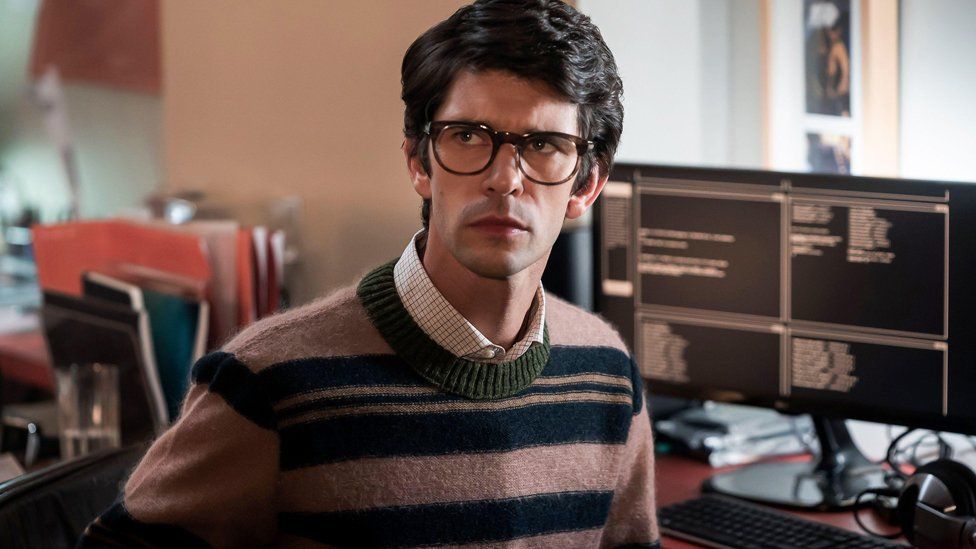 Mr Moore said
closer ties with tech giants would help the real-life "Qs" - as played
by Ben Whishaw in recent James Bond films - stay ahead
Mr Moore said
closer ties with tech giants would help the real-life "Qs" - as played
by Ben Whishaw in recent James Bond films - stay ahead
Looking ahead to the future of the Secret Intelligence Service, Mr Moore said he wanted to "partner in a different way" with the UK's technology industry to help its real-life "Q labs" stay ahead.
But he said the service would always uphold UK laws around privacy and data.
Mr Moore also revealed the significance of the green ink used by those in his role - which came from a tradition started by Sir Mansfield Smith-Cumming, the first head of MI6, or "C".
He said the green ink means those working in the service know any directive has been signed by him. "The same is true of my typescript on my computer," he added.