

Labour surges as Tory fears grow over Truss’s tax cut agenda
Senior Tories have warned that their party will suffer dire electoral consequences under a Liz Truss premiership that fails to address the cost of living crisis, as Labour enjoys a poll bounce suggesting Keir Starmer could be on course for No 10.
Amid signs of mounting panic among high-ranking Conservatives about Truss’s economic policies, several former cabinet ministers told the Observer on Saturday the party would suffer devastating losses in blue and red wall seats unless Truss changes tack, if and when she enters No 10.
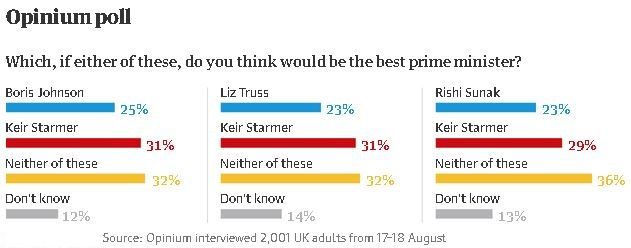
After Michael Gove described Truss’s plan to focus on cutting taxes as a “holiday from reality” and announced he was supporting Rishi Sunak, the latest Opinium poll for the Observer gives Labour and its leader a double poll boost, days after he backed a complete freeze on energy bills this autumn. Labour now enjoys its biggest Opinium poll lead in months – eight points – while Starmer has surged well ahead of Truss in the past two weeks when voters are asked who would be the best prime minister.
Two weeks ago 29% of all voters said Truss would be the best PM, against 28% who chose Starmer. This weekend, Truss has dropped to 23% while Starmer, who announced his price cap policy only last Monday, has increased his score to 31%. When the choice was Starmer versus Sunak, 29% backed Starmer and 23% Sunak.
A poll on Saturday for the Times by YouGov, whose current methodology tends to give Labour a higher figure than Opinium’s, showed Starmer’s party enjoying its biggest lead in 10 years, on 43% – 15 points ahead of the Conservatives on 28%.
Truss – the runaway leader in the contest to be the next Tory party leader and prime minister – is insisting she will resist more “handouts” to those struggling most with the cost of living, an approach she describes as “Gordon Brown economics”.
Instead, she says, she will use tax cuts as a way to boost the economy – despite warnings from economists and senior Tory colleagues that this will merely stoke and embed inflation.
In an interview in this weekend’s Observer New Review, the former Tory chancellor Kenneth Clarke describes the Truss approach as “nonsense” and “simplistic”.
Clarke says: “Everybody would do it if that worked. There’s a slight touch of the Argentinian or Venezuelan government about it. This is not a time for tax cuts because we have enormous public debts. Tax cuts will stimulate growth in demand, but the problems are with the difficulties in supply, so they will push inflation further up.”
Already, the deputy prime minister, Dominic Raab, and the former Tory leader Michael Howard have gone public to criticise Truss’s approach.
Gove said going down the tax-cutting route would benefit those least in need, and fail the poorest: “The answer to the cost of living crisis cannot be simply to reject further ‘handouts’ and cut tax. Proposed cuts to national insurance would favour the wealthy, and changes to corporation tax apply to big businesses, not small entrepreneurs.
“I cannot see how safeguarding the stock options of FTSE 100 executives should ever take precedence over supporting the poorest in our society, but at a time of want it cannot be the right priority.”
Another former Cabinet colleague of Gove and Truss, who is backing Sunak, said: “If Liz does not change tack and back a real economic package that does more to help those in need, I think we will be in big trouble. But to do so she will need to go back on what she has said in the leadership campaign, which will not be without consequences either.”
A former minister added: “We can write off those ‘blue wall’ seats under Liz. Cutting taxes won’t help us win support in the ‘red wall’ either. You can’t cut taxes and level up.”
Reacting to Gove’s announcement, a spokesperson for the Sunak campaign said the former chancellor was “delighted to have the support of a party and cabinet veteran who has incredible intellectual heft and has shown the radical reforming zeal in every job he has had, that we now so desperately need”.
He added: “Michael also understands the severity of the challenges we face in the winter and we need honesty about that and a plan to tackle it and support people, which Rishi has.”
Meanwhile the Liberal Democrats have set up a new “attack Truss unit”, to highlight what they say is her failure to help people with energy costs, in the hope of winning over more voters in the blue wall seats in which they came second to the Conservatives at the 2019 general election.
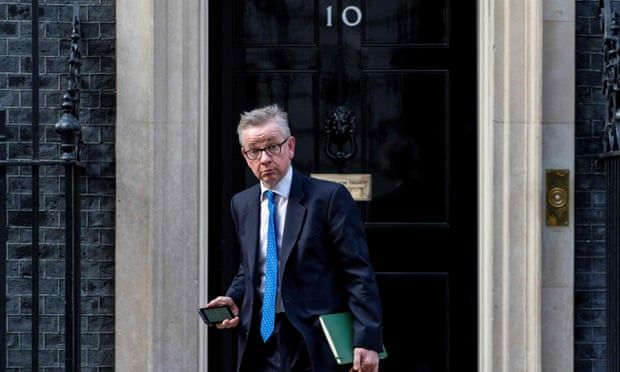 Michael Gove said last week that Truss’s proposals on tax suggested she had taken a ‘holiday from reality’.
In his interview, Clarke predicts a serious recession that will be made worse by the wrong tax policies, and suggests that under Truss the country could be in a desperate economic situation at the next election.
“I’ve felt for some time that we’re bound to have a very severe recession. And if we’re not careful, it’s going to be combined with very bad inflation, which does social, as well as economic, damage. Living standards generally are going to fall for the first time for a long time, and the main short-term measures should be to stop us seeing any increase in the number of people becoming destitute in this country. The government shouldn’t be asking themselves, what is the Daily Mail going to be saying tomorrow, but what is the economy going to look like in a couple of years’ time when we have an election?”
The Sunak campaign believes the polls suggesting Truss is home and dry in the leadership race are wrong, and is convinced the ex-chancellor is still in with a chance and is making up ground.
Opinium found that 62% of people support Labour’s policy of freezing energy bills. About 40% of respondents said they would not be able to afford the rise in the cap due to be announced by the energy regulator Ofgem this week without falling behind on other essential bills.