London Daily

Focus on the big picture.
Tuesday, Jul 14, 2026

Labour conference: Winning election more important than unity, says Sir Keir Starmer

Labour conference: Winning election more important than unity, says Sir Keir Starmer

Labour leader Sir Keir Starmer has said winning the next election is more important than party unity.

Rows with left-wingers angry over the direction he is taking the party have dominated Labour's annual conference.

But Sir Keir told the BBC Labour had to change to avoid losing a fifth general election in a row.

He said he came into politics "to go into government to change millions of lives", not "lose and then tweet about it".

In an interview with BBC political editor Laura Kuenssberg, the Labour leader called on "every single Labour Party member and supporter" to have the same focus on the ballot box as he did.

On Sunday, Sir Keir succeeded in getting the party conference to back changes to the way the party selects leadership candidates, which angered many on the left who saw it as an attempt to marginalise them.

Another row exploded on Monday when shadow employment minister Andy McDonald resigned from his job, claiming Sir Keir had made the party "more divided than ever".

Mr McDonald said he had been ordered by the leadership to argue against increasing the minimum wage to £15 an hour, as demanded by the left of the party and the majority of members at conference, and this had made his position "untenable".


"Most of the people here are actually interested in winning an election. I can feel it," said a member of Labour's shadow cabinet rather jubilantly.

It might sound deeply strange that a senior politician would feel the need to make such a remark about the members of their own party.

But over the past few years it has sometimes felt like Labour was spinning round in smaller and smaller circles of rage, so consumed with its own angst that it forgot its purpose - to win elections.

Laura Kuenssberg asked the Labour leader what was more important to him - winning or unity?

"Winning," said Sir Keir. "Winning a general election."

He was then asked why he did not seem to inspire Labour members in the same way his predecessor Jeremy Corbyn did.

"Two years ago we were here in Brighton at Labour party conference and within a few short months we'd crashed to the worst general election results since 1935," he said.

"I am not prepared to let that happen and if that means tough decisions to change our party, which is what I did on Sunday, I am going to take those tough decisions."
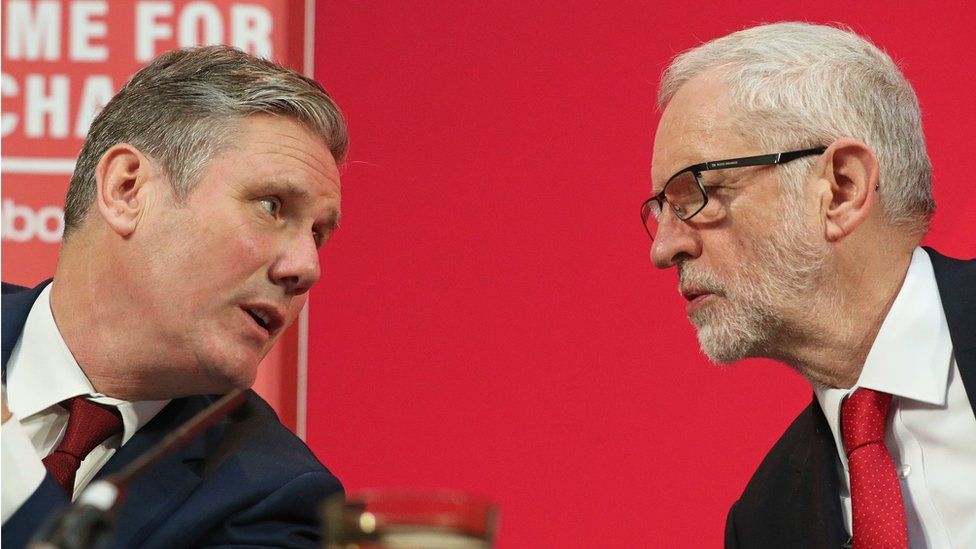
Sir Keir Starmer and Jeremy Corbyn used to sit beside each other on the front bench - but now seem miles apart

Mr Corbyn remains suspended from the Parliamentary Labour Party and sits as an independent MP, following comments he made over the party's handling of anti-Semitism.

Asked if he would re-admit Mr Corbyn, Sir Keir said: "The ball is in Jeremy's court".

He added: "Jeremy was asked to apologise, to take down the posts that caused the problem in the first place and to work with us."

Sir Keir - who will make his first keynote speech as leader to a hall full of activists on Wednesday - said Andy McDonald was "wrong" to say the party was more divided under his leadership.

But he added: "There will be some people who don't agree with those [changes and] I understand that."

Asked if he thought Labour's left wing was on its way out, he said: "We are a broad church in the Labour Party.

"But I am not going to be deflected from my central mission, which is to get a Labour government so we can change millions of lives."

'Values'


Sir Keir has moved away from some of the pledges he made during last year's leadership contest, such as on nationalisation.

He said he had "never made a commitment to nationalisation", instead proposing "common ownership" for services like rail and mail - two ideas he insisted were "worlds apart".

Asked if the left wing had a right to be angry with him, he said: "Those commitments I made, those pledges I made, are values that I hold dear.

"The world has changed since they were made but now the question is how do we apply them in the reflective circumstance that we find ourselves in going into a general election.

"I stand by the principles and the values that are behind the pledges I made to our members, but the most important pledge I made is that I would turn our party into a party that would be fit for government and capable of winning a general election and I am not going to be deflected from that."


Starmer: Winning power is more important than unity


Newsletter

Related Articles

0:00
0:00
Close
UK Prime Minister Keir Starmer Offers Condolences Following Death of Qatar’s Father Amir
UK Regional Innovation Policy Focuses on Research Clusters Across Scotland, Wales, and Northern England
UK Corporate Transparency Rules Set to Become More Strict Under Modern Slavery Reform Plans
UK Civil Service Estate Strategy Shifts Government Activity Away From London
UK Strengthens National Security Powers Through New Threat Designations
Greater Manchester Police Conduct Drink and Drug Driving Operations After Football Events
UK Government Advances Darlington Economic Campus With Construction Milestone
UK Authorities Increase Football-Related Security Operations After Tournament Fixtures
UK Invests Fifty-One Million Pounds in National Cryogenics Facility and Regional Innovation Hubs
UK Moves Toward Tougher Modern Slavery Reporting Rules With Corporate Penalties
UK Government Reports Forty-Three Million Pounds in Savings From Office Estate Reform
UK Government Expands Civil Service Regional Strategy With Manchester and Darlington Campus Projects
UK Designates Iran’s Islamic Revolutionary Guard Corps as National Security Threat
United Kingdom Financial Markets Monitor Business Response to Economic Policy Changes
Scottish Renewable Energy Expansion Highlights Need for Faster Grid Development
Wales and Regions Strengthen Focus on Economic Development Through Tourism and Investment
Retail Industry Warns High Street Businesses Remain Under Pressure
Police Chiefs Highlight Growing Challenges Managing Protests and Public Order
Agriculture Leaders Seek Clarity on Post-Brexit Farming Support and Environmental Rules
Transport Unions Warn of Further Industrial Action Over Pay and Working Conditions
Welsh Tourism Sector Reports Strong Growth Driven by Domestic and International Visitors
National Infrastructure Review Gains Support as Leaders Seek Faster Project Delivery
Financial Markets Assess Impact of United Kingdom Corporate Tax Policy Changes
Northern Ireland Assembly Debates Cross-Border Trade and Infrastructure Cooperation Plans
Government Opens Consultations on Housing Reform and Planning System Changes
Scottish Government Faces Pressure to Accelerate Offshore Wind and Grid Expansion
National Energy System Operator Warns Grid Investment Is Needed for Future Electricity Demand Growth
United Kingdom Research Council Invests in Artificial Intelligence and Biotechnology Innovation Hubs
United Kingdom Expands Oversight of Skilled Worker Visa Sponsors Amid Migration Debate
Cross-Party MPs Call for National Infrastructure Strategy Review to Accelerate Economic Growth
Prime Minister Announces One Billion Pound NHS Funding Package Ahead of Winter Pressures
Bank of England Signals Cautious Approach to Interest Rates as Inflation Remains Above Forecasts
World Cup Visitors Turn American Big-Box Stores Into Souvenir Stops
Netflix Weighs Always-On Channels, Bundles and Short-Form Video
Passenger Is Pulled Partly Outside Ryanair Jet After Window Fails Mid-Flight
Innovation-led growth strategy
Public service reform pressure
Defence and industrial security
Labour leadership transition and economic reset
Northern England Pushes for Greater Influence in Britain’s Future Economic Model
UK Technology Strategy Focuses on Life Sciences, Digital Innovation and Research Investment
Britain and United States Maintain Focus on Pharmaceuticals Cooperation and Industrial Growth
UK Public Services Face Continued Pressure as Government Promises Visible Improvements
Regional Economic Power Becomes Key Theme in Britain’s Next Political Phase
Britain Expands Support for Small Businesses as Firms Seek Better Access to Finance
UK Economy Remains Central Political Challenge as Cost of Living and Growth Concerns Persist
National Health Service Introduces New Workplace Reviews to Improve Conditions for Healthcare Staff
UK Life Sciences Sector Secures More Than Three Billion Pounds in Investment to Support Innovation
Britain Strengthens Defence Strategy as Security Concerns Reshape Military and Industrial Policy
Andy Burnham Promises Stronger UK Defence Industry and Expanded Domestic Production
×