London Daily

Focus on the big picture.
Saturday, Oct 31, 2026

Keir Starmer refuses to rule out coalition with Lib Dems

Keir Starmer refuses to rule out coalition with Lib Dems

Sir Keir Starmer has refused to rule out a coalition with the Lib Dems if Labour fails to win a majority at the next general election.

Asked if he would do a deal with the Lib Dems, the Labour leader told the BBC this was a "hypothetical question".

But he said he would never do a deal with the SNP because of a "fundamental disagreement" on Scottish independence.

Despite local election gains, experts say support for Labour may not yet be enough to win an overall majority.

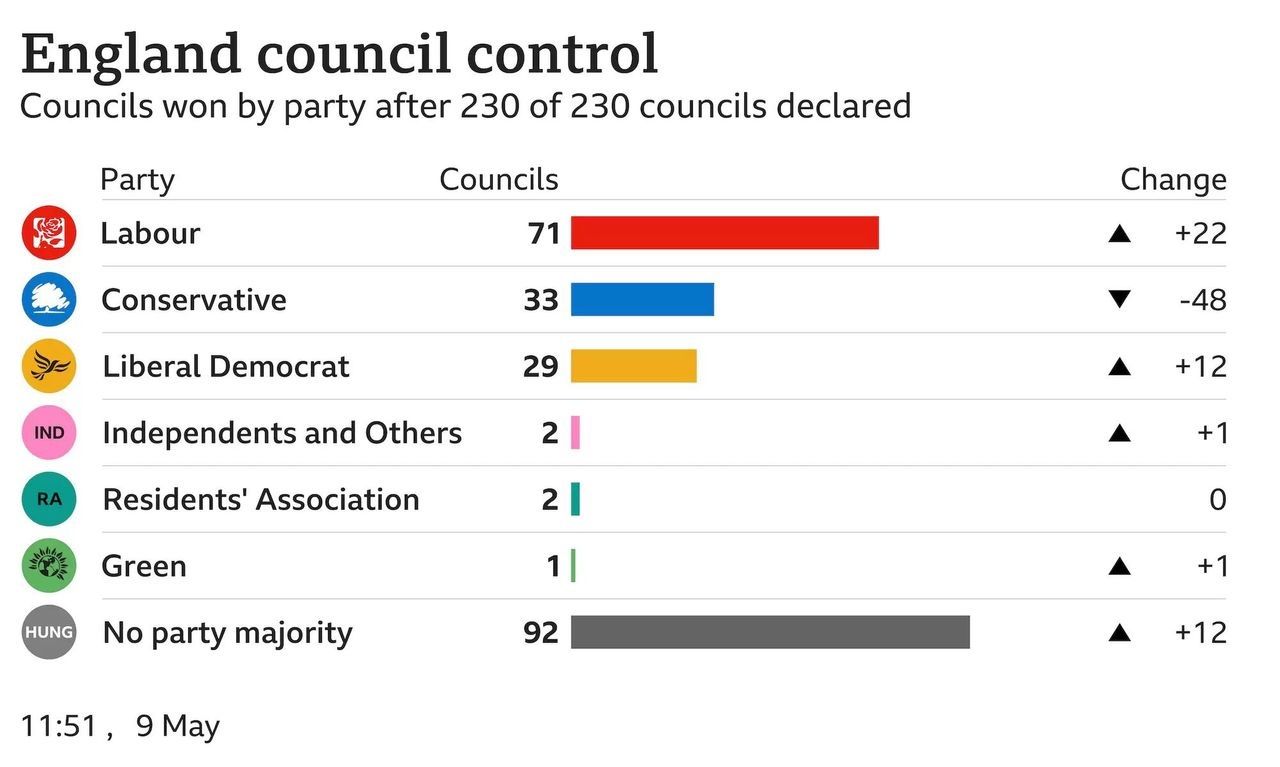
Last week the party gained 537 councillors and 22 councils in England, including key battlegrounds like Swindon, Plymouth, Medway and Stoke-on Trent.

Those are places where Labour is hoping for success at the next general election.

Following the results, Sir Keir said his party was on course for a majority.

The BBC's projected national share - which estimates what the outcome would have been if all of Britain had the chance to vote - put Labour at 35%, nine points ahead of the the Conservatives.

But many commentators have predicted this level of support may not translate into an overall majority at the next general election, which must happen before January 2025.

If no party wins a majority in the House of Commons, the result is a hung Parliament.

The party with the most seats is usually asked to form a government but in order to secure a majority it must get support from other parties - either through an informal deal or a formal coalition.

Asked if he would ever do a deal with the Liberal Democrats, Sir Keir told the BBC: "I want to press on for a Labour majority, that's what we're aiming for. This is a hypothetical question."

However, in response to the same question in relation to the Scottish National Party, he said: "No... because there's a fundamental disagreement.

"I will never do a deal with a party that thinks the separation of the United Kingdom is the way forward."

Put to him that this was also a hypothetical question, Sir Keir insisted "there is no basis for a deal at all with the SNP because of their politics of separation".

On Sunday, Lib Dem leader Sir Ed Davey - whose party gained 12 councils and more than 400 councillors on Thursday - ruled out going into a coalition with the Conservatives but refused to say the same for Labour.

He said it was a "hypothetical question" adding that he would not "take the voters for granted".

On Tuesday, he added that the party's strategy was to target Conservatives in so-called "blue wall" areas of southern England and there must be "no sitting back".

It all adds up to what looks like symmetrical flirting from Labour and the Liberal Democrats.

They each answer the question in exactly the same way, despite being able to be categoric about equally hypothetical situations of deals with the Conservatives and the SNP respectively.

In both local elections and at a general election, in most instances Labour and the Lib Dems are competitive against the Conservatives in different parts of the country.

Expect to see Tory MPs and ministers talk up what they see as the dangers of a hung parliament, with Labour reliant on other parties for support.

In 2010, the Lib Dems formed a coalition government with the Tories but the party paid the price at the next general election, losing 49 seats.

The Conservative-Lib Dem coalition lasted a full term and was arguably more stable than the Conservative-only governments that followed it.

Sir Keir said he was "confident" Labour's local election results put the party on course for a majority but he was not "complacent", saying "there's more work to do".

The Labour leader added that his party's campaign had focused on tackling the cost of living and it now needed to "deliver".

Leaders of the 22 councils won by Labour have been given the job of drawing up "emergency cost-of-living plans" within their first 100 days, as well as reviewing local housing and development policies.

Sir Keir was also asked if he agreed with comments made by Labour's then-Business Secretary Peter Mandelson at the height of the New Labour government under Tony Blair, that he was "intensely relaxed about people getting filthy rich as long as they pay their taxes".

"I'm very relaxed about people being rich and getting rich," Sir Keir said.

"I know what aspiration is. I came from a working class background and I was able to not only head up the Crown Prosecution Service but now lead the Labour Party."

He added: "But I want, obviously, everyone to pay their taxes and I want fairness and I want equality and I want every child to have that opportunity."

Meanwhile, Prime Minister Rishi Sunak has insisted his five priorities - including cutting inflation, bringing down NHS waiting lists and tackling small boat crossings - are the best way to put his party back on track after it lost 48 councils and more than 1,000 councillors.

Newsletter

Related Articles

0:00
0:00
Close
Department for Science, Innovation and Technology Prepares Enhanced Artificial Intelligence Safety and Cyber Defense Frameworks
United Kingdom Government Expands International Sanctions Framework Against Russian Shadow Fleet and Financial Enablers
Institute of Directors Reports Sharp Post-Budget Drop in Business Confidence Despite Long-Term Investment Intention Shifts
Chancellor John Healey Defends Sweeping Fiscal Adjustments and Household Support Packages Following Autumn Budget
Parliamentary Petitions Committee Schedules Major Legislative Debates on Special Educational Needs and Non-Stun Meat Labelling
Regional Devolution and Good Growth Fund Frameworks Reshape Local Government Funding Across English Regions
Loughborough University Economic Analysts Highlight Substantial Uncertainty Surrounding Public Sector Efficiency Savings
British Legal Sector Drives Sixty Billion Pounds in Annual Economic Output While Employing Over Half a Million Professionals
Law Society Welcomes New Better Regulation Executive While Pressing for Long-Term Legal Aid Funding Reform
Metropolitan Police and Security Services Heighten Operations Across London Ahead of Large-Scale Public Demonstrations
Bank of England Economists Scrutinize Corporate Tax Adjustments and Public Sector Borrowing Pressures
Chancellor John Healey Defends Autumn Budget Tax and Spending Allocations Following Intense Parliamentary Scrutiny
Department for Environment, Food and Rural Affairs Implements Strict Water Quality Monitoring Rules Following Severe Rainfall and Flooding
Welsh Government Unveils Comprehensive Regional Housing Strategy to Address Rural Affordability and Homelessness Pressures in Cardiff
Office for National Statistics Reports Slowing Consumer Price Inflation and Steady Retail Performance Across United Kingdom Markets
Northern Ireland First Minister Michelle O'Neill and Deputy First Minister Emma Little-Pengelly Advance Cross-Border Infrastructure Agreement in Belfast
Competition and Markets Authority Launches Formal Investigation Into Artificial Intelligence Partnerships Involving Major Technology Corporations
Scottish First Minister John Swinney Secures Cross-Party Support for Devolved Budget Framework and Renewable Energy Expansion
High Court Rules in Favor of Environmental Campaigners Over Department for Energy Security and Net Zero Licensing Procedures
National Health Service England Announces Major Digital Modernization and Artificial Intelligence Diagnostic Rollout Across Regional Trusts
Bank of England Monetary Policy Committee Signals Cautious Approach to Interest Rate Cuts Amid Persistent Wage Growth and Inflation Pressures
British Prime Minister Keir Starmer and Chancellor Rachel Reeves Outline Strategic Infrastructure Plans to Boost Regional Growth and Private Investment
Water pollution remains high despite £5bn investment
Regional Economic Divergence and Industrial Transformation
Technological Sovereignty and Regulatory Scrutiny
Fiscal Consolidation and Public Service Pressures
Automotive Industry Leadership Warns of Imminent Supply Chain Disruptions Following Recent European Trade Negotiations
High Court Delivers Landmark Ruling Affirming Strict Legal Protections for Corporate Data Privacy Against State Surveillance
Welsh First Minister Eluned Morgan Secures Additional Funding for Regional Transport Infrastructure and Rail Modernization
Scottish First Minister John Swinney Announces Major Green Energy Infrastructure Investment Package for Aberdeen
Department for Work and Pensions Proposes Sweeping Welfare Reforms to Incentivize Long-Term Unemployed Back into Work
Competition and Markets Authority Launches Formal Investigation into Artificial Intelligence Partnerships Involving Major Tech Giants
United Kingdom Foreign Secretary David Lammy Concludes High-Level Strategic Talks in Washington on Middle East Security
National Health Service England Unveils Emergency Winter Resilience Plan to Combat Projected Surge in Emergency Admissions
Bank of England Governor Andrew Bailey Signals Cautious Approach to Interest Rate Cuts Amid Persistent Inflation
British Chancellor Rachel Reeves Finalizes Corporate Tax Overhaul Ahead of Autumn Budget to Fund Public Services
Automotive Manufacturers Urge Government Action as High Energy Costs and Global Supply Chain Disruptions Threaten Production
Metropolitan Police Issue Formal Apology Following Inadvertent Release of Confidential Information During High-Profile Investigation
Scottish Finance Secretary Shona Robison Unveils Devolved Budget Highlighting Housing and Public Service Adjustments
Energy Regulator Office of Gas and Electricity Markets Prepares to Remove Household Gas Standing Charges Following Treasury Mandate
Treasury Confirms Reversal of Planned Cash Individual Savings Account Allowance Reduction Protecting Twenty Thousand Pound Limit
Office for Budget Responsibility Revisions Predict Moderate United Kingdom Economic Growth with Elevated Inflation Pressures
Chancellor John Healey Delivers First Autumn Budget in Parliament Highlighting Temporary Bank Surcharge and Cost-of-Living Support
Met Office Issues Extended Forecast Highlighting Stable High Pressure Weather Patterns Across the United Kingdom
Scottish Finance Secretary Shona Robison Outlines Changes to Tax Thresholds and Residential Property Levies in Edinburgh
Financial Markets and Government Bond Yields Remain Stable Following Muted Reaction to Autumn Budget Measures
Defence Committee Chair Tan Dhesi Criticizes Budget for Delaying Critical Defence Spending Decisions to Next Year
International Monetary Fund Forecasts United Kingdom Economic Growth at One Point Three Percent for Year
Office for Budget Responsibility Assesses Fiscal Headroom Reduced to Fifteen Billion Pounds Following Global Energy Shocks
Chancellor John Healey Delivers First Autumn Budget Introducing Household Energy Support and Bank Tax Hikes
×