

Johnson to press ahead with lifting Covid rules despite ‘worry’ over case numbers
Boris Johnson is set to lift Covid restrictions across England on Monday despite Downing Street last night conceding concerns over rapidly rising case numbers as more than 1,200 international scientists and health experts urged the government to scrap the “dangerous experiment” of “freedom day”.
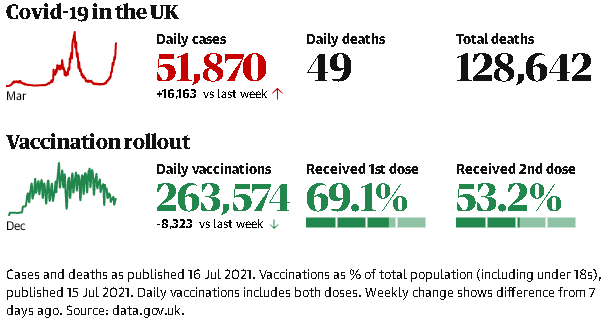
New daily infections in the UK broke the 50,000 threshold on Friday for the first time since mid-January and official figures showed one in 95 people in England are estimated to have the virus – more than quadruple the rate in the middle of June when the prime minister set 19 July for lifting most of the country’s last infection control measures.
A No 10 source said that “in terms of case numbers and projections” the picture was now “worrying”, with the UK over halfway to the 100,000 daily infections predicted by the health secretary, Sajid Javid, after curbs are lifted. Johnson had warned of 50,000 daily cases by 19 July but said the link with hospital admissions and deaths was all but broken.
Prof Chris Whitty, the chief medical officer, said on Thursday that restrictions may need to be reimposed in as little as five weeks, before the end of the summer holidays.
“I don’t think we should underestimate the fact that we could get into trouble again surprisingly fast,” Whitty told a Science Museum webinar. “We are not by any means out of the woods yet on this, we are in much better shape due to the vaccine programme, and drugs and a variety of other things. But this has got a long way to run in the UK, and it’s got even further to run globally.”
Asked whether restrictions could be reimposed, however, the No 10 source said: “We’re not in that place.”
The soaring infections, driven by the more transmissible Delta variant, forced managers at the South Tyneside and Sunderland NHS foundation trust to ask staff to postpone holidays due to “extreme pressure” after Covid patients there increased from two to 80 in a month. Infection rates in England are highest in South Tyneside, Newcastle upon Tyne, Blackburn with Darwen, Burnley and Manchester. A high “ping” rate by the NHS test-and-trace app is causing staff shortages, with bin collections from Liverpool to Bristol the latest service disrupted.
On Friday it emerged that ministers have shelved proposals to urgently overhaul the app, however, which currently detects if a person has been within 2 metres of someone with Covid for more than 15 minutes and tells them to isolate for 10 days.
No 10 did not deny reports that people had been pinged through walls but said this would not affect a “large number” of people. It was a “matter for individuals” if they wanted to close windows at home to stop getting told to isolate, a spokesperson said.
Manufacturers have also warned staff shortages “escalated significantly” this week with Stephen Phipson, chief executive of trade body Make UK, warning of “more and more companies being affected by isolation, with not just an impact on production but a hit to actual shipments of goods going overseas”.
In a further sign that Downing Street has abandoned the notion that its roadmap is “irreversible”, the prime minister’s spokesperson also declined to rule out reimposing some lockdown restrictions but said Johnson wanted to avoid it “given the huge economic, social and health costs there are as a result”.
Contingency plans which outline “reimposing economic and social restrictions at a local, regional or national level if evidence suggests they are necessary to suppress or manage a dangerous variant”, are available, the Downing Street source said, but these would only be used as a “last resort to prevent unsustainable pressure on the NHS”, which it is not currently facing.
But Lord Bethell, a health minister, signalled there would be no return to mandatory mask wearing, which will be dropped in most settings from Monday. He told the Lords: “Were we to mandate it, what is the option for the country? Are we going to issue tens of millions of fines to those who do not wear masks? If they do not wear them, will we lock them up in prison?”
Infection rates have risen so fast they are about to outrun the number of first vaccinations being administered in England. The number of first jabs delivered daily is close to plateauing at about 50,000 a day leaving one in eight adults – including more than 40% of 18- to 29-year-olds – still unvaccinated.
Johnson earlier this week moderated his previously buoyant tone over the unlocking as infections, hospitalisation and deaths from Covid rose, saying: “It is absolutely vital that we proceed now with caution.” But with just days to go until restrictions on indoor mass gatherings are scrapped, an alliance of 1,200 health experts endorsed a letter to the Lancet journal that demanded the government halts its plan altogether.
They warned the strategy “provides fertile ground for the emergence of vaccine-resistant variants”, putting the UK and the rest of the world at risk. At an emergency summit, government advisers in Israel, New Zealand and Italy were among those who sounded alarm bells about the policy.
Dr William Heseltine, a US virologist, said: “What I fear is that some of the worst impulses in many of our states will follow the UK example. It is leading to disaster in the numbers … Policies that release and open up a country in the midst of rising infections are counter productive in the most extreme.”
Michael Baker, a professor of public health at the University of Otago, who advises the New Zealand government on Covid, said it was “remarkable that [the UK] is not following even basic public health principles”.
Dame Sarah Gilbert, the Oxford University professor who was one of the leading scientists behind the Oxford/AstraZeneca jab, said the whole world needs to be vaccinated to avoid yet more variants emerging, telling an LBC podcast: “We will never get back to normality if we can’t get everybody vaccinated.”
The Covid-19 Bereaved Families for Justice Group described the government’s plan to press ahead with unlocking as “deeply unsettling”.
Jo Goodman, co-founder of the group that represents more than 4,000 families said: “The overwhelming scientific consensus is that lifting restrictions on Monday will be disastrous, and bereaved families know first-hand how tragic the consequences of unlocking too early can be.
“There is a real fear that once again the government’s thinking is being driven by what’s popular rather than the interests of the country.”