

Jacob Rees-Mogg, who decried ‘climate alarmism’, to take on UK energy brief
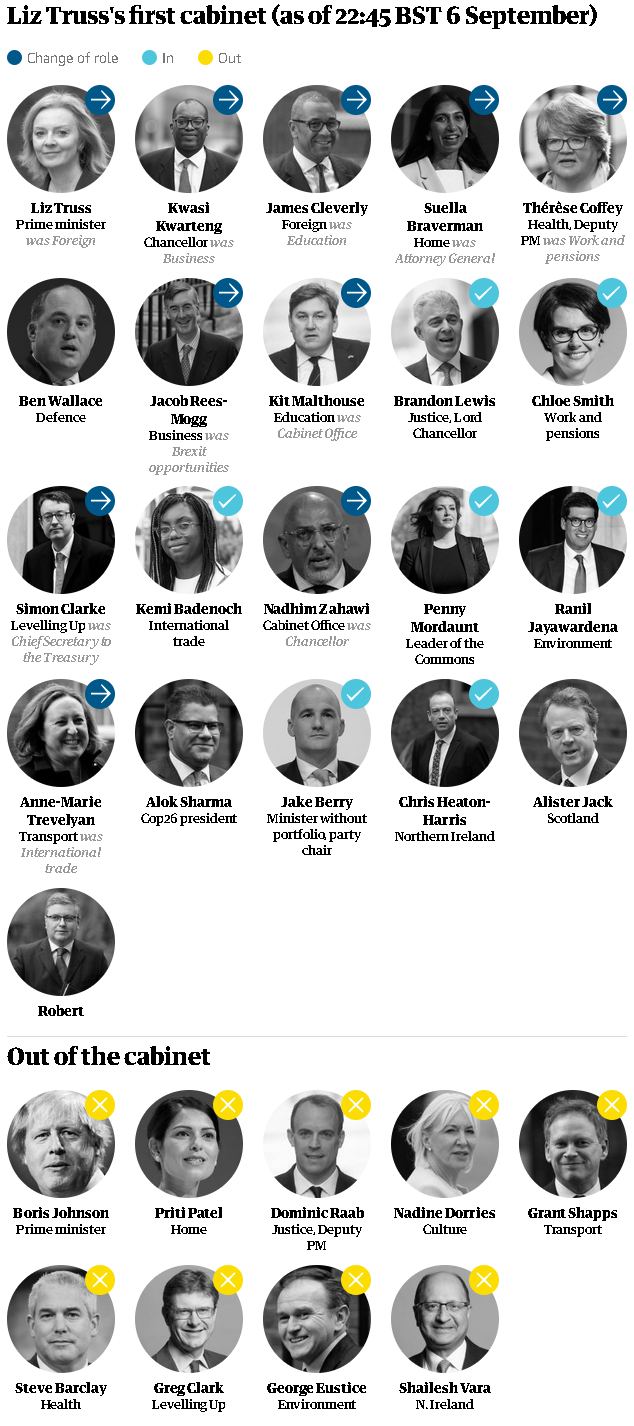
Jacob Rees-Mogg has taken on responsibility for energy after Liz Truss had struggled to find a dedicated minister to fill the role amid concerns over his scepticism.
Two Conservative MPs are understood to have turned down the role of climate change minister earlier in the day. However, late on Tuesday night No 10 announced that Graham Stuart would take the brief and be attending cabinet, prompting speculation that Downing Street had succumbed to concerns of green Tories about giving the role to Rees-Mogg as originally planned.
The Cop26 chair Alok Sharma has also been reappointed to the role.
Chris Skidmore, the former energy minister, was approached twice by the Truss team about reprising the role. However, he rebuffed them as, unlike last time, the job would not allow him to attend cabinet. It is understood he had no problem in working with Rees-Mogg but wanted to continue promoting net zero. He also has a fellowship at Harvard.
Green Tories admitted concerns that Rees-Mogg’s expanded brief signals that Truss, who has supported scrapping green levies and bringing back fracking, will not regard the climate breakdown as an emergency and therefore not treat it as a priority.
The Green party MP for Brighton Pavilion, Caroline Lucas, tweeted: “After three years with a reckless self-advancing PM, Liz Truss reportedly plans to lead us through biggest energy crisis in decades by making Jacob Rees-Mogg – known for snide notes to civil servants, horizontal slouching in Commons & devotion to fossil fuels – our energy secretary.”
Rees-Mogg has claimed that “climate alarmism” is responsible for high energy prices and that it is unrealistic for scientists to project future changes to the climate because meteorologists struggle to correctly predict the weather.
The new business secretary said in April that the government wanted “every last drop” of oil and gas to be extracted from the North Sea as he dismissed warnings that a renewed push for fossil fuels would ruin the UK’s chances of achieving net zero by 2050.
The cabinet minister also described the idea of reopening shale gas sites as “quite an interesting opportunity”, comparing the fracking threat to “a rock fall in a disused coalmine”.
Senior Tories admitted they were worried about Rees-Mogg’s appointment, with one former minister saying it was “not very encouraging” but that they hoped he would stick to Johnson’s commitment to reach net zero emissions by 2050.
One Tory MP suggested it was a “slim hope” that the new business secretary would recognise that tackling climate change was “an opportunity, not a cost”.
A former No 10 adviser said: “I always think it’s better with the devil you know with Tory MPs and we might just be about to find out. Unfortunately, the climate is now what’s at stake. Jacob would be so bad for the environment it breaks my heart.”
Allies of Rees Mogg dismissed the concerns of Tory MPs suggesting they were misplaced as the senior Tory had committed to the net zero target by 2050.
There were also indications that Truss’s new No 10 could play down tackling the climate crisis as a priority with Matthew Sinclair, her new chief economic adviser, having a history of arguing against taxation to pay for environmental policies.
Sinclair is the author of a book called Let Them Eat Carbon, which challenges whether policies to address climate change are worth the cost to living standards, and papers including The Case Against Further Green Taxes.
A former chief executive of the Taxpayers’ Alliance, a rightwing free market thinktank that does not disclose its funding, Sinclair has previously criticised the UK government for being “enthusiastic advocates for more ambitious targets and more draconian climate regulations”, while arguing in favour of more mitigation or adaptation.
Jacob Rees-Mogg on climate change
The Telegraph, Oct 23,2013:
Clearly expectations of a final disaster are part of man’s psychology and the doomsayers of the quasi religious green movement fit the bill. Perhaps one day the world will end, giving the last group to predict it the satisfaction of being right – but as many have been wrong so far it does not seem wise to make public policy on the back of these fears.
It is widely accepted that carbon dioxide emissions have risen but the effect on the climate remains much debated while the computer modelling that has been done to date has not proved especially accurate … common sense dictates that if the Meteorological Office cannot forecast the next season’s weather with any success it is ambitious to predict what will happen decades ahead.
Chat Politics, March 2014:
I would like my constituents to have cheap energy rather more than I would like them to have windmills.
I think we have to be realistic about what we can change, the timescale over which we can change it, and actually I think mankind is highly adaptable, and we need to look at more adaptability rather than changes in behaviour.
Centre for Policy Studies, April 2022:
Net zero is going to be a huge regulatory cost and that is an issue for the country to face and to face up to … If we were to have a ‘one in, one out’ or ‘one in, two out’ rule [where a piece of regulation is scrapped for every new one instituted], you would end up excluding net zero, as we previously excluded EU regulation, and then you’re tinkering at the edges because you’re ignoring the biggest piece of regulation.