

Is the government still hiding the truth about Britain’s ‘Dirty Duchess’, 60 years on?
The celebrated television writer Sarah Phelps, the woman behind recent popular Agatha Christie adaptations, has revealed that research for her latest Christmas drama has convinced her that a 60-year-old mystery at the heart of the British establishment has yet to be solved.
Phelps, the writer of A Very British Scandal, starring Claire Foy, told the Observer she suspects that successive governments have acted to keep the full salacious details of a sensational 1960s divorce case away from the public.
Her new three-part drama, beginning on Boxing Day on BBC One, tells the true story of a 1960s sex scandal that tarnished the gilded image of key members of the aristocracy. Phelps hopes her new screen version of the court battle between the 11th Duke of Argyll and his supposedly unstable, “Dirty Duchess” will do something to restore the reputation of his wife, played by Foy. But the writer also believes that crucial facts about the duchess’s adventurous sex life are still judged too sensitive to reveal.
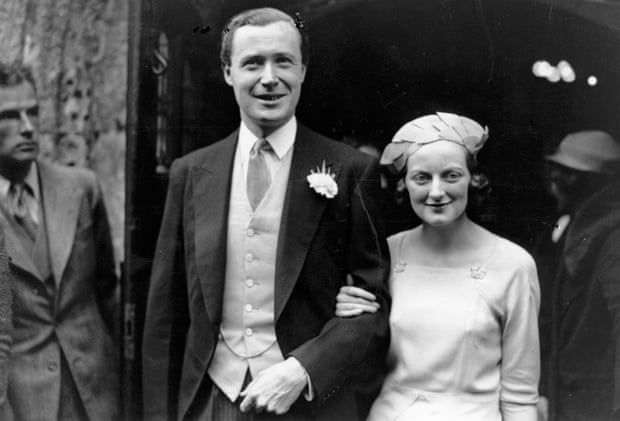 Tory minister Duncan Sandys – pictured on his wedding to Diana Churchill in 1935 – was a ‘headless man’ candidate.
“The sin that Margaret, Duchess of Argyll, really committed was to break the code of silence, the omertà that protected the top tier of the upper classes,” Phelps said. Instead, sordid myths about the duchess, myths that later went on to inspire Thomas Adès’s acclaimed opera Powder Her Face, have masked an episode of government lies and whitewashing, Phelps argues.
The Argyll couple’s bitter divorce case dominated the front pages and society columns in March 1963, and at its centre was the riddle posed by a shocking series of erotic photographs stolen from her desk by her husband. Commentators were especially intrigued by the hidden identity of a man who was only visible from the neck down in a nude polaroid photograph taken in the 1950s and put forward by the duke as evidence of his wife’s voracious sexual appetites and alleged 88 infidelities. The so-called “headless man” is pictured in a sexual act with the duchess and speculation raged as to whom he might be.
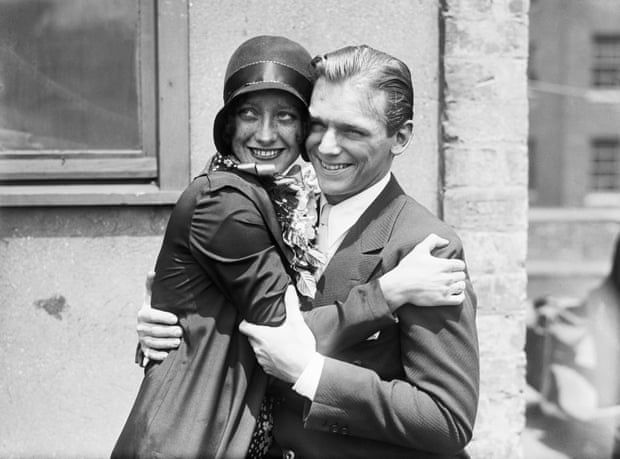 The Hollywood actor Douglas Fairbanks Jr was
another candidate for the ‘headless man’. He is pictured here getting
married to the actress Joan Crawford, in 1929.
The Hollywood actor Douglas Fairbanks Jr was
another candidate for the ‘headless man’. He is pictured here getting
married to the actress Joan Crawford, in 1929.
At one time, the film star Douglas Fairbanks Jr was a candidate, as were members of the royal family, the Pakistani prince, Aly Khan, Max Aitken, Lord Beaverbrook’s heir, various wealthy Americans and, maybe most damagingly, the then-secretary of state for the Commonwealth, Winston Churchill’s son-in-law, Duncan Sandys.
And the speculation did not stop, long after the duchess’s reputation lay in tatters and she had suffered heavy financial losses.
In 2000 a Channel 4 documentary claimed it had an answer. Just released government papers indicated the involvement of two well-known men, rather than just one: Fairbanks and Sandys. Further secret proof was said to lie in documents originally put together in the 1960s by Lord Denning, the judge who was Master of the Rolls from 1962 to 1982, and then marked for destruction, since the law lord had assured his illustrious interviewees that names would never become public. But the dossier was instead sealed for 30 years.
It was eventually shown in 1993 to the then-prime minister, John Major, but he in turn ruled the documents should not be released for another 70 years. They remain in the National Archive at Kew.
The Conservative government may have assumed this would end the matter. But other contemporary Westminster papers released under the same 30-year rule showed that Sandys had considered resigning from Harold Macmillan’s government over the gossip around the scandal.
On 20 June 1963, cabinet minutes record a discussion about setting up what soon became the Denning inquiry: “The Commonwealth secretary [Sandys] said he was himself the subject of some of the rumours to which the prime minister had referred.
“In one respect the allegations involved him in some difficulty. For the rest, he completely denied them.”
Sandys died in 1987, but Lord Denning, still alive at that time, then decided to speak out. He told the Independent newspaper he had incontrovertible evidence that Sandys was not implicated. He had, Denning said, later learned of physical characteristics that made it impossible for the pictured torso to belong to the late commonwealth secretary. However Fairbanks, the film star, stayed in the frame.
Since then, the name of William Lyons, a married Pan American airline executive, has been put forward as the duchess’s lover by Lady Colin Campbell, a relative by marriage. And Argyll was indeed known to have had an affectionate affair with a man she called Bill.
A recent biography of the duchess has also offered the name of a Texan millionaire, Joe Thomas.
But Phelps is unpersuaded. After her lengthy investigations into the vicious legal fight and the admittedly outrageous life of the duchess, she believes a series of names have been released to hide the truth.
“Why would John Major have extended the ban on the release of the trial documents for another 70 years?” she asked. “Was it really just someone like Bill Lyons in that picture? Would that be enough for the lengthy ban, just to protect a prominent businessman?”
Margaret, Duchess of Argyll, died aged 80 in a nursing home in Pimlico, London, just a few days before the Major government decided to keep all the testimonies given to Lord Denning under wraps, including her own.
So the last official word on her is the scathing verdict of the divorce trial judge, who described her as “a highly sexed woman who had ceased to be satisfied with normal relations and had started to indulge in disgusting sexual activities”.
Phelps sees it differently: “Margaret’s image was trashed deliberately in the case. In my view the aristocracy are no worse than the rest of us. But they have a lot more time for debauchery and a lot more at stake.”