

‘Insufficient and very defensive’: how Nick Clegg became the fall guy for Facebook’s failures
On Sunday, Nick Clegg did a succession of interviews with some of the US’s biggest TV news shows. In his role as Facebook’s vice-president for global affairs and communications, he was defending his company after weeks of headlines about its latest crisis – this time involving Frances Haugen, a Facebook staffer turned whistleblower who had testified days earlier before a committee of the US Senate. The story centred on a stash of company documents that Haugen had given to the Wall Street Journal. The central allegation, which Facebook vehemently denies, was that the company had ignored its own research into the harms caused by some of its products in favour of the pursuit of “astronomical profits”.
Anyone au fait with the five grim years Clegg spent as the UK’s deputy prime minister would have had the familiar impression of someone emphasising his good intentions in almost impossible circumstances. His facial expression regularly expressed a sort of righteous exasperation; his words seemed to imply that if only his critics could grasp the facts, everything would quickly die down. Like any well-briefed politician, he emphasised a handful of statistics: the 40,000 content moderators Facebook employs, the $13bn (£9.5bn) it says it has spent cracking down on misinformation and hate speech; the company’s claim that the latter accounts for only five of every 10,000 Facebook posts.
“With a third of the world’s population on our platforms, of course you’re going to see the good, the bad and the ugly of human nature,” Clegg told MSNBC’s Meet the Press. “Our job is to mitigate and reduce the bad and amplify the good.” He once said very similar things about his party’s approach to going into political partnership with George Osborne and David Cameron.
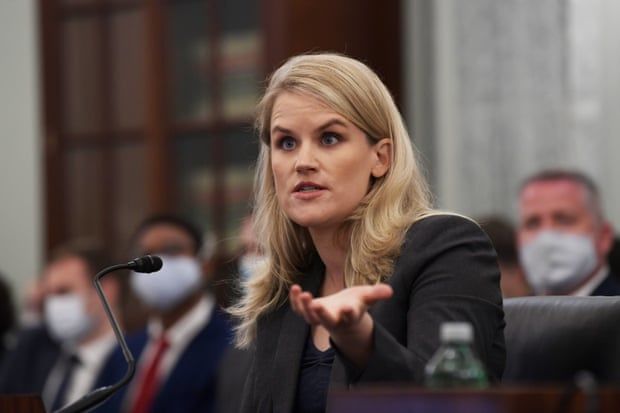 Frances Haugen testifies about Facebook before a US Senate committee on 5 October.
Of course, most people in the US know nothing of his history as a British politician: the brief burst of “Cleggmania” in 2010; his fate-sealing U-turn on university tuition fees; and what the time he spent in coalition with the Conservatives did to the Liberal Democrats. In the US, Clegg is simply a very high-ranking Facebook executive, given the job of facing an increasingly hostile media in the absence of two more important players: Facebook’s founder and chief executive, Mark Zuckerberg, and its longstanding chief operating officer, Sheryl Sandberg.
“When he appears on these Sunday shows, the question is: ‘Who is he trying to convince?” says the American journalist and writer Steven Levy, the author of the definitive book Facebook: The Inside Story. “Clearly, the people who are critics of Facebook aren’t going to be turned around by him saying: ‘Most of what we do is good.’ That argument doesn’t get traction. But people who work at Facebook need somebody going in to defend the company, because Mark and Sheryl have indicated, at least at this moment, that they do not have a taste for publicly defending the company they built.”
The to and fro between Facebook and its detractors looks like exactly the kind of polarised political battle the company is routinely accused of encouraging. Haugen says Facebook knew that Instagram, which it has owned and run since 2012, had a negative impact on the wellbeing of a large proportion of teenage girls, but carried on downplaying its effects. Instagram insists that her material is “focused on a limited set of findings and casts them in a negative light”, while Facebook maintains that correlation does not prove causation. In response to Haugen’s insistence that changes to Facebook’s News Feed algorithm in 2018 amplified divisive content and thereby contributed to political unrest, the company points to a blog Clegg wrote in March, including lines such as: “Facebook’s systems are not designed to reward provocative content. In fact, key parts of those systems are designed to do just the opposite.”
Levy says: “Someone is now presenting a case backed up with a lot of documents. Facebook can quite accurately say: ‘That’s just a selection of documents – they’re being cherrypicked.’ But the larger question is: ‘Is Facebook going to shift the core of its attitude?’ It probably could stem the bleeding if the right words came out of Mark or Sheryl’s mouth. But what I’m hearing from inside the company is they’ve had it with that. When Mark apologises, people just list all the other times he’s apologised. So, at least for now, he’s brazening it out.”
So far, Zuckerberg has only published a Facebook post – which, among other points, insists that the idea “that we prioritize profit over safety and well-being” is “just not true”. Levy says: “Someone’s got to speak for Facebook. And it’s Nick Clegg. So my bottom line is – and this is just supposition – that this job isn’t as much fun as he thought it was going to be.”
The story of how Clegg ended up at Facebook begins with Britain’s 2015 general election, when, after five years as deputy prime minister, he led the Liberal Democrats to a catastrophic defeat. It looked like an existential crisis for the party.
The Lib Dems lost 49 of their 57 seats in the House of Commons, leaving them with only eight MPs. Clegg was one of them, having held on to the constituency of Sheffield Hallam, a largely middle-class corner of the city that nudges the Peak District. The year after, Clegg – a one-time MEP who speaks English, French, Dutch, German and Spanish – reacted with horror to the result of the Brexit referendum. In 2017, he lost his seat to the Labour newcomer Jared O’Mara.
Meanwhile, in the very different environs of Menlo Park, in the Bay Area of northern California, the world’s biggest social media company had hit trouble. After the 2016 US election and the arrival in the White House of Donald Trump, the company was the focus of huge questions about misinformation, polarisation and online political meddling perpetrated by Russia. In the spring of 2018, Facebook was hit by a scandal surrounding the political consulting firm Cambridge Analytica, which had harvested millions of Facebook profiles of US voters. At around the same time, outrage exploded about the role apparently played by Facebook in the persecution of the Rohingya in Myanmar.
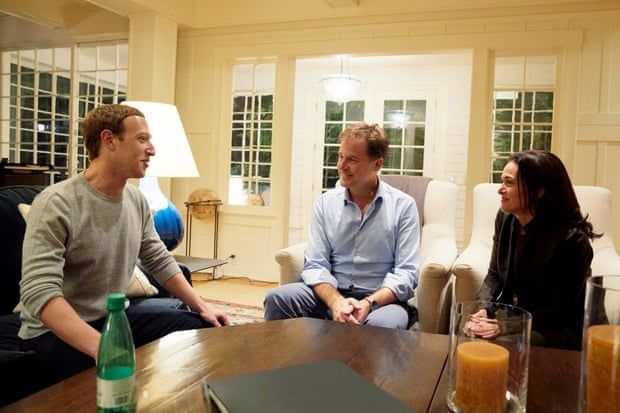 Clegg with Mark Zuckerberg, the founder of
Facebook, and Sheryl Sandberg, its chief operating officer, after
joining the company.
Clegg with Mark Zuckerberg, the founder of
Facebook, and Sheryl Sandberg, its chief operating officer, after
joining the company.
The EU was making increasingly loud noises about the power of so-called big tech – and its avoidance of taxes. When the then prime minister, Theresa May, visited the World Economic Forum in Davos in January 2018, she got most of the way to accusing the bosses of the big social media companies of standing by while their platforms were used “to facilitate child abuse, modern slavery or the spreading of terrorist and extremist content”. For Facebook, all this noise meant it had to change its approach to the policies that governed its content, as well as its public relations. It also had to prepare for an international wave of government regulation that was, sooner or later, going to break.
In the summer of 2018, Facebook’s then vice-president of communications and public policy, Elliot Schrage (“a bit of a Silicon Valley dinosaur,” according to one tech insider), announced that he was leaving the company. Sandberg and Zuckerberg quickly decided that his ideal replacement would be an experienced politician from Europe. They soon convinced a somewhat reluctant Clegg to fly to California for a conversation with Zuckerberg and his wife, Priscilla Chan. In Levy’s account, Clegg’s opening gambit was blunt: “Your fundamental problem is that people think you’re too powerful and you don’t care.”
One important human element in the story of Clegg’s recruitment is Richard Allan, AKA Lord Allan of Hallam, the former Liberal Democrat politician. Thanks to one of those coincidences that seem to tie together politics and business, he had held Clegg’s former Westminster seat until 2005, before joining Facebook in 2009 and becoming its director of European policy. He says he emphasised Clegg’s suitability for a senior role in conversations with Sandberg and Zuckerberg, and also encouraged his old friend (they have known each other since about 1997) to take the job.
Allan, who left Facebook in 2019 and spends part of his working life developing electric cars, says that being ejected from government left Clegg at a loose end. “He had a little thinktank going and he wrote a book. But I think he was always thinking: ‘I’d like to get my teeth into something.’ He was looking for a job where you make big and important decisions that affect a lot of people.”
Clegg’s appeal to Facebook, he says, centred on one fact: that he would come to Silicon Valley as an outsider. “It was really important to have somebody who could say: ‘That thing you’re doing may seem like a good thing, but when people in Europe hear about it, they’re going to think it’s terrible and slam you for it.’ Nick brings them that outsider’s voice. He’s not a tech utopian: ‘We just build this great stuff and the world’s going to be lovely.’ Nick comes from a much more typical position for European politicians: they’re rather sceptical about technology.”
Clegg is reportedly paid £2.7m a year and lives in a £7m house – complete with a pool, “outdoor fireplace” and hot tub – in the Atherton neighbourhood of San Francisco, often reckoned to have the highest property prices in the US. His wife, Miriam González Durántez, has talked about northern California as a paradise of second chances, saying: “People praise failure here in a way we don’t. It’s so healthy.”
Clegg was approached to be interviewed for this article, but Facebook’s PR team said participating in such coverage was not his policy. Instead, the company sent a set of bullet points for “background”, about why Clegg took the job and how he sees the role.
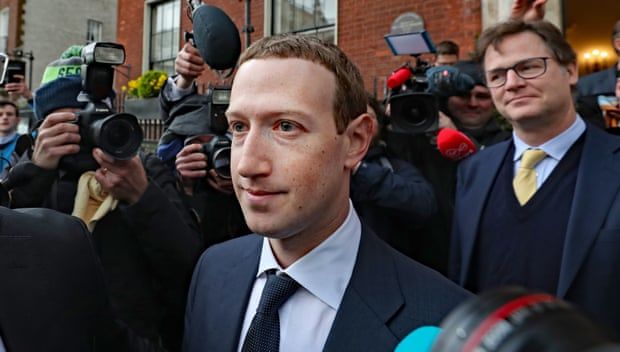 Clegg and Zuckerberg in Dublin in April 2019.
That email emphasised Clegg’s work in setting up the Facebook oversight board, a group of 20 high-powered people – including lawyers, academics and Alan Rusbridger, a former editor of the Guardian – that hears cases about the moderation of content referred to it by Facebook users and makes binding, precedent-setting decisions about them. (Interestingly, the board has just announced that it intends to hear testimony from Haugen.) The company’s spokesperson highlighted Clegg’s work at Facebook around the 2020 US elections, when he “steered [the] company-wide response and public comms on election integrity” and led the decision to pause the running of new political advertising in the week leading up to the election.
This brings us to another of Haugen’s allegations. She says that crucial safeguards that had been put in place to suppress political misinformation and the possibility of violence were quickly removed once voting had finished. “As soon as the election was over, they turned them back off, or they changed the settings back to what they were before, to prioritise growth over safety,” she told the CBS current affairs programme 60 Minutes. As she sees it, this change contributed to the riotous events in Washington DC on 6 January.
A little more than a week ago, Clegg appeared on the CNN programme Reliable Sources and denied – despite evidence to the contrary – that activity on Facebook had been at least partly responsible for what happened in and around the Capitol building. Any such suggestion, he said, was “ludicrous”. He went on: “The responsibility for the violence of January 6 lies squarely with the people who inflicted the violence and those who encouraged them, including President Trump.”
A few moments before, his interviewer had said something that has been endlessly quoted since: “A part of me feels like I’m interviewing the head of a tobacco company right now.”
‘I feel that, in the last two weeks, Nick Clegg’s standing has fallen, in terms of being a credible voice,” says Levy. “In a debating society, his arguments might have some traction, but given this situation where people are seeing this very compelling figure and calling her a hero, to say that this statistic or that statistic presents an alternative point of view to what she’s saying – it’s not compelling. People aren’t buying it.
“My impression of him is that he’s a super-smart guy and he must know that the mission he’s sent out on is not a desirable one – not one where he’s going to change people’s minds.”
Other voices are more sanguine. David Kirkpatrick, the author of The Facebook Effect, an acclaimed 2010 book about the company, says he would have liked to see “a more senior global leader” doing Clegg’s job; just before he was recruited, Kirkpatrick suggested Facebook might do its best to hire Barack Obama. But he says Clegg deserves at least qualified praise. “I feel he’s had a positive effect. I’m critical of him for not doing enough, and I think his interviews recently have been insufficient and very defensive, in a classic Facebook fashion. But he’s the best they’ve got, in terms of having good judgment about Facebook’s relationship to the world. If he weren’t there, my strong suspicion is that it would be even worse.”
It feels as if Clegg is in a similar position to the one he endured between 2010 and 2015 – facing derision and hostility, but doggedly assuring anyone who will listen that things are not nearly as bad as they think. The gargantuan salary and hot tub must help; so too the sense that, whatever he has to explain to the media, he has left Westminster behind and opened up a new chapter. “He’s in a tough position,” says Levy. “But he’s going to come out of this OK. I’m not worried about Nick Clegg. How long’s he been at Facebook now? Three years. His international profile and his profile within are up. Whatever happens, the Facebook experience will have been good for him.”