London Daily

Focus on the big picture.
Monday, Mar 09, 2026

'I regret atom bombs but they are why I'm alive'

'I regret atom bombs but they are why I'm alive'

Jack Ransom regrets that atoms bombs were dropped to end World War Two but says without them he would not have survived to be 100.

His uncle, whose name he shares, had died during World War One at the age of 19 and Jack says he could easily have not survived the brutal treatment at the hands of the Japanese if World War Two had not been brought to a final conclusion on 15 August 1945.

Jack was stood at the gates of Changi jail in Singapore when he discovered his ordeal was over.

He had been a prisoner of the Japanese for more than three years, during which time he had been forced to build the infamous Burma railway and carry out other punishing work on rations of just a bowl of rice a day.

When he was liberated he knew nothing of VE Day four months earlier, which marked the end of the war in Europe.

He was also unaware that Japan had finally surrendered after atom bombs were dropped on the cities of Hiroshima and Nagasaki.

All the 25 year-old artillery man knew was that the Japanese guards who took him every day to work on digging defence tunnels had failed to turn up.

"The first sign that I had was a paratrooper walking up the road towards the jail," he said. It was from him that Jack learned the war was finally over.

Dressed in rags


Jack weighed just six stones and describes himself as looking like a scarecrow, dressed in rags and no shoes.

Seventy-five years on, he says he was "bloody lucky" to survive his horrendous punishment as a prisoner of war.

The veteran, who is originally from Peckham in London but has lived in Largs for many years, had joined 118 Field Regiment Royal Artillery at the start of the war but did not leave Britain until November 1941.

He left from Liverpool for Halifax, Nova Scotia, where he transferred to an American troop ship and sailed to South America and across to South Africa.

America was not officially in the war when they set off but while the convoy was in Cape Town the Japanese bombed Pearl Harbour, bringing the US into the conflict.

Jack went to India before sailing to Singapore in January 1942.

"Our job was to use the guns to fire on the Japanese who at the time were across the straits in the Malaya peninsula.

"It was jungle on the other side so whether you hit anything or not you don't know."
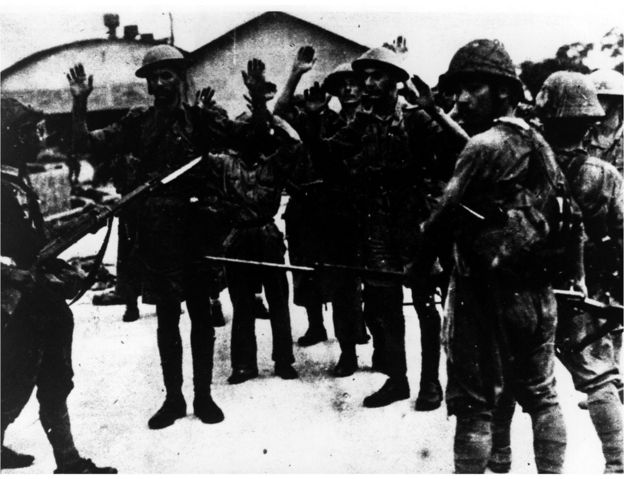


British soldiers were told to surrender in Singapore


On 15 February 1942, Jack was told to surrender because of the heavy punishment the main town on the island was taking.

The troops were ordered to destroy as much as they could before the Japanese arrived and took them prisoner.

Jack was taken to Changi prison camp in Singapore but at the beginning of 1943 he was sent to work on the Burma railway, often called the Death Railway.

About 12,000 Allied prisoners died during the construction of the railway that ran 250 miles between Thailand and Burma (now Myanmar), to supply troops and weapons in Japan's Burma campaign.

Jack says he was one of the final groups to be sent to the railway and thousands had already died from cholera and other diseases.

He was forced to march about 200 miles from the start of the railway to where they were to work building an embankment.

"We lost people along the way," he says. "They fell by the wayside and died. They just left them."

"It was a hard job," Jack says. "The embankments were 6ft or 8ft high. We had to scoop earth up and build them up. We had no machinery it was just four men and two shovels."
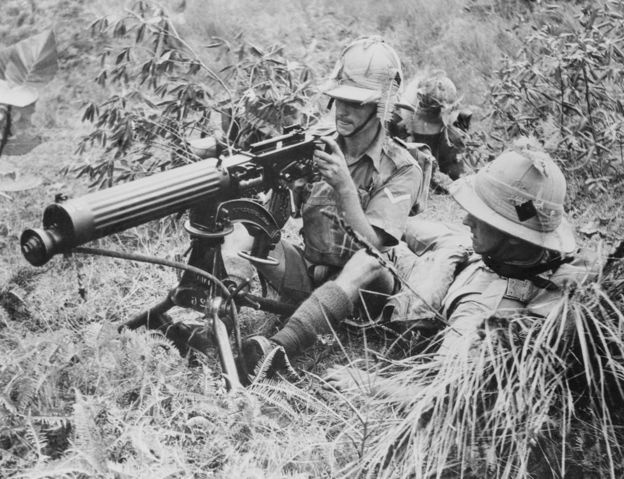


British Troops tried in vain to stop the Japanese at Singapore


The Japanese were brutal, he says, and the prisoners worked from dawn to dusk with hardly any rations.

"We lived on a mess tin of rice per day," he says. "That's all we got."

After the railway was finished at the end of 1943 he was taken back to Changi jail in Singapore where he did more hard labour digging defence tunnels or levelling land for the airport.

Then one morning in August 1945 it ended.

Jack says the gates to the jail were open but nobody knew what to do.

"After three years of being a prisoner of war you weren't going to stick your nose out of the door and get your head shot off," he says.

It was the paratrooper who confirmed the news that they had dropped the atom bombs and the war was over.

A month later he got his transport home. Jack says he started the journey on the Polish boat at six stone and arrived home 12 stone.

"They gave us bacon eggs and bread and butter," he says. "I dreamed of a slice of bread and butter."

The events of 75 years are still fresh in Jack's memory.

"I always think every day of my comrades, my pals, who didn't come home but I also think of the civilians in Japan who suffered the two terrible atom bombs. I have a sense of regret that happened.

"But you have got to be honest. I would not be alive if it wasn't for the atom bombs."

Newsletter

Related Articles

0:00
0:00
Close
Trump Declines UK Offer to Deploy Aircraft Carriers to Middle East Amid Iran Conflict
Prince Harry and Meghan Markle to Return to Australia After Seven Years for Philanthropic and Business Engagements
UK Government Signals Independence From Washington as Cooper Says Britain Does Not Agree With Trump on Every Issue
UK Experts Warn AI Chatbots Are Fueling Surge in Claims of Organised ‘Satanic’ Ritual Abuse
UK Political Parties Divided Over Strategy as Iran Conflict Reshapes Foreign Policy Debate
Britain Discloses Secret Military Repair Hubs Operating Inside Ukraine
Trump Says US No Longer Needs UK Carrier Support After Delayed Offer Amid Iran Conflict
Why Britain Has Become Involved in the US-Israel Military Campaign Against Iran
UK Gas Storage Falls to Under Two Days as Iran Conflict Jolts Global Energy Markets
UK Warned to Brace for Economic Shock as Iran War Drives Global Energy Price Surge
Starmer and Trump Hold First Call After Public Dispute Over Iran Conflict
UK Dentists Returned £1.3 Billion to Government as Shift Toward Private Care Accelerates
Expert Warns UK Must Build Emergency Food Stockpiles to Prepare for Climate Shocks or War
UK Plans Charter Flight to Evacuate British Nationals from Gulf as Regional Conflict Disrupts Air Travel
Families of Zimbabwe’s Liberation Fighters Call on Britain to Help Locate Skulls Taken During Colonial War
Iran’s Ambassador Warns Britain to ‘Be Very Careful’ Over Deeper Role in Expanding Middle East War
UK Military Leadership Defends Britain’s Defensive Role in Expanding Middle East Conflict
Four U.S. Strategic Bombers Arrive in Britain as Iran War Intensifies
Soham Murderer Ian Huntley Dies After Violent Attack in High-Security Prison
UK Lawmakers and Experts Condemn Scale of Overseas Human Remains Held in British Museums
Royal Navy Aircraft Carrier HMS Prince of Wales Placed on Standby for Potential Deployment
United Kingdom Confirms U.S. Military Using British Bases for Operations Targeting Iranian Missile Sites
Starmer Defends UK Role in Iran Conflict After Renewed Criticism from President Trump
Blue Owl Reveals £36 Million Exposure After Collapse of UK Lender Serving Wealthy Clients
UK Asylum Reform Plan Triggers Fierce Debate Over Border Control and Humanitarian Impact
US Stealth Bombers Head to UK Base as Trump Issues Stark Warning to Iran
UK Deputy Prime Minister Says Legal Case Could Exist for British Strikes on Iranian Missile Sites
Investigators Link Mysterious Parcel Fires Across Europe to Russian Intelligence Operation
Debate Intensifies Over Britain’s Legal Justification for US Military Operations Launched From UK Bases
Britain Faces Heightened Energy Price Risks as Iran-Linked Tensions Threaten Global Oil and Gas Supplies
British Counter-Terror Police Arrest Four Suspected of Spying on Jewish Community for Iran
Axel Springer Agrees $770 Million Deal to Acquire Britain’s Daily Telegraph
Iceland Supermarket Drops Trademark Challenge Against Icelandic Government in Long-Running Naming Dispute
UK Defence Secretary Visits Cyprus Following Scrutiny of Britain’s Response to Drone Attacks
Questions Grow Over Britain’s Military Readiness as Response to Iran Conflict Draws Scrutiny
UK Offers Failed Asylum Seeker Families Up to Forty Thousand Pounds to Leave Voluntarily
Saharan Dust Could Bring ‘Blood Rain’ to Parts of the UK as Weather Systems Shift
UK Deploys Additional Typhoon Fighter Jets to Qatar and Helicopters to Cyprus Amid Rising Middle East Tensions
Experts Urge Britain to Accelerate Renewable Energy Push as Global Conflicts Drive Up Costs
British Public Shows Strong Reluctance to Join Wider War in Iran
First UK Evacuation Flight Departs Middle East After Lengthy Delay
United Kingdom Imposes New Visa Requirements on Travelers from St. Lucia and Nicaragua
Iran Conflict Strains U.S.–U.K. Alliance as Trump and Starmer Clash Over Military Strategy
UK Interest Rates Could Rise Above Four Percent Again if Energy Shock Continues, Think Tank Warns
Starmer Defends Britain’s Iran Strategy as Badenoch Urges Stronger Military Support
Labour MP Says She Saw No Sign Husband Broke Law After Arrest in China Espionage Investigation
UK Jobless Rate Overtakes Italy’s for First Time in Years as Labour Market Weakens
United Kingdom Suspends Student Visas for Four Countries in Unprecedented Immigration Move
Campaigners Warn UK Student Visa Ban Could Push Migrants Toward Dangerous Channel Crossings
First U.K. Charter Flight for Stranded Nationals Set to Depart Oman Amid Middle East Crisis
×