

How life in Britain has changed between 1961 and today
Nearly seven per cent of homes did not have an indoor toilet in England and Wales and just 19 per cent of households owned bathrooms in the capital in 1961, an ONS census has unearthed.
Data from the 1961 Census Small Area Statistics has revealed how life in Britain has changed dramatically over the last 60 years - with figures showing in some rural regions, more than half of homes had a toilet separate from their property in 1961.
The statistics also reveal that divorce rates have risen dramatically over the years - with just 0.8 per cent of couples getting divorced in 1961 compared to the nine per cent now.
The census, which offers a glimpse of life from more than 60 years ago, reveals that owning a flushing indoor toilet at home was much less common in 1961, with nearly seven per sent of households in England and Wales using an outdoor toilet.
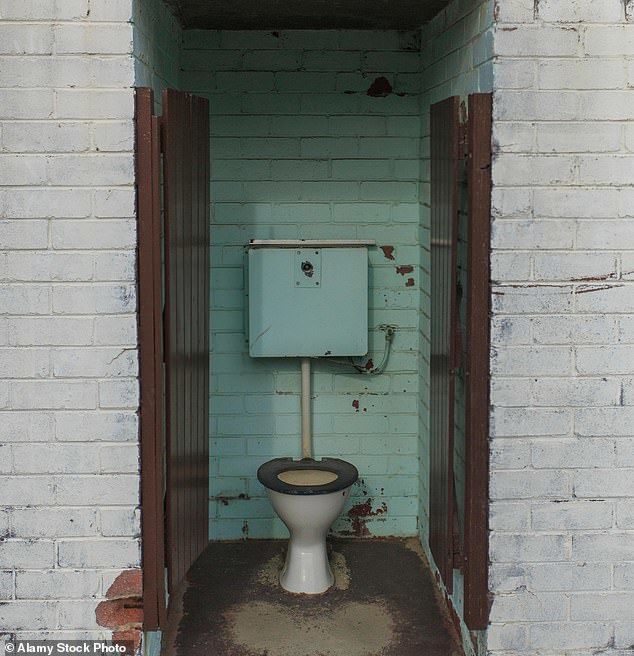 Data from the 1961 Census Small Area Statistics has revealed now nearly
seven per cent of homes did not have an indoor toilet in England and
Wales in 1961. Pictured: A typical outdoor toilet during the 1960s
Data from the 1961 Census Small Area Statistics has revealed now nearly
seven per cent of homes did not have an indoor toilet in England and
Wales in 1961. Pictured: A typical outdoor toilet during the 1960s
These toilets could in a separate building in the garden, or in some cases, could be a communal toilet for the households living along the same street.
However in some regions, more than half of households had a toilet separate from their property, with figures showing 59 per cent of homes were without an indoor toilet in Mitford and Launditch in Norfolk.
Elsewhere, in the rural district of Aethwy in Wales, 56 per cent of households did not have an indoor toilet and in Clun, south-west Shropshire, 52 per cent were left having to step outside their homes to use the toilet.
And in Teifiside in Wales, 39 per cent of homes were without an indoor toilet.
It was also revealed that some 19 per cent of households were without an indoor bath in the City of London, with many having to use shared or communal bath instead.
Meanwhile in Holyhead, the number of households without an indoor bath stood at 39 per cent and in Gwyrfai, Wales, a staggering 51 per cent did not have a bath inside their home in 1961.
In Longdendale, Greater Manchester, 50 per cent of of homes were without a bathroom while in Blackburn the figure stood at 40 per cent in 1961.
Meanwhile divorce rates have also seen a sharp rise since 1961, with 0.8 per cent of married couples getting divorced compared to the nine per cent now.
At the time of the 1961 Census, 68 per cent of people aged 16 years and over were married but the 2011 Census showed this had changed to 49 per cent of people aged 16 years and over married or in a same-sex civil partnership - reflecting a period of dramatic social change between the two periods.
The data also showed the proportion of people married was lower in 2011 in almost every local area of England and Wales than 50 years previously.
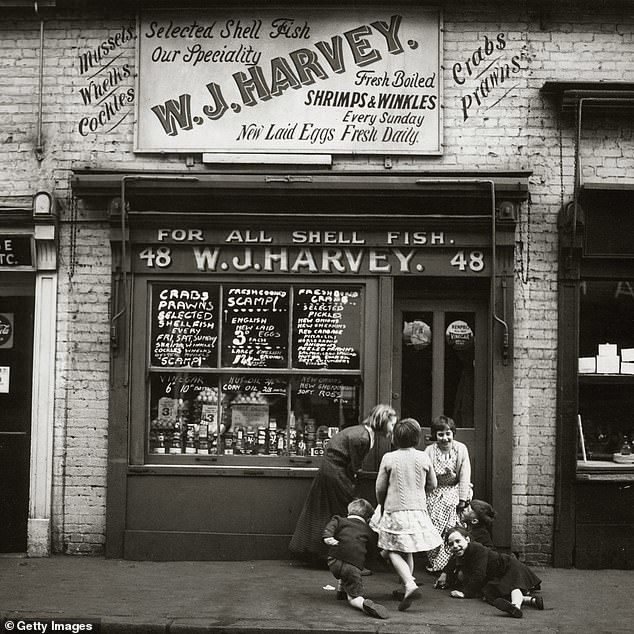 The ONS figures showed more than half of
households had a toilet separate from their property in some rural
regions. Pictured: Children outside a shellfish shop in London in 1961
The ONS figures showed more than half of
households had a toilet separate from their property in some rural
regions. Pictured: Children outside a shellfish shop in London in 1961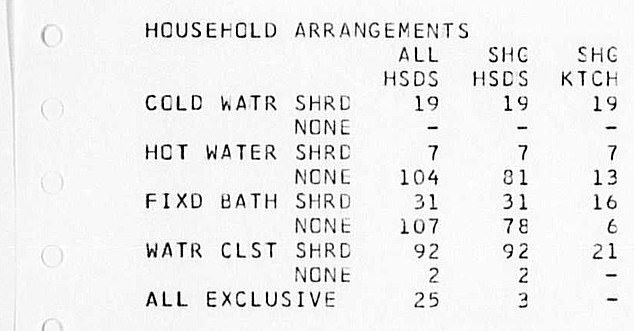 The census offers a glimpse of life from more
than 60 years ago and has revealed how the country has changed.
Pictured: Household amenities from a 1961 area microfilm printout
The census offers a glimpse of life from more
than 60 years ago and has revealed how the country has changed.
Pictured: Household amenities from a 1961 area microfilm printout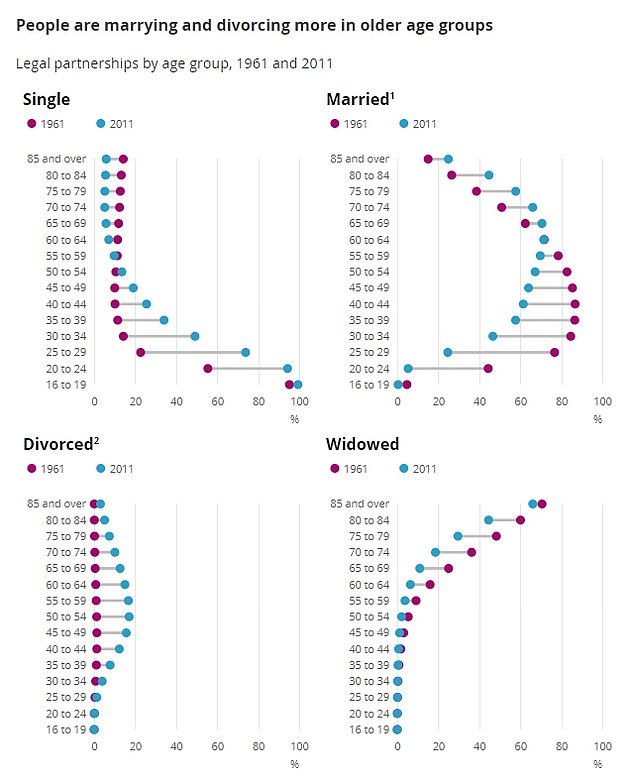 Divorce rates have also seen a sharp rise since
1961, with 0.8 per cent of married couples getting divorced compared to
the nine per cent now
Divorce rates have also seen a sharp rise since
1961, with 0.8 per cent of married couples getting divorced compared to
the nine per cent now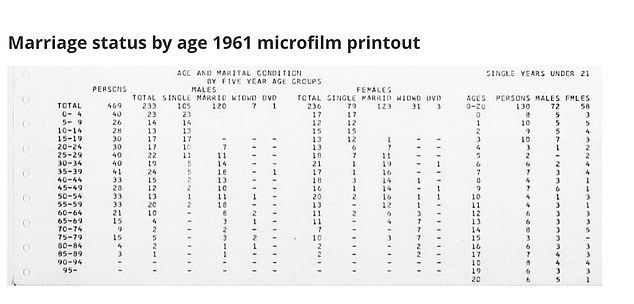 Figures from the 1961 Census show 68 per cent of
people aged 16 years and over were married but by 2011 this figures
dropped to 49 per cent. Pictured: Marriage status by age 1961 microfilm
printout
Figures from the 1961 Census show 68 per cent of
people aged 16 years and over were married but by 2011 this figures
dropped to 49 per cent. Pictured: Marriage status by age 1961 microfilm
printout
However in Clitheroe in Lancashire, the number of people entering marriage at each census rose by eight per cent and in Blackburn the number of couple getting married rose by four per cent.
The data also revealed that nine per cent of the populating were widows and widowers in 1961 compared to seven per cent in 2011.
The fascinating census has also shown how renting was more prevalent in 1961 that it is now, with only 42 per cent of Britons owning their own home 60 years ago.
Data showed that in 1961, 28 per cent of households were classed as private rented accommodation, and 24 per cent of properties were rented from a local authority.
But by the time of the 2011 Census, figures showed home ownership had risen to 64 per cent, and only 9 per cent of homes were rented from a local authority and 15 per cent of homes were classed as private rented accommodation.
However the lowest home ownership was still in certain regions in London, with figures showing that in 2011 just over 40 per cent of people owned their own home.
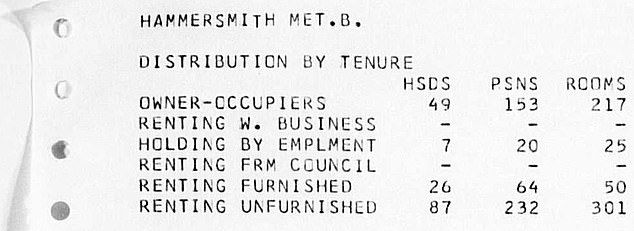 The census also showed how renting was more
prevalent in 1961 that it is now, with only 42 per cent of households
owning their own home 60 years ago. Pictured: Housing tenure in a 1961
microfilm printout
The census also showed how renting was more
prevalent in 1961 that it is now, with only 42 per cent of households
owning their own home 60 years ago. Pictured: Housing tenure in a 1961
microfilm printout
Figures also showed that between 1961 and 2011, the proportion of people aged 75 years and over increased due to increased life expectancy and declining birth rates.
In Hunstanton, the proportion of older people increased from six per cent to 23 per cent and the coastal areas of Norfolk and Suffolk also recorded a rise in the number of people over the age of 75.
However in the borough of Hove, the proportion of over-75-year-olds dropped from 11 per cent to seven per cent between 1961 and 2011, and in Hastings county borough it went down from 10 per cent to 8 per cent.
The census also noted an increase in the number of household in the number of rooms available per person to live in, with areas such as Kirkby noting a 38 per cent increase in households with up to 1 person per room.

