

Hero or hoax? The man who broke into Auschwitz – or maybe didn’t
It started with an extraordinary tale of wartime bravery and led to the publication of a bestselling account, The Man Who Broke Into Auschwitz, and to a BBC documentary. Then the difficult questions began. Were the heroic exploits of Denis Avey really all they seemed? Was his dramatic claim he had swapped places with a man inside a concentration camp possibly a fake?
In spite of growing doubts, Avey’s story that he saved the life of a Jewish prisoner by placing himself in danger while he was being held in a prisoner-of-war sub-camp near Auschwitz is still in popular currency.
But now a dogged historical researcher, working to document the history of the German POW camps and concentration camps in Poland, is demanding the return of the price he paid for his copy of Avey’s 2011 autobiography and suggesting that other readers do the same. The story laid out by Avey is full of holes, according to the British-Israeli researcher Alon Shapira, and therefore damaging to the integrity of Holocaust history.
This weekend the Observer has learned that Hodder & Stoughton, publisher of The Man Who Broke Into Auschwitz, plans to include qualifying notes in any future edition of the influential book, which remains in print. The move would follow a decision recently taken by the Holocaust Education Trust to dissociate itself from the flawed historical narrative it contains of Avey’s incarceration as a POW in Poland. This is despite the fact the organisation originally put forward Avey’s name for the honour of being named a British Hero of the Holocaust.
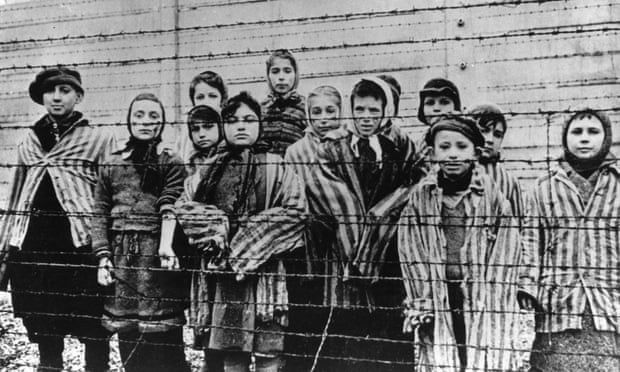 Children who survived Auschwitz after the liberation in 1945.
In a statement to the Observer this weekend, the trust said: “Upholding the truth and integrity of the Holocaust is vital, and when new information comes to light it must be taken seriously.”
The Imperial War Museum, which first interviewed the late Avey about his wartime experiences, has also distanced itself from the story of this Englishman, who was certainly held nearby as a POW, and who then claimed to have briefly switched identities with a Jewish camp inmate in order to help him and to verify the horrors committed inside. The museum’s file containing Avey’s testimony has now been flagged with a public warning.
“This story needs to be corrected as soon as possible by the publishers so that the real facts can be passed on to the next generation,” said Shapira.
James Long, a British author who knew Avey before his death seven years ago and who helped research the original book, is now also keen for the next edition to contain a full acknowledgment of the questions and doubts since raised about Avey’s memories. “I would like to provide more of the background information and include some of the questions that have been raised since,” he said.
But Shapira’s discoveries of a series of discrepancies in Avey’s story have now mounted up into a big potential problem for Hodder & Stoughton.
While wartime memories are likely to become confused for any survivor, the accumulation of conflicting detail and changes to Avey’s recollections are now impossible to ignore. First, a similar account of a prisoner swap with a camp internee was originally printed in a book called The Password Is Courage, about the mysterious and not always trustworthy wartime character, Charles Coward. This narrative also uses the phrase “the man who broke into Auschwitz”. Avey’s defenders, among them Long, argue that Coward may actually have appropriated the story of Avey’s brave mission, rather than the other way around.
Second, Avey initially told the Imperial War Museum that he had swapped with a Birkenau prisoner called Ernst. He later changed the location of the camp to a factory worker site and the identity of the Jewish camp survivor to a man called Hans, who has never been traced. It is possible, the publisher’s researchers have argued, that Avey innocently mixed up the location of the work camps next to his POW camp with the infamous death camp Auschwitz-Birkenau, which was several miles away.
Among other conflicting assertions to have come to light, Avey also failed to mention that his father, who lived until 1960, was with him in his POW camp. In the book, Avey specifically said he had no knowledge of his father’s wartime experiences, as the two had never discussed them. “I don’t think he ever knew that I had been in a camp near Auschwitz,” Avey wrote.
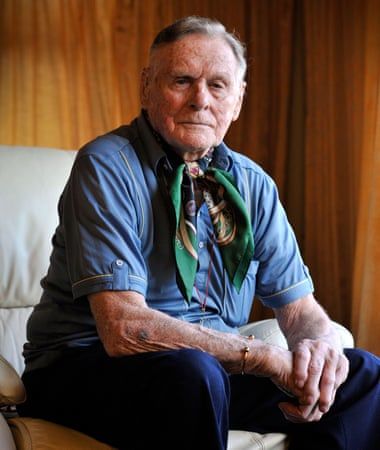 Denis Avey, aged 91, in 2009, six years before his death.
Now Shapira has produced a German POW record for Avey’s father, seen by the Observer, that shows he spent time in the same prison as his son, a facility known as E715. Those protective of Avey’s reputation point out they believe there were between 800 and 1,000 prisoners in E715 and that it might still have been possible for father and son to have been in different buildings. Shapira’s argument that a battered photograph of POWs that appears to show father and son together is not conclusive, they argue.
The publisher’s new plan to consider adding amendments and contextual notes of queries and doubts to Avey’s account, which was written with journalist Rob Broomby, comes after an official response from Hodder & Stoughton last week that said it stood by Avey’s original account.
“We have no reason to question the veracity of Denis Avey’s book, The Man Who Broke Into Auschwitz,” it reads. Referring to previous attempts to question the facts in the autobiography, the response continues: “Avey and his father were not in the same prison camp, E715, as the book makes completely clear,” and it concludes, “Denis Avey’s book is not in any way based on or derived from the Charles Coward book.”