

Global experts urge Boris Johnson to delay ‘dangerous’ Covid reopening
Lifting the remaining Covid restrictions in England this month is “dangerous and premature”, according to international scientists and doctors, who have called on the UK government to pause reopening until more people are vaccinated.
Writing in the Lancet, more than 100 global experts warn that removing restrictions on 19 July will cause millions of infections and risk creating a generation with chronic health problems and disability from long Covid, the impact of which may be felt for decades.
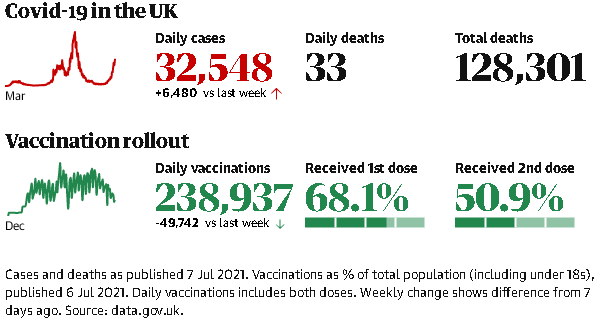
Government scientists expect cases of Covid to soar in the summer months even without the further easing of restrictions that is scheduled for 19 July. On Wednesday, the UK reported more than 30,000 new cases for the first time since January, and rises of more than 40% in hospital admissions and deaths.
Whitehall sources have said further delay or U-turn is not on the cards, but expect to come under increasing pressure in the coming days to change course. “I think we’d only be looking at further delay if there was an emergence of a particularly nasty new variant,” one said. Another source said it was unlikely” that the plan could be knocked off course, whatever the numbers.
With the number of cases estimated to be doubling every nine days, infections are set to surpass the winter peak of 68,000 a day within a fortnight and may reach six figures before the end of the month.
The surge is forcing hospitals to again cancel operations, including cancer surgery, because they are treating growing numbers of patients with Covid and losing staff who are having to isolate.
Leeds teaching hospitals NHS trust has had to call off some planned non-urgent operations this week to help it cope with an influx of patients seriously ill with Covid. Other hospitals and ambulance services are coming under serious pressure too in what NHS staff believe is an unfolding third wave of Covid, which they fear will only grow worse over the next few weeks.
Speaking to the liaison committee of senior MPs, Boris Johnson said modelling from the government’s Spi-M-O advisory group suggested infections were not on course to exceed their predictions. The prime minister said: “We have data about hospitalisations and deaths, we have had predictions about where they might go.
“At the moment we are tracking in about the middle of the projections that Spi-M made for the third wave if we went ahead with all the openings, we are in the middle to the low end of the projections they made, if you look at the graphs.”
According to the Lancet letter, the surge in infections will disrupt education, provide “fertile ground for the emergence of vaccine-resistant variants”, and have a significant impact on the health service and exhausted staff who have yet to recover from previous waves.
As deprived communities are more exposed and more at risk from Covid, they will bear the brunt of the next wave, exacerbating inequalities that have been evident throughout the pandemic, the letter adds.
Scientists and doctors from more than a dozen countries signed the letter, which states: “We believe the government is embarking on a dangerous and unethical experiment and we call on it to pause plans to abandon mitigations on 19 July 2021.
“Instead, the government should delay complete reopening until everyone, including adolescents, have been offered vaccination and uptake is high, and until mitigation measures, especially adequate ventilation … are in place in schools.”
Signatories of the letter include Dr Chaand Nagpaul, chair of the council of the British Medical Association, Prof Eric Topol, director of the Scripps Research Translational Institute in California, and Sir David King, the former government chief scientific adviser who set up the Independent Sage committee.
Martin McKee, professor of European public health at the London School of Hygiene and Tropical Medicine, and another signatory to the letter, said: “For months the government has justified its actions as ‘led by the science’ and focused on ‘data, not dates’. Yet here we are struggling to find any scientific justification for what is proposed and a policy that seems to be ignoring the data showing rapidly rising cases.”
There was a blunt message from the World Health Organization on Monday for countries to lift their restrictions slowly so as “not to lose the gains that [they] have made”.
The comments from the UN global health body’s head of emergencies, Mike Ryan, were not aimed directly at Johnson’s plans. However, they will be interpreted as grist to the mill of those health experts who have been arguing that England is moving too broadly and too fast amid a rapidly growing surge in infections. Ryan said the idea of letting people get infected with Covid-19 earlier rather than later was “epidemiological stupidity”.
Further evidence for a surge in the epidemic in England was released on Thursday by scientists at Imperial College London. The latest round of swabs tested by the React study reveal a quadrupling of new infections between the periods of 20 May to 7 June and 25 June to 5 July. The biggest rise was in London, where cases were eight times higher than the previous two-week period the scientists studied. According to the interim report, cases are doubling every four to 12 days.
The React study found increases in infection among all age groups up to 75 years old and for the first time revealed a striking difference between the sexes, with women 30% less likely to test positive in the two weeks from 24 June. The sudden disparity reflects differences in social contacts and may be driven by the Euro 2020 football championship. “Because of the timing, it could be that watching football is resulting in men having more social activity than normal,” said Professor Steven Riley on the React study.
Further analysis by the researchers found that vaccinated people were about 70% less likely to test positive than those who had yet to receive their shots.
Dr Chaand Nagpaul said that while the link between hospital admissions and deaths had been weakened by vaccines, it had not been completely broken.
“There are twice as many people with Covid-19 in hospital beds and on ventilators than this time last month. The government has also airbrushed the impact of long Covid on one in 10 people getting infected and with 2 million having been unwell for more than three months. It would be irresponsible to inflict further suffering on millions more,” he said.
“We know that masks are effective in stopping the spread, so it is nonsensical and dangerous for the government to abandon compulsory mask-wearing in indoor public settings, such as public transport, on July 19. It is vital that we continue with these targeted measures to prevent the spread of this deadly virus until we have enough of the population fully vaccinated with both doses.”
Labour’s Jonathan Ashworth, the shadow health secretary, said the policy appeared to be based on the government’s complacency about allowing young people to catch the virus.
“Sajid Javid’s policy of allowing infections to rise as high as 100,000 a day has baked into it an expectation that younger people will catch the virus and develop natural antibodies, which they hope means by the winter, when immunity is waning for the vaccinated population, the surge will be less severe,” he said.
“But given that’s the government approach, they ought to spell out what they think that translates to in terms of hospitalisations, deaths, and cases of long Covid.”

