London Daily

Focus on the big picture.
Saturday, Jun 20, 2026

GCSE and A-level changes give pupils advance warning of exam content

GCSE and A-level changes give pupils advance warning of exam content

Teenagers in England will be given advance warning of some exam content next year because of disruption caused by Covid, the government says.

New plans also say GCSE and A-level students should sit three sets of mock exams to help decide grades, if exams are cancelled.

Teacher-assessed grades have been used for the past two years.

The headteachers' union said schools would be relieved - but that it placed "a great deal of pressure" on pupils.

Labour criticised the government for a "delay" in confirming a Covid backup plan.

Under plans confirmed by the Department for Education (DfE), AS and A-level students will be given some indication of the content exams will focus on, to help with revision.

There will be more changes to GCSEs - with formulae provided in maths exams, and equations in physics and combined science assessments.

In English literature, history and geography, schools will be advised to focus on a narrower range of content.

Advance warnings about content for both sets of exams will be issued by early February.

The DfE has also issued a back-up plan in the "unlikely" event that exams are cancelled.

It advises that, for subjects which are usually assessed with exams, schools assess pupils three times: in the second half of the autumn term, in the spring term and in the first half of the summer term.

It says these should be held "under exam-like conditions wherever possible" - meaning they should be timed, and without access to books and revision notes.

Julie McCulloch from the Association of School and College Leaders said having a contingency plan would mean a lot of extra work.

She said it would "probably" mean that students take both mock exams - which "may or may not count" towards their ' final grades - and formal exams.

"This is far from ideal and places them under a great deal of pressure," she said.

"But not having a contingency plan would risk a repeat of the chaos of the past two years, and therefore, on balance, this seems like the right course of action, and the confirmed set of measures appears to be sensible enough."

Two years of replacement grades, after exams were cancelled in the pandemic, have had significantly higher results for GCSEs and A-levels.
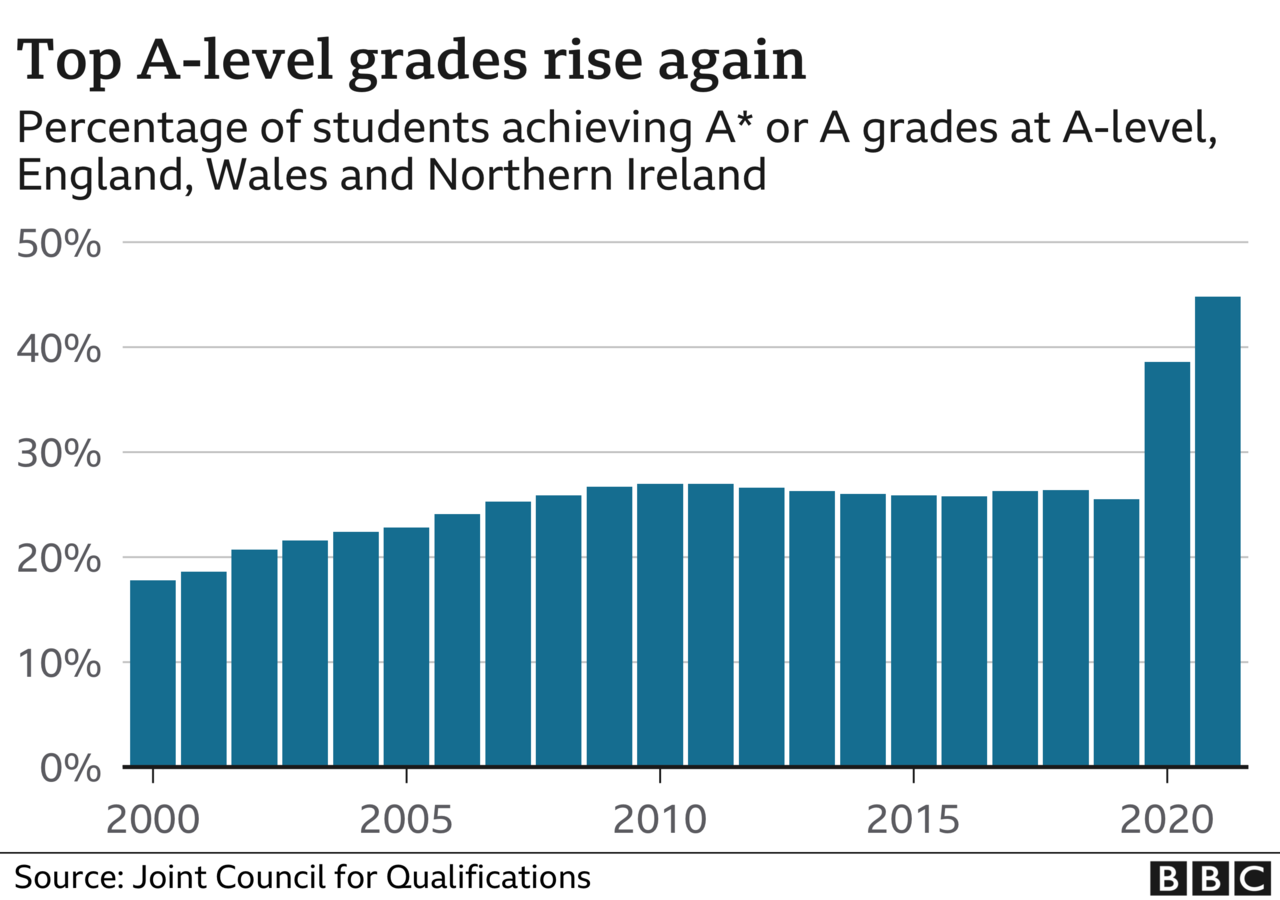

The cancellations mean that next summer more than 700,000 teenagers in England will sit high-stakes real exams for the first time in their lives.

The regulator Ofqual said overall grades would be moderated to be halfway between 2019 and 2021.

Jo Saxton, its chief regulator, said in a letter to students "exam boards will set the grade boundaries so that more students get higher grades in 2022 than before the pandemic".

She said this would provide a "safety net" for students who may otherwise "just miss out" on a higher grade.

"We have taken this decision to reflect the disruption that you as a cohort have experienced already in your course," she wrote.

Kate Green MP, Labour's shadow education secretary, said that students and teachers had already "had weeks of unnecessary uncertainty waiting for confirmation of assessment and contingency plans for 2022".

She said Labour had published a "plan B" for exams at the beginning of the academic year, adding: "The government's dither and delay has left teachers with less time and capacity to gather the samples of work needed."

Ministers have made clear they expect exams to go ahead in 2022, unless there are exceptional circumstances.

"The government believes that exams and other formal assessments are the best and fairest means of assessment, and the government's firm intention is that students will take national exams in summer 2022, set and marked by the exam boards," the DfE said.

Newsletter

Related Articles

0:00
0:00
Close
Long-Term Economic and Political Effects of Brexit Continue to Shape UK Policymaking
Digital Disinformation Emerges as a Growing National Security Challenge in the United Kingdom
Britain's Dependence on Global Energy Routes Drives Push for More Resilient Supply Chains
Rising Energy Costs Continue to Threaten Britain's Cost-of-Living Recovery
Concerns Grow Over Far-Right Organizing and AI-Driven Online Radicalization in Britain
UK-Led Global Partnerships Conference Calls for Reform of International Development Finance
Middle East Tensions Continue to Weigh on UK Business Confidence
Reports of Middle East Peace Deal Ease Pressure on UK Energy Prices
UK Warns Middle East Conflict Could Worsen Global Food Insecurity
UK Economy Loses Momentum After Strong Start to 2026
Bank of England Holds Interest Rates at 3.75% Despite Easing Inflation
Brexit's Legacy Remains Deeply Divisive Ten Years After the UK Voted to Leave the European Union
International Anti-War Conference Opens in London as Debate Over European Rearmament Intensifies
UK Health Authorities Introduce Drug Price Concessions Amid Record NHS Medicine Shortages
Sir David Attenborough Supports Sherwood Forest Conservation Efforts After Loss of Major Oak
Aardman Animations Marks 50 Years With Major Exhibition in Bristol
Drax Cleared After Investigation Into Wood Pellet Sourcing Practices
Jaguar Land Rover Shifts Toward Hybrid Vehicle Production for US Export Strategy
UK Police Arrest Liberal Democrat MP Cameron Thomas on Suspicion of Assault
Health Concerns Grow Over Elevated Kidney Cancer Rates Near Lancashire PFAS Factory
Royal Navy F-35 Jets Conduct First NATO Air Warfare Exercise from Finnish Airspace
UK NHS Issues Price Concessions for Medicines Amid Severe Drug Shortages
Heathrow Third Runway Project Faces Sharp Downward Revision in Expected Economic Benefits
Amber Heat Warning Issued Across Parts of England and Wales as Temperatures Rise
Train Collision Near Bedford Disrupts UK Rail Network and Leaves Multiple Injured
Bank of England Data Suggests Brexit Has Reduced UK Economic Output by Around Six Percent
UK Borrowing Costs Hold Near 4.8 Percent as Political Uncertainty Fuels Market Pressure
Andy Burnham Emerges as Front-Runner to Succeed Keir Starmer After Landslide Makerfield Victory
Prime Minister Keir Starmer Faces Mounting Pressure to Resign After Labour By-Election Defeat in Makerfield
Payment Fraud Losses Reach £1.28 Billion and Raise National Security Concerns
Lending to Small Businesses Climbs to Highest Level Since Late 2024
Middle East Conflict Clouds UK Economic Recovery Despite Strong First-Quarter Growth
Bank of England Moves to Simplify Capital Rules for Smaller Lenders
UK Government Fast-Tracks National Security and Cyber Resilience Legislation
Ofcom Investigates Telegram Over Alleged Role in Organising Arson Attacks
MPs Press Fujitsu to Speed Compensation for Post Office Horizon Victims
Bank of England Delays Final Basel III Implementation Changes to Support UK Banking Competitiveness
Pound Falls as Political Uncertainty and Bank of England Signals Weigh on Markets
0Andy Burnham Wins Makerfield By-Election and Emerges as Main Challenger to Keir Starmer
Dorset Council Tests AI Tools to Streamline Local Planning Applications
UK Researchers at Kew Gardens Use AI to Speed Up Identification of Threatened Plant Species
UK Gilt Yields Ease Toward 4.8% as Inflation and Labour Market Data Weigh on Bonds
Bank of England Data Shows Resilient SME Lending Despite Economic Slowdown
UK Finance Reports Weakening Services Activity as Business Confidence Softens
UK Introduces Mandatory Internal Complaints Process Under Data Use and Access Act
Bank of England Governor Andrew Bailey Flags Geopolitical Uncertainty as Key Risk to Inflation Outlook
Bank of England Holds Interest Rates at 3.75% as Policymakers Signal Cautious Stance on Inflation Risks
Cornwall Clergy Raise £40,000 for Church Repairs Through Everest-Themed Charity Challenge
UK Business and Social Landscape Reflects Strain From Geopolitical and Domestic Pressures
Tensions Grow in UK Over Sikh Kirpan and Religious Symbolism in Public Debate
×