

Fully vaccinated UK arrivals from France will not need to quarantine
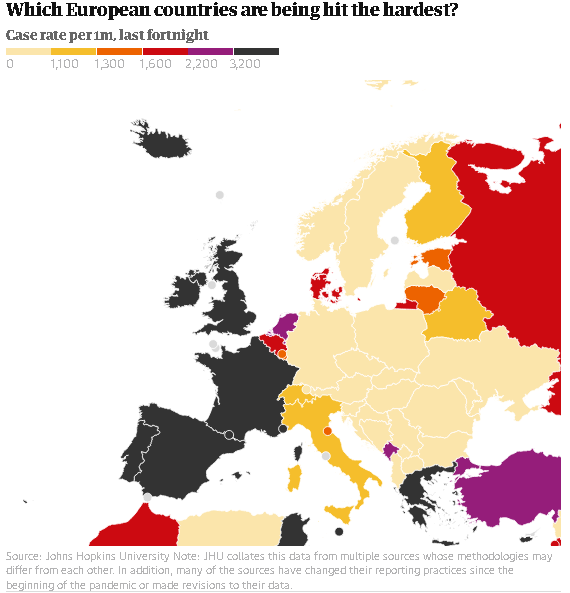
Millions of Britons have been given the green light to travel to Europe’s holiday hotspots, avoiding quarantine on return from France and Spain where concerns have been raised about Covid variants.
Ministers announced on Wednesday that fully vaccinated holidaymakers returning from France would no longer need to quarantine and ditched plans for a “watchlist” of amber countries such as Spain.
The move is likely to partially revive the struggling tourism sector but will raise questions about whether the government is being complacent about the spread of the Beta variant.
The decision to abandon plans for a watchlist under pressure from mutinous cabinet ministers will also put UK tourists at risk of having their plans aborted without any notice, raising the spectre of a repeat of last summer’s chaotic travel corridors.
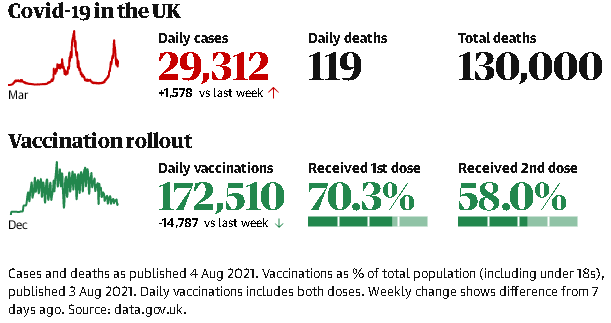
Under-18s and those fully jabbed in the UK are now exempt from quarantine, as well as those who have been vaccinated in the EU and US.
Boris Johnson signed off the deal under pressure from his chancellor, Rishi Sunak, who had declared the UK was lagging behind vaccinated nations.
The move will also end a tense diplomatic situation over the additional quarantine measures for France, to which senior politicians in Paris had vociferously objected.
However, in a final note of caution, the government has warned there are still concerns about Spain, the most popular summer destination for British tourists, and said it would keep the country under close watch.
Concerns had grown that the UK would not have hotel capacity for hundreds of thousands of people returning from Spain if it was forced on to the red list, which requires quarantine in a supervised facility. Even during last year’s disrupted travel season, at least 3.2 million Brits travelled to Spain.
Arrivals from Spain, including all its islands, will now be advised to use a PCR test as their pre-departure test wherever possible, a move that could be a prelude to tighter restrictions.
Government sources said British tourists should travel to Spain and that the latest advice suggested the risk was not high enough to merit a move to the red list. Another review would take place in three weeks. “The message is that it is fine to go,” one Whitehall source said.
The Department for Health and Social Care (DHSC) said tourists heading back from Spain were being requested to take a PCR test because of the risk of importing the B.1.621 and Beta variants. It said using PCR tests would allow the results to be genomically sequenced, so variants of concern could be detected. Preliminary studies have suggested vaccines may be less effective against the variant, though they should still prevent the most severe illness.
The transport secretary, Grant Shapps, said the new rules were reopening a significant number of new travel destinations. “While we must continue to be cautious, today’s changes reopen a range of different holiday destinations across the globe, which is good news for both the sector and travelling public,” he said.
The government also announced a hefty increase in the cost of hotel quarantine to £2,285 for a single adult arriving from a red list country, a rise of more than £500, which the government said would cover increased costs.
A number of key destinations as well as international travel hubs will be removed from the red list – India, Bahrain, Qatar and the UAE. India’s placement on the red list was the subject of substantial controversy after MPs accused Boris Johnson of delaying its inclusion in the spring as cases rapidly rose and the new Delta variant emerged.
Mexico, Georgia, Réunion and Mayotte are to be added to the red list. More countries will also be added to the green list where travellers can go regardless of vaccine status. New green list countries are Austria, Germany, Slovenia, Slovakia, Latvia, Romania and Norway. All changes come into effect at 4am on Sunday 8 August in England.
The health secretary, Sajid Javid, said there was still a need for caution by adding countries to the red list “to help protect the success of our vaccine rollout from the threat of new variants.”.
Georgia and Mexico have been added to the red list due to increasing case rates in the country and positive cases of those travelling to the UK, as well as concern in Mexico about the presence of the B.1.621 variant first identified in Colombia. In Réunion and Mayotte there is concern about the high prevalence of the Beta variant.
British travellers returning from those countries will face the hefty 30% increase in their hotel quarantine. Prices for children up to 12 remain the same.
Cabinet sources said the amber watchlist plans were killed off by the Treasury, including a leaked letter from Sunak demanding that Johnson open the UK back up to international travel.
Some Whitehall sources have suggested travellers will be worse off without a public watchlist because they will get no warning of the country they are in, or due to travel to, being put on the red list.
The shadow transport secretary, Jim McMahon, said families’ plans would still have been disrupted because of “flip-flopping over France” and said he feared the government had abandoned all caution.
“While everyone wants to see international travel open up, it has to be done safely,” he said. “Ministers must explain to passengers and the industry how they’ve reached these changes with clear information on the direction of travel of infections in each country.
“Ministers need to get a grip and set out a proper strategy, provide full data, and progress work with global partners on international vaccine passports so travellers and the industry can have clarity instead of reckless U-turns and confusion.”
Mark Tanzer, the chief executive of the ABTA travel association, welcomed the changes but called for a greater sense of urgency from the government to get people travelling again.
“The UK is falling behind our European competitors and the opening up of international travel from the UK is progressing at a snail’s pace – making it extremely difficult for travel agents and tour operators to generate enough income to kickstart a recovery, which is desperately needed to protect jobs, businesses and livelihoods.”
Paul Hunter, a professor of medicine at the University of East Anglia, welcomed the moves, saying: “Travel restrictions have never had much success in stopping international spread of an infectious disease. There is evidence that they can delay spread but only really when combined with strict restrictions within the destination country.
“We do not have any restrictions remaining so benefits to us of keeping border controls are marginal. That may change if a rapidly spreading new variant starts to out-compete Delta but so far no evidence for one. I am not so worried about Beta as it seems to struggle whenever Delta is dominant.”