London Daily

Focus on the big picture.
Monday, Jul 13, 2026

Former Senator Bill Nelson is officially NASA's new administrator. His goals: support climate research and put astronauts on the moon.

Former Senator Bill Nelson is officially NASA's new administrator. His goals: support climate research and put astronauts on the moon.

Presidential administration transitions can give NASA whiplash, but Bill Nelson wants the US space program to have "constancy of purpose."

NASA has a new leader, but he does not plan to shake things up.

Instead, Bill Nelson is keeping his eyes on the same prizes as his predecessor, Jim Bridenstine: sending astronauts to the moon and Mars.

Nelson, a three-term US Senator from Florida who flew into orbit aboard the Space Shuttle Columbia in 1986, was sworn in as the new NASA Administrator on Monday.

His plan is mainly to keep the ball rolling. During confirmation hearings, Nelson told Congress that he wants to see NASA achieve its most ambitious goal — sending astronauts to the lunar surface and, eventually, to Mars. He also advocated a renewed focus on climate-change research, which has historically been a big part of NASA's directive but was deprioritized under the Trump administration.
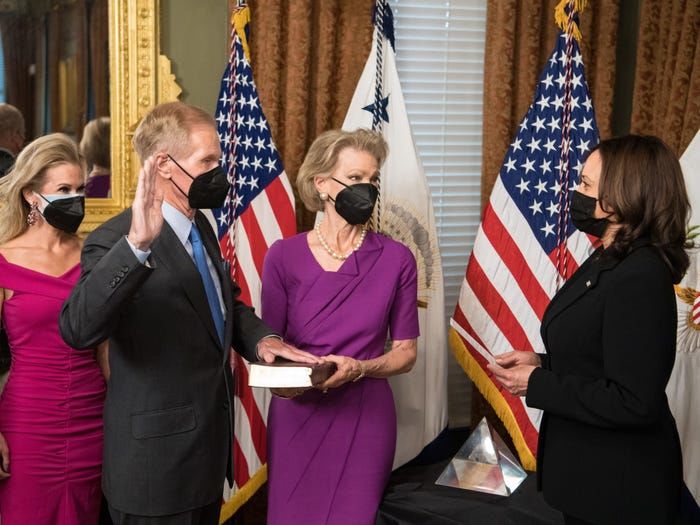
Former Senator Bill Nelson is sworn in as NASA Administrator, as his wife, Grace Nelson, holds their family Bible, and his daughter, Nan Ellen Nelson watches, May 3, 2021.


"The space program needs constancy of purpose," Nelson said in a written testimony to the Senate Committee on Commerce, Science, and Transportation. For continuity, he added, he plans to work with Bridenstine and "seek his advice."

That consistency may give NASA a break from the whiplash it often gets with new administrations. President George W. Bush first asked NASA to pursue a return to the moon in 2005. Five years later, President Barack Obama shifted the focus to Mars. The Trump administration shifted back to the moon, with a tight deadline: to return astronauts to the lunar surface by 2024. That's four years earlier than NASA was previously planning.

"If you ask me what is my vision for the future of NASA, it is to continue for us to explore the heavens with humans and with machines," Nelson told the Senate committee, of which he was previously a member, during a confirmation hearing on April 21. "There is a lot of excitement."

Sending astronauts back to the moon and on to Mars
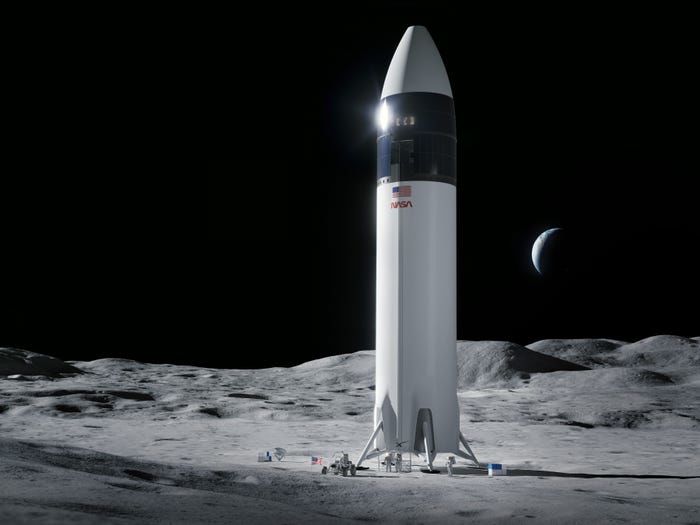
An illustration of SpaceX's Starship as a lander carrying NASA astronauts to the moon.


NASA still hopes to land astronauts on the moon by 2024 — a feat nobody has accomplished since 1972. Nelson is on board, even though the timeline may be too ambitious. NASA's Office of the Inspector General recently determined a 2024 landing is "highly unlikely."

"I think you may be pleased that we're gonna see that timetable try to be adhered to, but recognize that, with some sobering reality, that space is hard," Nelson told the Senate committee.

NASA's plan is to launch an astronaut crew inside an Orion spaceship, using the mega-rocket the agency is currently developing, called the Space Launch System. Once in lunar orbit, Orion would rendezvous with a lander. Two of the astronauts would move into that vehicle then land on the moon's surface.

NASA recently awarded the contract for that lander to SpaceX. Elon Musk's rocket company intends to convert its planned Starship mega-spaceship into a lunar lander. But NASA was expected to pick two contractors instead of one, so the decision prompted SpaceX's competitors — Dynetics and Blue Origin — to file complaints. While things are being sorted out, NASA asked SpaceX to pause work on the project.

NASA cited a lack of funding from Congress when it decided to award one single contract, and promised there would be a follow-on competition. Nelson stood by that statement, vowing that there will be competitions for contracts to send the first astronauts to Mars.

"Competition is always better than sole sourcing, because you can get the efficiencies and you get a lower price," he told the Senate committee.

NASA aims to launch its first Mars-bound astronaut mission in the 2030s.

'You can't mitigate climate change unless you can measure it'

Clouds over the Amazon rainforest, as seen from space, January 30, 2015.


During his hearing, Nelson defended a White House request to budget $2.3 billion for NASA's Earth-science programs. That would constitute a roughly 15% increase from the agency's 2020 Earth-science budget.

"It's a very important increase. You can't mitigate climate change unless you can measure it, and that's NASA's expertise," Nelson said. "Understanding our planet gives us the means to better protect it."

Nelson vocally opposed the Trump administration's decision to cancel NASA's Carbon Monitoring System — a $10-million-per-year program that gathers data on how carbon moves around the planet. Congress subsequently reinstated the program.

"When I flew on the space shuttle, any time that was not scheduled with experiments or flight activities – which was not often – I would make my way to the spacecraft window to look at our home, our planet," Nelson wrote in his testimony. "I was struck by how fragile it looked with its thin atmosphere. Combating climate change cannot succeed without robust observations, data, and research."

Newsletter

Related Articles

0:00
0:00
Close
World Cup Visitors Turn American Big-Box Stores Into Souvenir Stops
Netflix Weighs Always-On Channels, Bundles and Short-Form Video
Passenger Is Pulled Partly Outside Ryanair Jet After Window Fails Mid-Flight
Innovation-led growth strategy
Public service reform pressure
Defence and industrial security
Labour leadership transition and economic reset
Northern England Pushes for Greater Influence in Britain’s Future Economic Model
UK Technology Strategy Focuses on Life Sciences, Digital Innovation and Research Investment
Britain and United States Maintain Focus on Pharmaceuticals Cooperation and Industrial Growth
UK Public Services Face Continued Pressure as Government Promises Visible Improvements
Regional Economic Power Becomes Key Theme in Britain’s Next Political Phase
Britain Expands Support for Small Businesses as Firms Seek Better Access to Finance
UK Economy Remains Central Political Challenge as Cost of Living and Growth Concerns Persist
National Health Service Introduces New Workplace Reviews to Improve Conditions for Healthcare Staff
UK Life Sciences Sector Secures More Than Three Billion Pounds in Investment to Support Innovation
Britain Strengthens Defence Strategy as Security Concerns Reshape Military and Industrial Policy
Andy Burnham Promises Stronger UK Defence Industry and Expanded Domestic Production
UK Government Faces Difficult Spending Choices as Labour Leadership Transition Approaches
Rachel Reeves Warns Andy Burnham of Immediate Economic Challenges After Expected Leadership Change
Andy Burnham Prepares to Lead UK Government With Plans for Regional Power Shift and Economic Reset
Government Creates Emergency Support Scheme for Financially Struggling Universities
United Kingdom Replaces Traditional Farm Subsidies With Payments Linked to Environmental Performance
National Grid Reports First Week of Electricity Generation Without Fossil Fuels
United Kingdom Financial Regulator Introduces Tougher Capital Rules for Cryptocurrency Exchanges
Belfast Harbour Expands Operations to Attract Investment Through United Kingdom and European Union Market Access
Scottish Government Threatens Legal Challenge Over Westminster Cuts to North Sea Transition Funding
United Kingdom Accelerates Trans-Pennine High-Speed Rail Project Linking Northern Cities
United Kingdom Secures Ten Billion Pound Investment for Cambridge Quantum Computing Campus
Port Talbot Steelworks Wins Support for Green Hydrogen Transition and Protection of Industrial Jobs
United Kingdom Sends Royal Navy Carrier Strike Group to Indo-Pacific as Regional Security Focus Expands
National Health Service Expands Artificial Intelligence Diagnostics Across England to Reduce Screening Backlogs
United Kingdom Launches Fifty Billion Pound Infrastructure Fund to Accelerate Housing and Construction
UK Medical Chiefs Update Health Guidance to Promote Everyday Physical Activity
Office of Communications Keeps Wikipedia Under Review Under UK Online Safety Rules
UK Defence Ministry Expands Deep-Strike Capability Through Precision Missile Programme
Russell Group Universities Warn Funding Cuts Could Damage NHS Workforce Training
UK Parliament Calls for National Emergency Broadcast as Heatwave Conditions Intensify
UK and Netherlands Strengthen Naval Cooperation With New Amphibious Defence Partnership
UK Defence Ministry Joins International Missile Programme With One Hundred and Ninety Million Pound Investment
Bank of England Warns Middle East Conflict and AI Risks Could Pressure UK Economy
UK Government Introduces New Rules to Limit Foreign Influence in Political Donations
UK and France Prepare Naval Mission to Protect Shipping Through Strait of Hormuz
United States Pressures UK to Increase Defence Spending at NATO Summit
Bank of England Warns Artificial Intelligence Investment Boom Could Create Financial Stability Risks
Bank of England Begins Direct Oversight of Critical Technology Providers Supporting UK Finance
Andy Burnham Set to Become UK Prime Minister After Labour Leadership Race Clears Path to Downing Street
Scottish Fishing Industry Calls for Emergency Support Amid Rising Costs
UK Supports Stronger European Response to Russian Actions in Ukraine
Devon and Cornwall Police Release Suspect in Ann Widdecombe Murder Investigation
×