London Daily

Focus on the big picture.
Tuesday, Jul 07, 2026

Food prices will remain stubbornly high for a while but there is good news on inflation ahead

Food prices will remain stubbornly high for a while but there is good news on inflation ahead

Why a sharp drop in inflation lies ahead and the highest rate of food price inflation for 45 years will take longer to ease back down.

The government has made it its primary aim to halve inflation by the end of the year but things aren't quite going to plan.

Britain has shot up the leader board and now has western Europe's highest rate of consumer price inflation.

Economists were expecting the headline rate to fall from 10.4% to 9.8% in March but it only came down to 10.1%.

This may not seem hugely significant, but it has massively raised the prospect that the Bank of England will have to raise Bank rate again to help bring inflation down to target.

That doesn't come without pain. Higher interest rates increase the cost of borrowing, which inflicts a burden on those paying off their mortgages.

For renters, it raises the risk that landlords will pass on higher mortgage costs in the form of higher rents.

By raising interest rates the Bank is trying to dampen demand in the economy, which it hopes will help bring prices back down.

It is focusing on something called "core inflation".

This strips out volatile components like food and energy, which can swing wildly from month to month, and gives economists a better view of domestically generated inflationary pressure.

This remained stubbornly high at 6.2% in March. Economists thought it would come down.

Just last week it was still unclear whether the Bank would raise the interest rate from its current level of 4.25%.

However, the odds were raised on Tuesday, when official figures showed that wages were still rising robustly.

This is something policymakers pay close attention to because higher wages may force businesses to put up prices to cover their costs.

Wednesday's inflation figures have ratcheted up the odds once more. Financial markets believe there is now a 97% chance that the Bank will raise rates by a quarter of one percentage point to 4.5% in May. That is up from 82% yesterday.

Samuel Tombs, economist at Pantheon Macroeconomics, said: "The fall in CPI inflation in March likely is too modest for the MPC (monetary policy committee) to hold back from raising Bank rate one final time next month."

However, Inflation should start to fall more substantially now.
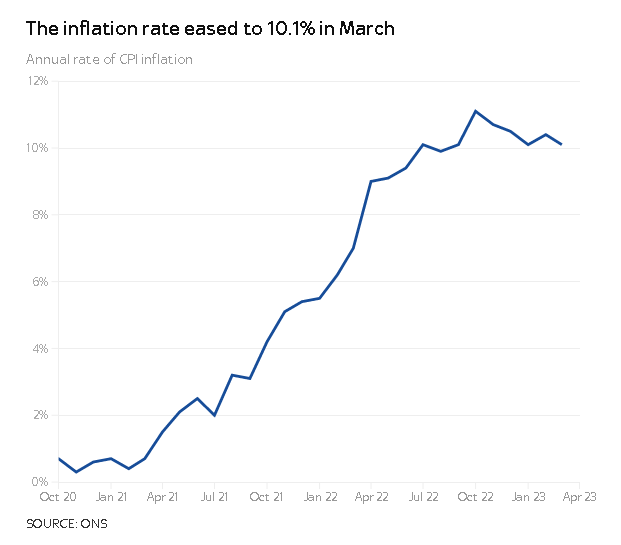

The headline rate should drop to 8% in April as energy prices continue to fall.

Wholesale gas prices have been falling consistently and are now lower than they were in February last year, before the war in Ukraine started.

According to the Institute for Fiscal Studies, this suggests that the average households' annual energy bill will drop to about £2,000 in July, from £2,500 at present, reducing energy's contribution to the headline rate to zero.

After hitting a new record of 19.1% in March, food price inflation should also start to slow.

Shipping, transport and packaging costs have been falling, which has filtered into slowing food producer output prices.

This means the rate of price growth for goods leaving warehouses and factories has been slowing. While price growth may slow, it will take longer for prices to come down from their current level.

James Smith, research director at the Resolution Foundation, said: "Headline inflation should fall sharply next month as the effect of last April's energy price spike falls out of the data.

"But the acceleration of food price inflation to nearly 20% is a major cause for concern, particularly for low-income families who spend a far greater share of their income on food than richer households."

Newsletter

Related Articles

0:00
0:00
Close
Deep Purple Has Released Its Best Album in Decades
UK MPs Criticise Student Loan System as Potentially Mis-Sold to Millions of Borrowers
Policy Groups Propose Bank of England-Backed Solar Loan Scheme for Millions of Homes
UK Health Agency Issues Amber Heat Alerts Across Six Regions as Temperatures Rise
Royal Air Force F-35 Jets Conduct First High North Air Policing Missions From Aircraft Carrier
Major UK Companies Join Government Cybersecurity Pledge Amid Rising Digital Threats
UK Sanctions Russian Operatives Linked to Chemical Weapons Programmes and Poisoning Cases
UK Government Expands Free Breakfast Clubs and Limits School Uniform Costs
UK Water Companies Face Tougher Penalties Under New Environmental Enforcement Rules
UK Universities Warn Funding Cuts Could Damage Skills Pipeline and Economic Growth
NHS Expands Artificial Intelligence Tools to Help Reduce Patient Waiting Lists
NHS Ombudsman Criticises Failures in End-of-Life Communication and Patient Care
NHS Launches Nationwide Vaccination Drive After Rise in Measles Cases
UK Government Introduces New Limits on Foreign-Linked Political Donations
Thames Water Creditors Advance £10 Billion Rescue Plan to Prevent Potential Public Ownership
Andy Burnham Prepares Labour Leadership Platform as Party Faces Post-Starmer Transition
UK Met Office Issues Heatwave Alerts for London and Southern England
Keir Starmer Blocks Earlier World Cup Kick-Off Time for England Match Against Mexico
NHS Digital Transformation and Media Consolidation Highlight UK Policy Priorities
UK Government Pushes Digital Trade Rules to Cut Export Costs for Businesses
Bank of England Plans Leverage Rule Changes to Support Government Bond Market
UK Police Operation Targets Organised Immigration Crime Networks With Hundreds of Arrests
Yvette Cooper Calls for Global AI Rules to Prevent Security Risks
NHS Begins Major AI Expansion Through £10 Billion Digital Investment Programme
UK Government Tightens Rules on Political Donations to Limit Foreign Influence
Keir Starmer Defends UK Defence Spending Plan at NATO Summit in Turkey
Comcast’s Sky Agrees £1.6 Billion Deal to Acquire ITV Media and Entertainment Division
Senior NHS Doctors Vote in Favour of Renewed Strike Action Over Pay Dispute
Andy Burnham Set to Succeed Keir Starmer as Labour Leadership Nominations Open
Microsoft Lays Off 4,800 Employees and Xbox Suffers the Hardest Blow
Office for National Statistics Updates Historical Investment Data Review to Improve Accuracy
Department for Science, Innovation and Technology Highlights Economic Gains From Digital Inclusion
Debate Intensifies Over UK Defence Strategy and Domestic Security Priorities
Report Warns Full Transport Accessibility Could Add £176 Billion to UK Economy Annually
Medicines Regulator Approves First Targeted Treatment for Advanced Merkel Cell Skin Cancer
Government Commits £22 Million to Brighton Seafront Infrastructure Renewal and Transport Safety
National Security Bill Returns to House of Commons Amid Calls to Protect Humanitarian Work
Government Tightens Overseas Political Donation Rules to Strengthen Safeguards Against Foreign Influence
NHS Maternity Reform Expands Central Oversight After Critical National Review
Dover Border Warnings Highlight Post-Brexit Pressure on Cross-Channel Trade
Private Nuclear Consortium Advances £35 Billion Small Reactor Strategy in UK
UK Labour Leadership Signals Shift Toward Reindustrialisation and Regional Power
House of Lords Debates Rail Nationalisation Bill to Create Great British Railways
Scottish Affairs Committee Expands Inquiry Into SNP Financial Conduct
Evri Launches £1.2 Million Defamation Case Against BBC Over Panorama Investigation
Port of Dover Warns of Border Delays as EU Entry-Exit System Looms
Nigel Farage Referred to Standards Watchdog Over Alleged Undeclared Benefits
UK Government Faces Scrutiny Over Claimed AI Datacentre Investment After FOI Findings
UK and India Finalise Trade Agreement Rules Ahead of Mid-July Implementation
UK Government Establishes National Maternity Commissioner After Major Review of NHS Care Failures
×