London Daily

Focus on the big picture.
Wednesday, May 13, 2026

Fall in England’s GCSE grades signals a return to pre-pandemic normality

Fall in England’s GCSE grades signals a return to pre-pandemic normality

The hard work and resilience of teachers and pupils to reach this point is the most impressive result of all

This summer’s GCSE results are the first from examinations in three years. Results are significantly lower than last year but we should not read anything into that. After two years of grades increasing with the use of teacher-assessed grades, the government signalled its intentions early that we should begin the process of returning to pre-pandemic grade distributions. In September, the qualifications regulator, Ofqual, announced results would be around the midpoint of those in 2019 and 2021.

This is exactly what we have seen in today’s data. The proportion of entries from 16-year-olds awarded a grade 4 or above is down from 79% last year to 75% today, and the proportion getting the higher grades (grade 7 and above), which peaked at 30% in 2021, has fallen to 27% this year.
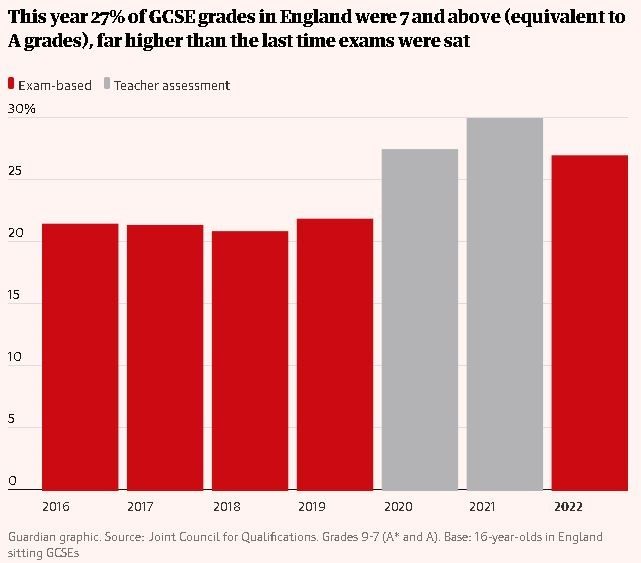

But on average, that means results are still about a fifth of a grade above where they were in 2019. This, along with a number of mitigations ahead of exams such as optional topics in some subjects, struck a balance between fairness across different cohorts, whilst recognising the level of disruption experienced by those students getting their results today. Remember, this is a group of young people who have not had a year at school that was not affected by the pandemic in some way since they were in year 8. The hard work and resilience of this cohort and their teachers to get through to today is surely the most impressive result of all.

Away from the headline figures, there has been data published today that gives us a better understanding of what has happened in schools over the course of the pandemic. Results from the national reference tests in English and mathematics, which are sat by a representative sample of year 11 students, provide a good way of tracking standards over time. In English, results have held up, despite the effect of the pandemic, with no statistically significant change in outcomes. The same cannot be said for mathematics, where there have been falls across the attainment distribution.

The breakdown of results by region continues to reflect the geographic disparities in pupil outcomes, with those in London outperforming those elsewhere. A third of grades awarded to pupils in London on Thursday were at grade 7 or above, whereas in the north-west and Yorkshire and the Humber it was under a quarter. These differences have grown slightly since 2019. We cannot yet say whether this is as a direct result of the pandemic, but our own analysis of learning loss for younger pupils did highlight that the pandemic’s effects on education were felt more acutely in parts of the north and the Midlands than in London.
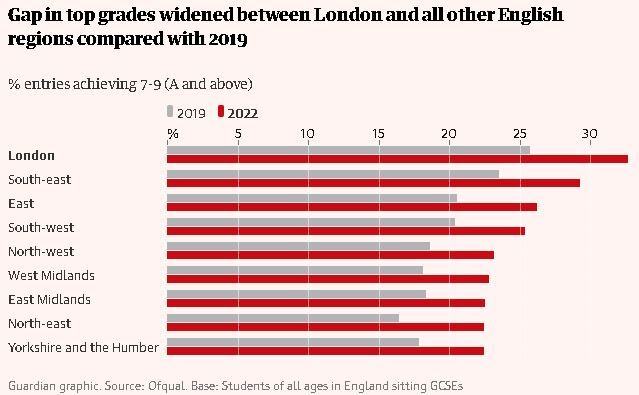

But whether it is the pandemic or longstanding differences in outcomes, it means a pupil opening their GCSE results in London was considerably more likely to receive grade 7s than a pupil in the north. Boris Johnson’s rhetoric about levelling up opportunity at the start of his time in office has, for now at least, not translated into a more equitable education system.

The way the school system has dealt with the challenges thrown its way over the last two years is extraordinary. But the challenges continue, and as we move into the new school year, among everything else, school leaders are scratching their heads about how they are going to meet increased energy and staff costs within already stretched budgets. The arrival of a new prime minister in the coming weeks could also mean the appointment of a new secretary of state for education, the fifth in the last year. What are the chances they will still be in post to comment on GCSE results next summer? And crucially, if they are, what will they have done to help schools through another difficult year?

Newsletter

Related Articles

0:00
0:00
Close
The Great Western Exit: Why Best Citizens Are Fleeing the Rich World [PODCAST]
The New Robber Barons of Intelligence: Are AI Bosses More Powerful Than Rockefeller?
The End of the Old Order [Podcast]
Britain’s Democracy Is Now a Costume
The AI Gold Rush Is Coming for America’s Last Open Spaces [Podcast]
The Pentagon’s AI Squeeze: Eight Tech Giants Get In, Anthropic Gets Shut Out [Podcast]
The War Map: Professor Jiang’s Dark Theory of Iran, Trump, China, Russia, Israel, and the Coming Global Shock [Podcast]
Labour Is No Longer a National Party [Podcast]
AI Isn’t Stealing Your Job. It’s Dismantling It Piece by Piece.
Lawyers vs Engineers: Why China Builds While America Litigates [Podcast]
Churchill’s Glass: The Drunk, the Doctor, and the Myth Britain Refuses to Sober Up From
Apple issues an unusual warning: this is how your iPhone can be hacked without you doing anything
Kennedy’s Quiet War on Antidepressants Sparks Alarm Across America’s Medical Establishment
The Met Gala Meets the Age of Billionaire Backlash
Russian Oligarch’s Superyacht Crosses Hormuz via Iran-Controlled Route
Gunfire Disrupts White House Correspondents’ Dinner as Trump Is Evacuated
A Leak, a King, and a Fracturing Alliance
Inside the Gates Foundation Turmoil: Layoffs, Scrutiny, and the Cost of Reputational Risk
UK Biobank Breach Exposes Health Data of 500,000, Listed for Sale on Chinese Platform
KPMG Cuts Around 10% of US Audit Partners After Failed Exit Push
French Police Probe Suspected Weather-Data Tampering After Unusual Polymarket Bets on Paris Temperatures
CATL Unveils Revolutionary EV Battery Tech: 1000 km Range and 7-Minute Charging Ahead of Beijing Auto Show
Crypto Scammers Capitalize on Maritime Chaos Near the Strait of Hormuz: A Rising Threat to Shipping Companies
Changi Airport: How Singapore Engineered the World’s Most Efficient Travel Experience
Power Dynamics: Apple’s Leadership Shakeup, Geopolitical Risks in the Strait of Hormuz, and Europe's Energy Strategy Amidst Global Challenges
Apple's Leadership Transition: Can New CEO John Ternus Navigate AI Challenges and Geopolitical Pressures?
Italy’s €100K Tax Gambit: Europe’s Soft Power Tax Haven
News Roundup
Microsoft lost 2.5 millions users (French government) to Linux
Privacy Problems in Microsoft Windows OS
News roundup
Péter András Magyar and the Strategic Reset of Hungary
Hungary After the Landslide — A Strategic Reset in Europe
Meghan Markle Plans Exclusive Women-Focused Retreat During Australia Visit
Starmer and Trump Hold Strategic Talks on Securing Strait of Hormuz Amid Rising Tensions
Unofficial Australia Visit by Prince Harry and Meghan Expected to Stir Tensions with Royal Circles
Pipeline Attack Cuts Significant Share of Saudi Arabia’s Oil Export Capacity
UK Stocks Rise on Ceasefire Momentum and Renewed Focus on Diplomacy
UK to Hold Further Strategic Talks on Strait of Hormuz Security
Starmer Voices Frustration as Global Tensions Drive Up UK Energy Costs
UK Students Voice Concern Over Proposal for Automatic Military Draft Registration
Rising Volatility Drives Uncertainty in UK Fuel and Petrol Prices
UK Moves to Deploy ‘Skyhammer’ Anti-Drone System to Strengthen Airspace Defense
New Analysis Explores UK Budget Mechanics in ‘Behind the Blue’ Feature
Man Arrested After Four Die in Channel Crossing Tragedy
UK Tightens Immigration Framework with New Sponsor Rules and Fee Increases
UK Foreign Secretary Highlights Impact of Intensified Strikes in Lebanon
UK Urges Inclusion of Lebanon in US-Iran Ceasefire Framework
UK Stocks Ease as Ceasefire Doubts in Middle East Weigh on Investor Confidence
UK Reassesses Cloud Strategy Amid Criticism Over Limited Support Measures
×