

EU vaccine export row: Bloc backtracks on controls for NI
In a statement, the European Commission said it would ensure the Northern Ireland Protocol is "unaffected".
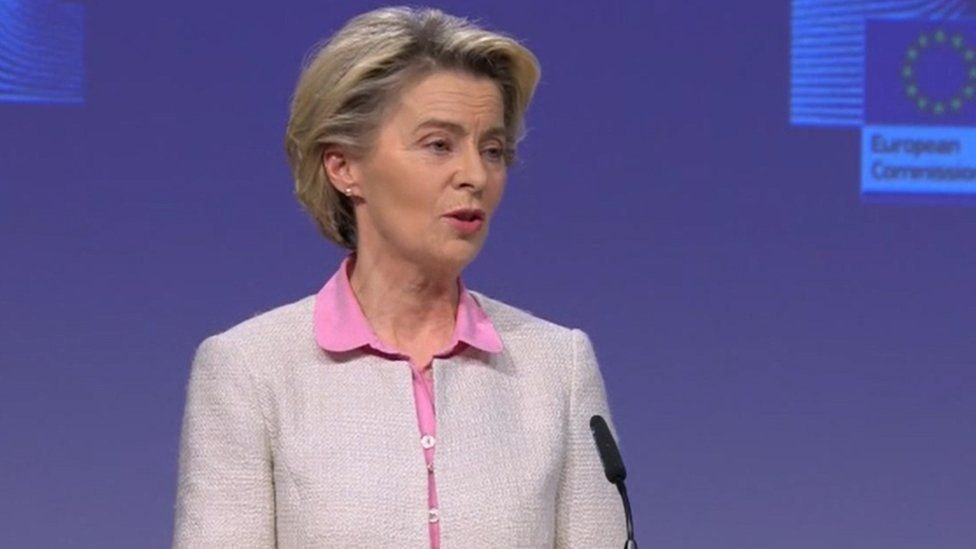
European Commission President Ursula von der Leyen said she and Boris Johnson had "constructive talks".
Irish Taoiseach Micheál Martin welcomed the "positive development given the many challenges we face".
Earlier, the EU said it would trigger a clause to introduce export controls on vaccines to Northern Ireland, with Mr Johnson urging the bloc to "urgently clarify its intentions".
Under the Brexit deal, all products should be exported from the EU to NI without checks.
On Friday, the bloc invoked Article 16 of the Northern Ireland Protocol in a bid to prevent the region becoming a backdoor for EU vaccines to be sent to the wider UK. The EU previously said its actions were "justified" to avert problems caused by a lack of supply.
It was not thought that the move would directly disadvantage Northern Ireland, which gets its vaccine supplies through the UK procurement system.
Despite backtracking on Northern Ireland, the EU is still introducing new controls giving member states the power to block exports of the coronavirus vaccine to countries including the UK - should they want to.
It was the latest development in a deepening dispute over the vaccine producer AstraZeneca's delivery commitments to the EU.
The bloc agreed to buy up to 400m doses of the AstraZeneca vaccine last year, and on Friday the EU's drugs regulator approved the vaccine's use for all adults.
But the firm said that due to problems at one of its EU factories, supplies would be reduced by about 60% in the first quarter of 2021.
In a statement released earlier on Friday evening, a No 10 spokesman said Mr Johnson had spoken to Mrs von der Leyen and expressed his "grave concerns" about the "potential impact" of the EU's actions on vaccine exports.
A later statement from the European Commission said it was "not triggering the safeguard clause" of the Brexit deal, and the Northern Ireland Protocol would remain "unaffected".
Mrs von der Leyen said she and the PM "agreed on the principle that there should not be restrictions on the export of vaccines by companies where they are fulfilling contractual responsibilities".
The Commission added that in order to tackle "the current lack of transparency" over vaccine exports outside the EU, it would be introducing a measure requiring that all such exports "are subject to an authorisation" by member states.
The statement warned that the EU would "consider using all the instruments at its disposal" should vaccine supplies "toward third countries be abused to circumvent the effects of the authorisation system".
The EU's original move was criticised by a string of politicians, with Northern Ireland's First Minister Arlene Forster describing it as "an incredible act of hostility" that places a "hard border" between Northern Ireland and the Republic of Ireland.

Article 16 of the Northern Ireland Protocol is a safeguard mechanism. Similar measures are often found in a variety of trade agreements.
It allows either the UK or the EU to take unilateral action if the application of the protocol leads to serious 'economic, societal or environmental difficulties' which are liable to persist.
It doesn't define what 'serious' means, but Article 16 is only meant to be used in an emergency. So, the fact that the EU chose to invoke it shows just how seriously it is taking its vaccine shortages.
The intriguing thing is that Article 16 doesn't, of course, apply only to vaccines.
There have been plenty of people calling on the UK government to invoke Article 16 to help alleviate the trade problems that have arisen between Great Britain and Northern Ireland since the beginning of the year.
That's because Great Britain is now outside the EU single market, but Northern Ireland is still following many single market rules.
This latest development means the plot thickens even further.
Cabinet minister Michael Gove told his opposite number on the EU-UK Joint Committee, Maros Sefcovic earlier that the UK was concerned by the "lack of notification from the EU about its actions in relation to the NI protocol" and warned that Britain "would now be carefully considering next steps".
In a phone call earlier with the Irish Taoiseach, Mr Martin, on Friday evening, Mr Johnson "set out his concerns" about the move and "what these actions may mean for the two communities in Northern Ireland", according to a No 10 spokesperson.
The PM is also said to have "stressed the UK's enduring commitment" to the Good Friday agreement and called on the EU to "urgently clarify its intentions and what steps it plans to take to ensure its own commitments with regards to Northern Ireland are fully honoured".
In an interview with the Times, Michel Barnier, who was the EU's chief Brexit negotiator, said he was calling for "cooperation" between the EU and the UK over the vaccine supplies across Europe.
He said the world was facing an "extraordinarily serious crisis" which he argued must be faced with "responsibility" rather than the "spirit oneupmanship or unhealthy competition".
He added: "I recommend preserving the spirit of co-operation between us."