

EU leaders back 'global value chains' instead of vaccine export bans
EU leaders backed “global value chains” rather than support Brussels in using new powers to block Covid jab exports to highly vaccinated countries, despite being told that 21m doses had been sent to the UK.
At a virtual summit, attended briefly by Joe Biden, the European commission president, Ursula von der Leyen, highlighted the large shipments sent over the Channel, amounting to two-thirds of the jabs given in the UK.
The lack of supply to the EU was emphasised by an early summit squabble between the German chancellor, Angela Merkel, and her Austrian counterpart, Sebastian Kurz, who demanded extra doses. Merkel informed Kurz that the lack of vaccine in Austria was due to his government’s failure to order sufficient amounts rather than a failure in Brussels.
But in a post-summit statement, the leaders failed to offer their support for the commission’s decision to take new powers allowing it to potentially block exports to countries with high vaccination rates or where governments blocked shipments through law or their contracts with suppliers. Previously the EU had just said it would move against companies that failed to fulfil their contracts with the bloc.
“We underline the importance of transparency as well as of the use of export authorisations,” the joint statement said. “We recognise the importance of global value chains and reaffirm that companies must ensure predictability of their vaccine production and respect contractual delivery deadlines.”
Commission officials insisted in response that the need for maintaining open global supply chains was the main purpose of the new rules.
But Merkel told reporters following the summit that while the EU had to “provide [for] our own population” the bloc would not damage the supply chains necessary for the production and distribution of vaccines.
She said: “Regarding the export regime we said we had absolutely no desire to disturb the global supply chain, but also that we of course have an interest in ensuring that the companies that have made contracts with us remain truly loyal to those contracts.
“We are, as the EU, the part of the world that is not only supplying itself but also exporting to the wider world – unlike the US, unlike Britain.
“And so on the one hand our objective is to really respect the global supply chains and to combat protectionism, but on the other, of course we want to provide our own population [with vaccines] because we know that is the way out of the crisis.”
France’s president, Emmanuel Macron, used a press conference after the meeting to criticise the British media. “Every day, when I read the press across the Channel, they make a case against us saying that it is the EU that is being selfish. This is false!” he said.
Macron reiterated support for action against companies, such as AstraZeneca, who failed to fulfil their contractual obligation to make deliveries to the bloc. “It’s the end of naivety,” Macron told reporters. “I support export control mechanisms put in place by the European commission. I support the fact that we must block all exports for as long as some drug companies don’t respect their commitments with Europeans.”
The commission increased its scope on Wednesday for blocking exports to countries with a better record than the EU in vaccinating its population, or those that restrict exports through law or in their contracts with suppliers.
The EU regulation, in force since January, previously only took into account whether a supplier was fulfilling its contract with the EU.
In an attempt to garner explicit support for the move, Von der Leyen disclosed to the leaders that 77m doses made by producers in the EU had been shipped to 33 countries since 1 December.
Of those, 21m went to the UK, of which just over 1 million were from AstraZeneca, with the rest supplied by Pfizer. “While remaining open, the EU needs to ensure Europeans get a fair share of vaccines,” she had tweeted.
The UK does not ban the export of vaccines, but the government signed a contract with AstraZeneca that obliges the Anglo-Swedish company to deliver doses produced in Oxford and Staffordshire to Britain first.
The UK would also appear to fall foul of the EU’s new criteria on vaccination coverage, with 45 jabs administered per 100 residents, compared with 13 per 100 on average across the 27 member states. A total of 31m jabs have been administered in the UK.
There was disquiet among some member states at the commission’s move given the risk of inflaming relations with the UK, and in light of the opposition voiced by vaccine suppliers.
The Netherlands and Belgium insisted that the EU needed to explicitly support global supply chains in its summit communique while Spain, Italy and France had sought more explicit support for Von der Leyen.
Despite the lack of explicit backing among leaders for use of the new export restrictions, the revised regulations will remain within the commission and member states’ power.
Earlier in the day, an executive at Pfizer had emphasised the company’s vehement opposition to the new regulation. “We have observed these recent developments with concern,” Sabine Bruckner, Swiss country manager for Pfizer, said. “Should it really come to export restrictions, that would be a ‘lose-lose’ situation for everyone, also for the members of the European Union.”
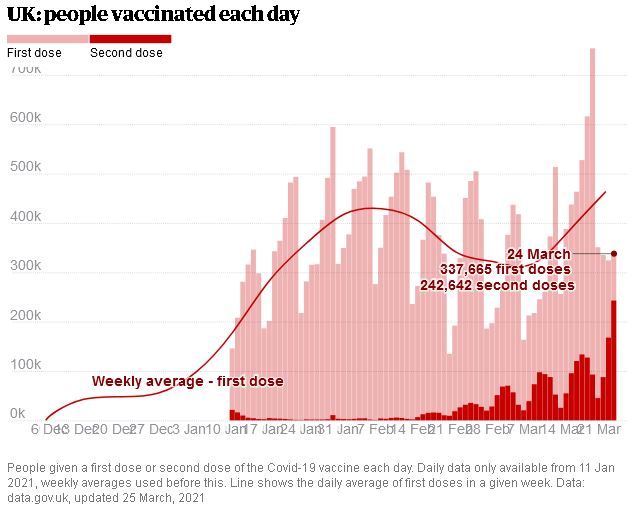
The EU has suffered from a major supply shortfall of the Oxford/AstraZeneca vaccine because of a yield problem at a plant in Belgium and the company’s subsequent refusal to divert doses made in the UK. Of the 120m promised doses this quarter, just 30m are expected to be delivered.
Given the shortage of supply, the EU has been threatening to block the export to the UK of an unspecified number of doses being made at an AstraZeneca plant in the Netherlands.
UK officials have been in negotiations since Monday on the issue. In a joint statement on Wednesday evening, the two sides had said they were continuing to seek a “win-win” solution.
But EU officials were exasperated by a subsequent intervention by the health secretary, Matt Hancock. In an interview with the Financial Times on Wednesday, Hancock had said the UK had a better contract than that secured by the commission, a claim vehemently denied by sources in Brussels.
Merkel had clashed during the summit with Kurz over Austria’s claim to 10m extra doses provided by Pfizer. The Austrian chancellor has led the charge among a group of six member states who had initially turned down their full pro-rata amount of vaccine doses only to later find they had a shortfall but that other countries had taken on the rejected stock. Merkel told Kurz that governments signed contracts and not “bureaucrats” in Brussels. Diplomats in Brussels have been instructed to find a solution.

