London Daily

Focus on the big picture.
Thursday, Sep 03, 2026

Energy crisis: European gas storage levels at record highs - and it suggests good news for supplies

Energy crisis: European gas storage levels at record highs - and it suggests good news for supplies

Record gas storage levels this year are unlikely to mean prices drop to levels seen before the pandemic and the Ukraine war, but energy security has improved after months when the UK worried about keeping the lights on.

Energy costs could come down as European gas storage facilities are expected to end the winter season at a record of more than 50% full.

Modelling done by energy consultancy Cornwall Insight suggests gas supplies are secure after concerns of shortages following Russia's invasion of Ukraine.

Fuller storage units mean less future demand for gas, which can bring down prices.

Storage facilities across Europe will end winter between 45% and 61% full - an average of 55% capacity - bypassing the previous end of winter record of 54% in 2020.
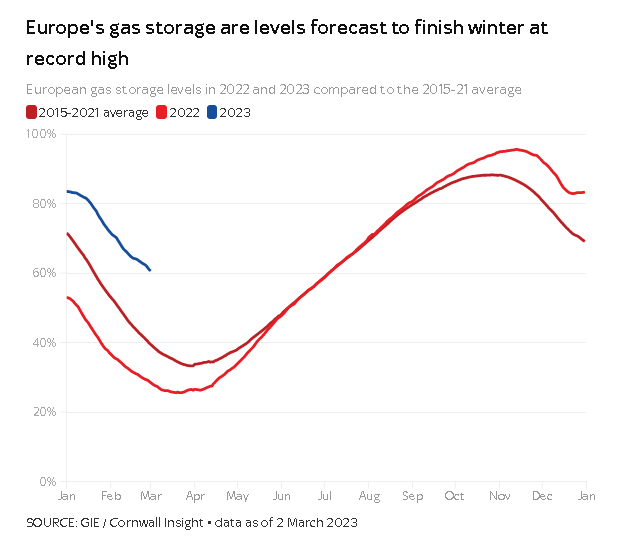

Following the start of the conflict in Ukraine, European countries raced to reduce their reliance on Russian gas, which pushed up prices and led to concerns about energy supplies in winter 2022 to 2023.

Having a greater amount of gas in storage means more is ready for winter 2023-2024 and less needs to be bought, leaving supplies more secure than in 2022.

It is a doubling from last year.

On 31 March 2022 just 26% of European storage facilities were filled, according to data from Gas Infrastructure Europe.

There was concern that the lights could not be kept on amid gas shortages. In the UK the National Grid's Electricity System Operator had warned in October that planned three-hour power blackouts could be imposed in the event of gas supplies falling short of demand.

To reduce energy demand and cope with potential shortages, EU countries formally agreed a voluntary 10% cut in gross electricity consumption and a mandatory reduction of 5% during peak use hours.

But high gas storage levels this year do not mean prices will drop to lows seen at the end of previous high storage-level winters.

Despite the "considerably more positive" forecasts, the lead research analyst at Cornwall Insight said he was cautious about saying Europe is over the worst of the energy crisis.

"Any single factor can influence the pace and pattern of storage refill, and perhaps more pertinently, change the cost paid to achieve it," Dr Matthew Chadwick said.

"We are certainly not out of the woods yet."

Factors that could bring up energy costs include weather, US exports, Chinese demand and Russian supplies.

While a mild winter helped preserve gas stocks, a summer with heatwaves would bring energy demand for air-conditioning and fans.

Imports of US liquified natural gas in the second half of last year rose significantly as reliance on Russian gas waned. Going forward, however, the US is under domestic pressure to protect consumers from price rises, which could mean less exported to Europe.

Russian gas is still relied on by Europe and will continue to be needed.

The reopening of China, following nearly three years of lockdown restrictions, and the associated economic growth will impact energy markets, the Cornwall Insight report said, though the impact is uncertain.

For those looking to hear good news about bills, Dr Chadwick is not the barer.

"Whatever the outlook for storage levels, the need to compensate for Russian pipeline volumes with expensive and volatile liquified natural gas will keep gas bills higher," he said.

"This, at least for now, is the "new normal", and consumers and economies should prepare for energy costs to remain higher than before the pandemic, and the Ukraine war, for some time to come."

Households can expect prices to be "more muted" than last year, Dr Chadwick said, as the panic from the Ukraine war outbreak subsides.

"What may ease this year is the heightened level of understandable panic that led to hectic energy-buying practices during the autumn of 2022.

"As a result, we can probably expect prices to be much more muted than 2022, despite any uncertainties that may come into play."

Gas storage facilities in the UK include Rough, a facility reopened this year off the Yorkshire coast, and the Stublach onshore facility in Cheshire.

Newsletter

Related Articles

0:00
0:00
Close
UK Business Confidence Improves but Remains Deeply Negative
Aberdeen Hydrogen Bus Sale Recovers Just Six Pence for Every Pound Invested
Which? Exposes Booking.com Verification Failures With Fake 10 Downing Street Listing
British Business Bank Invests Up to £46 Million in Deep-Tech Startup Fund
Scottish Government Puts Violence Against Women at Center of Legislative Program
FCA Eases UK IPO Rules to Strengthen London’s Listing Market
UK Likely to Avoid Next US Tariff Measures as Washington Targets EU
Macron Visits UK for Bayeux Tapestry Exhibition and Border Security Talks
British Chambers of Commerce Cuts UK Growth Outlook to 1% for 2026 and 2027
Keir Starmer Resigns as MP for Holborn and St Pancras, Triggering By-Election
Prime Minister Andy Burnham Unveils Devolution and Cost-of-Living Agenda
UK Borrowing Costs Surge as 30-Year Gilt Yield Reaches 5.88%
Cleveland Police Receive £2 Million to Tackle Serious Crime in Middlesbrough
Number of Young People in England Without a Close Friend Reaches Record Level
Five Arrested After Newborn Baby Dies From Stab Wounds in Sheffield
Nigel Farage Faces Questions Over Reported Second Parliamentary Standards Investigation
UK Retirement Funding Requirement Rises by £64,000 Compared With 2021
UK House Prices Rise for First Time Since April, Nationwide Says
FCA Chief Faces Allegations of Intimidating Consumer Group Over £9 Billion Car Loan Inquiry
Scottish Government Presses Ahead With Cap on Essential Food Prices
Burnham Government Moves to Overhaul Early Prison Release Scheme
UK Records Hottest Summer on Record in 2026, Met Office Says
UK Government Announces Major Reset of Diplomatic Policy Towards Israel
UK Pushes Back After Trump Reopens Falkland Islands Sovereignty Dispute
Keir Starmer Resigns as MP, Triggering Holborn and St Pancras By-Election
Andy Burnham Blames Brexit for UK’s Decade of Weak Growth in First Commons Address
England Faces Renewed Scrutiny Over Sewage Discharges and Water Quality
Victoria Beckham Business Reports First Operating Profit Since Launch
BT Expects £2 Billion From Copper Sales During Full-Fibre Rollout
UK Train Drivers Secure 3.6% Pay Rise and Avert Strike Action
FCA Chief Faces Scrutiny Over Alleged Pressure on Consumer Group in Car Finance Case
Kemi Badenoch Names Andrew Griffith Shadow Chancellor in Conservative Reshuffle
UK House Prices Rise for First Time Since April
UK Shop-Price Inflation Accelerates to 1.5% in August
Met Office Data Point to Hottest UK Summer on Record
UK Announces Emergency Prison Release Measures and £110 Million Capacity Expansion
UK Launches Expanded Free School Meals and 1,400 Breakfast Clubs
Bank of England Governor Warns G20 of AI-Related Economic and Cyber Risks
Prime Minister Andy Burnham Calls for Greater Public Control of Water, Energy and Transport
UK Gains Full Access to £13 Trillion Trans-Pacific Trade Bloc
UK Long-Term Borrowing Costs Hit 28-Year High as Oil Shock Drives Global Bond Selloff
Royal Mail Keeps First-Class Stamps at £1.80 and Second-Class at 91p
Church of England Prepares Formal Apology Over Historical Forced Adoptions
UK Competition Regulator Caps Veterinary Prescription Fees at £21
UK Aviation Authorities Roll Out Airspace Changes to Reduce Flight Delays
England Makes School Allergy Policies Mandatory Under Benedict’s Law
England and Wales Tighten Child Safeguarding Checks by Removing Supervision Exemption
Cornwall Geothermal Plant Begins Commercial Power and Lithium Operations
UK Inflation Holds Near 2.9% as Energy Costs Remain a Risk
UK Productivity Growth Averages 1.1% Over Two Years, Resolution Foundation Says
×