

Elections bill is ‘a power grab to rig polls in favour of Tories’
Boris Johnson’s government is today accused of trying to rig future elections by stifling opposition and deterring participation, as a storm of protest erupts over its controversial elections bill, which is to be debated in parliament this week.
In an open letter, charities including Save the Children, independent campaign groups such as Greenpeace, and the trades union movement, condemn the legislation as “an attack on the UK’s proud democratic tradition and some of our most fundamental rights”.
The Labour party last night confirmed it would vote against the second reading of the bill, which will confer new powers on Cabinet Office minister Michael Gove over the hitherto independent Electoral Commission, which oversees elections and regulates political finance, in the Commons on Tuesday.
Cat Smith, the shadow minister for democracy said: “The Conservative government’s elections bill is a brazen attack on our democracy and the freedom of people to organise politically. The ability of trade unions and civil society organisations to engage and campaign are vital components of any free and democratic society. This is all about the government rigging democracy in favour of the Conservative party.”
The government says the bill has been drawn up to ensure “that UK elections remain secure, fair, modern, inclusive and transparent”. But its many critics says it amounts to a “power grab”, while doing nothing to stop big money donations.
One of the most controversial measures in the bill is that voters must show photo IDs before getting a ballot paper in a polling station at parliamentary and local elections in England – a move ministers say will improve the integrity of elections and prevent votes from being stolen. It proposes a broad range of photo IDs, such as passports or driving licences, will be allowed, as well as a free voter card available to those without any other form of ID.
Opponents insist, however, that cases of stealing another’s vote are rare and point out that huge numbers people who are less well off and less inclined to back the Conservatives do not have photo ID and will be put off, or prevented from, voting. The Electoral Reform Society, which opposes the voter ID move, has pointed out that “in the UK and US, the richer you are the more likely you are to have ID. Many citizens who can’t afford to go on foreign holidays don’t have passports, and those that can’t drive don’t have driving licences.”
In their joint letter, co-ordinated and backed by the civil society organisation Best for Britain, they say the bill will not only allow Gove to set the EC’s strategic priorities but will also allow him to unilaterally define campaigning and to ban campaigners and donors. It will also increase administrative burdens and potential risk for smaller organisations including charities, ahead of elections.
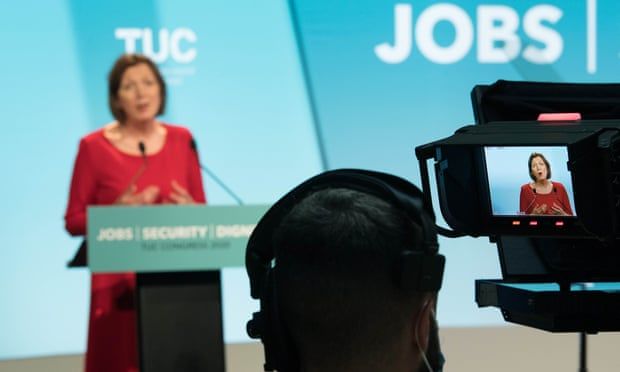 Frances O’Grady, general secretary of the TUC speaking at the 2020 congress in London.
The letter, also signed by the TUC general secretary, Frances O’Grady, states: “The bill bestows unprecedented and unchecked power to government over elections. At a stroke, the minister could ban whole sections of civil society, including unions and charities, from engaging in elections either by campaigning or donating.”
It adds: “Giving control of the Electoral Commission to ministers opens it to abuse by the government, turning it into a tool which they could use disproportionately against opposition campaigners while ensuring their own side receives less scrutiny.
“It could also be used to deter organised opposition before an election is even announced, with ministers able to instruct the Commission to retroactively criminalise groups and individuals for action undertaken up to one year before an election that the minister for the Cabinet Office defines as ‘campaigning’.
“For example, activities undertaken before an election is announced are currently not considered electoral activity by the commission, but a minister could change that guidance so a group demonstrating for higher wages for NHS workers could be criminalised if a snap election is called six months later.”
Naomi Smith, chief executive of Best for Britain, said: “Despite the spin, it’s clear that the true aim of this bill is to silence critics, cripple opposition and rig future elections for those already in government.
“This power grab smacks of a government that is afraid of educating the electorate and afraid of accountability.”
A Cabinet Office spokesperson said the measures were “necessary and a proportionate approach to reforming the accountability of the Electoral Commission to parliament while respecting its independence. The elections bill will update elections law ensuring our electoral system remains secure, modern, transparent and fair.”