

Defense minister Reznikov under fire as corruption probes rock Ukraine
Ukraine’s Defense Minister Oleksii Reznikov — one of the most prominent faces of the war against Russia — is now under fire on the home front as investigations into government corruption rocked the country over the weekend.
Kyiv’s officials have been at pains over the course of the war to attempt to show that the nation is pulling together and cleaning up its act on corruption in a bid to chart a course toward the EU, so the revelations of two probes into top-level graft have come as a severe blow.
Both of the inquiries are related to war profiteering, and triggered an immediate pledge of action from President Volodymyr Zelenskyy on Sunday night. The case involving the defense ministry involved purchases of military rations at inflated prices — a topic that has snowballed into top news in Kyiv. Almost simultaneously, the deputy infrastructure minister was fired in a case linked to an overpriced public purchase of electrical generators. The National Anti-Corruption Bureau of Ukraine said it was investigating both matters.
“This week will be a time for appropriate decisions. I don’t want to announce them now, but it will all be fair. In each situation, we will analyze everything in detail. The issues related to energy and procurement. The relations between the central government and the regions. Everything related to procurement for the military,” Zelenskyy said.
Although Reznikov did not personally sign the defense food and catering contract worth 13 billion hryvnias (€326 million), journalists and watchdogs said that he had ultimate responsibility and had publicly stated his zero tolerance toward corruption. Reznikov called the accusations a smear campaign, aimed at undermining trust in the defense ministry and its reputation among international partners.
While Reznikov is vigorously defending the ministry’s contract, Deputy Minister of Communities, Territories and Infrastructure Development Vasyl Lozynskiy was fired almost immediately. The National Anti-Corruption Bureau of Ukraine (NABU) reported the deputy minister was busted while accepting a $400,000 bribe for facilitating an overpriced power-generating equipment purchase.
David Arakhamia, head of Servant of the People faction in the Ukrainian parliament, affiliated to Zelenskyy, promised some of the corrupt officials could face jail terms this spring.
“Since February 24, officials at all levels have been constantly warned through official and unofficial channels: focus on the war, help the victims, reduce bureaucracy and stop doing dubious business. Many of them have actually listened, but some, unfortunately, did not,” Arakhamia said in a Telegram statement. “If it doesn’t work in a civilized way, it will be done according to the laws of wartime. This applies both to recent purchases of generators and to fresh scandals in the ministry of defense.”
Food for soldiers’ scandal
Yurii Nikolov, an investigative journalist and founder of the Nashi Groshi (Our Money) investigative website, who broke the defense procurement story for Ukrainian news website ZN.UA, wants to see action rather than more promises from politicians.
“Now Ukraine has a unique opportunity to show we are not like Russia, where they launder money on everything. If some guy wants to steal millions of euros from us during the war, when our economy is 60 percent dependent on EU aid, we have to stop him,” Nikolov told POLITICO.
The publicity from Nikolov’s article helped draw attention to the dubious contract before the payments went through, Nikolov claimed.
The NABU said it had opened its inquiry into the military catering deal even before Nikolov published his investigation.
 Ukrainian military units stationed in Poltava, Sumy, Kyiv, Zhytomyr,
Chernihiv, and Cherkasy regions were supposed to receive popular food
products for prices two or three times higher than they cost on the
market
Ukrainian military units stationed in Poltava, Sumy, Kyiv, Zhytomyr,
Chernihiv, and Cherkasy regions were supposed to receive popular food
products for prices two or three times higher than they cost on the
market
Nikolov has been investigating corruption involving state procurement for more than 10 years. Like many other Ukrainian journalists, he stopped criticizing the Ukrainian government so as not to undermine trust in Ukrainian leaders during the full-scale invasion during the first sixth months of 2022.
However, since the end of summer, Nikolov’s sources in the government started alerting him to dubious defense procurement hidden from the public. Then, in December, his sources in the armed forces sent him the contract on food and catering services worth 13 billion hryvnias that lies at the heart of the current uproar. The defense ministry signed the deal with a firm affiliated with former defense officials.
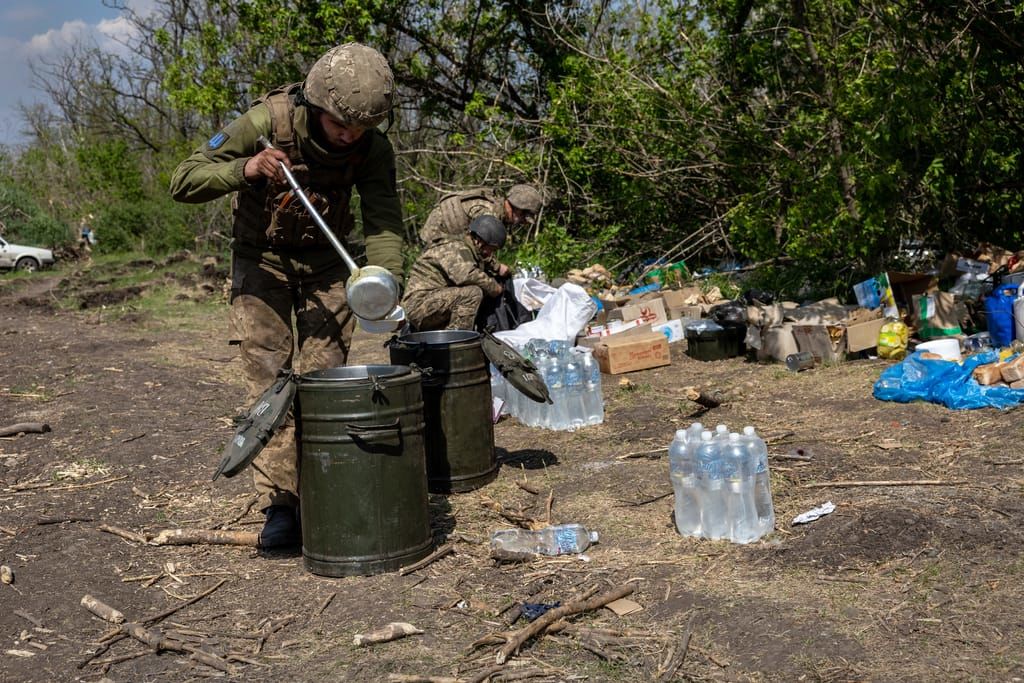
According to the contract, Ukrainian military units stationed in Poltava, Sumy, Kyiv, Zhytomyr, Chernihiv, and Cherkasy regions were supposed to receive popular food products for prices two or three times higher than they cost on the market. And those units were stationed far from the frontline, where the dangerous delivery lines can indeed make purchases more expensive.
Reznikov publicly accused Nikolov of manipulating his findings and promised to cooperate with parliamentarians and law enforcers during the investigation.
The price of eggs
He claimed that some of Nikolov’s findings, like the information about the inflated prices for eggs, were just a “technical mistake by the contractor, who meant to write the price of eggs in kilos, not per piece.” However, all the previous contracts showed that the ministry was always buying eggs per piece. Reznikov claimed the defense ministry managed to introduce competition into buying food for army procurement and now has signed contracts with eight suppliers. Each of those food suppliers and catering teams feeds specific military units no matter whether they are stationed at the front or not.
“There are no ‘rear’ or ‘far from the frontline’ regions in Ukraine from the point of view of food for servicemen. Anyone who claims otherwise is engaging in a deliberate deception,” Reznikov claimed. So, the suppliers charge not only for food but also for delivery and the catering of a “daily ration for a soldier” at a fixed cost within a certain predicted price range, he explained.
“As of now, additional internal checks are being completed on all contracts, military units are checking with the catalog, technical errors are being corrected, additional supply agreements are being prepared within the proven parameters of the state budget,” Reznikov claimed.
The minister said a person, who leaked a copy of the contract to a journalist, had committed a crime. The Security Service of Ukraine will investigate the leak and the motives behind it, he added.
In terms of the generator scandal, Lozynskiy has not yet commented.
In the summer, the cabinet allocated 1.68 billion hryvnias (€40 million) for the purchase of the power-generating equipment needed to get through the winter – when Russia has been massively bombing energy infrastructure facilities across Ukraine. However, according to the NABU, the public officials responsible for the purchase decided to make some extra money on the deal.
“They conspired with a group of intermediaries and ensured the conclusion of procurement contracts with pre-determined business entities. The cost of the contracts was inflated by 280 million hryvnias (€7 million), which was a kickback to be paid to the officials for their facilitation,” the NABU said.
In a statement announcing Lozynskiy’s dismissal, Ukraine’s Infrastructure Minister Oleksandr Kubrakov promised a wider clean-up.
“I instructed the team of the ministry to start the inspection of all active projects of the regions’ ministry, including budget funds, funds from international financial institutions, and technical projects.”