

How the UK military supports Israel’s combat operations against Palestinians
The UK’s new military strategy, released in March, states clearly that “Israel remains a key strategic partner”.
Months before the importance of the relationship was spelled out, the military chiefs of the two states signed a cooperation agreement “to formalise and enhance our defence relationship, and support the growing Israel-UK partnership”, according to the Israel Defence Forces (IDF).
Following the agreement, Britain’s ambassador to Israel, Neil Wigan, tweeted he was “delighted”, saying it would “further deepen our military cooperation”.
What is in that agreement is secret and has not even been formally acknowledged by the UK government. But Israel lobby group Bicom (the Britain Israel Communications and Research Centre) has written that the two militaries are “integrating their multi-domain capabilities in maritime, land, air, space, and cyber and electromagnetic”.
This is an extraordinary development and follows recent visits to Israel by two UK chiefs of the defence staff, General Sir Nick Carter in 2019 and his predecessor, Air Chief Marshal Sir Stuart Peach in 2017.
Training
Military training is a key part of the deepening relationship between the two countries’ armed forces. A UK minister revealed in 2018 that the British army was providing training to Israel and Declassified subsequently found two courses were given to Israeli military officers in the UK in 2019.
A course in “ordnance design” was delivered at the Defence Academy in Oxfordshire, southern England, and an “amphibious warfare course” was provided at HMS Collingwood, the Royal Navy’s largest training school.
The training is reciprocal. In 2016, it was revealed that British military pilots would receive training in a programme part-run by Israeli arms firm Elbit Systems. Pilots have since graduated from the programme which is being run at Royal Air Force (RAF) bases in the UK.
In 2011, British soldiers were even trained in Israel in the use of drones that had been “field-tested on Palestinians” during the 2009 war in Gaza two years earlier.
Soldiers in Israel
Britain stations 10 soldiers in Israel, the government told parliament last year. When asked for clarification, a Ministry of Defence (MoD) spokesperson told Declassified these troops are “deployed in both Israel and the West Bank” and that “we have military officers in the embassy in Tel Aviv to support the UK’s foreign mission in Israel”.
The spokesperson added that the “defence section” in that embassy “plays a diplomatic role” and that defence sections “facilitate international engagement between the countries” and provide opportunities for “training exercises”.
Declassified also recently found that two British soldiers assist Mark Schwartz, the US “security coordinator” for Israel and the Palestinian Authority, who uses the embassy in Jerusalem as his headquarters.
Schwartz leads an eight-nation team which ensures that security forces nominally working on behalf of the Palestinians – a people under occupation – liaise with Israel, the state enforcing the occupation.
 Activists demonstrate outside Israeli-owned Elbit Ferranti arms company on 1 February 2021 in Oldham, England.
 Military exercises
On top of the soldiers stationed in Israel, the British military now conducts regular exercises with Israeli forces. The RAF in particular has stepped up its engagement with Israel in the past two years.
In June 2019, the British military acknowledged for the first time that its fighter jets carried out a joint exercise with their Israeli counterparts, alongside American aircraft. “The following month an RAF squadron trained with the Israeli air force at the Palmachim air base, just south of Tel Aviv, in “search and rescue”.
Just months later, the Israel air force undertook its first-ever deployment of fighter jets to Britain. Israeli F-15 warplanes took part in a joint combat exercise with the RAF, as well as aircraft from the German and Italian air forces.
Known as Cobra Warrior, one of the largest annual RAF exercises, it involved “three weeks of intensive training”, including in “conflict situations that could be encountered in operations”, the RAF said.
The exercise was based out of the RAF Waddington air base, home to Britain’s intelligence-gathering aircraft. “The Israeli F-15s took part in air-to-air operations in mock dogfights and aircraft interceptions, as well as simulated ground attacks”, Israeli newspaper Haaretz reported.
Israel has used such F-15s – supplied by the US – in its attacks on Gaza.
In March this year, the head of the RAF, Air Chief Marshal Sir Mike Wigston, visited Israel and said “it has been a privilege to visit the Israeli Air Force, celebrating our common heritage, nurturing our enduring partnership, and exploring many areas of mutual interest”.
Also highly controversial – and again largely ignored by the British media – has been Royal Navy exercises with Israel. The policy is contentious given the role played by the Israeli navy in the country’s blockade of Gaza, which is widely regarded as illegal, partly because it inflicts “collective punishment” on an entire population.
In August 2019, the Royal Navy took part in the largest international naval exercise ever held by Israel, off the country’s Mediterranean shore. This followed other naval exercises involving the British and Israelis in November 2016 and December 2017.
Arms exports
The UK and Israel buy significant quantities of military equipment from each other. Britain has licenced over £400-million worth of arms exports to Israel since 2015.
Routine UK exports include components for assault rifles, pistols, warplanes, tanks and radars. UK components for drones and combat aircraft have continued flowing while Israel has used such equipment for surveillance and armed attacks against Palestinians.
The UK also supplies components used in US-built equipment exported to Israel, such as missile triggering systems for Apache helicopters and Head-Up Displays for F-16s. Both have been used to bomb Lebanese and Palestinian towns and villages.
Official UK export figures understate the real total since Britain has rubber-stamped over 30 “open licences” for weapons sales to Israel over the past five years. Such licences often permit an unlimited quantity of equipment to be exported.
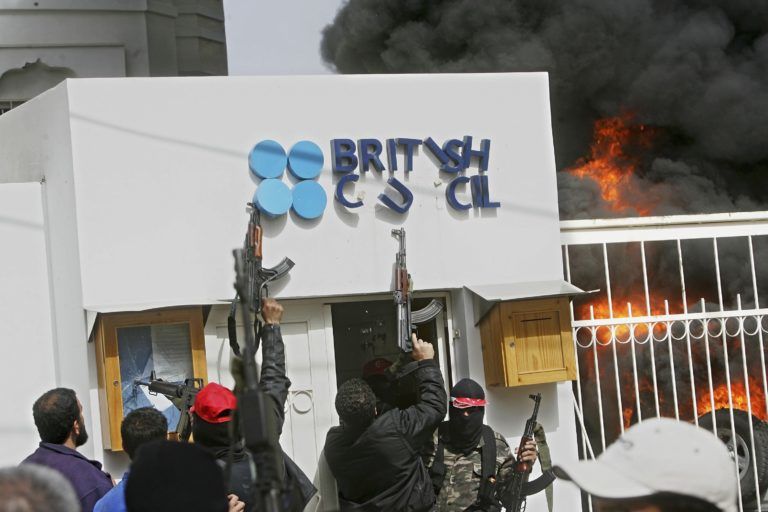 Palestinian militants set fire to the offices of the British Council on 14 March 2006 in Gaza City, Gaza Strip.
Especially noteworthy is that the UK government applies no “end use” restrictions on its supplies of military equipment to Israel, meaning the country is free to use that equipment however it likes.
In 2017 the British Foreign Office admitted it had not assessed the impact of its arms exports to Israel on Palestinians.
Three years earlier, a UK government review identified 12 licences involving components “which could be part of equipment used by the Israel Defence Forces in Gaza”. This was during the Israeli army’s 51-day bombardment of the territory in the summer of 2014, which killed over 2,200 Palestinians, most of them civilians.
Arms purchases
Britain’s armed forces are an important customer for Elbit Systems, a major Israeli arms corporation with nine production sites or offices in the UK. One of these subsidiaries, in Shenstone, near Birmingham, manufactures engines for drones.
Declassified recently found that the MoD has placed eight orders worth almost £46-million with Elbit since 2018. The largest of the contracts – valued at £31-million – is for virtual reality military equipment made by Ferranti Technologies, an Elbit subsidiary based in Oldham, near Manchester.
According to the MoD, the equipment will allow British soldiers to train “as if they were on the ground in a hostile environment”.
Elbit first registered its British division in 2004. The following year, UAV Tactical Systems – a joint venture between Elbit and French arms giant Thales – won a contract with the British MoD worth an initial £800-million.
The deal was to provide the British army with Watchkeeper surveillance drones, which are modelled on Elbit’s Hermes 450.
In 2018, the UK’s MoD agreed on a contract worth up to $52-million to purchase a “battlefield management application” from Elbit Systems UK. That same year Israel’s armour specialist, Plasan, was selected by the MoD to design and produce armour protection for Britain’s new “Type 26” frigates being built by BAE Systems in Glasgow.
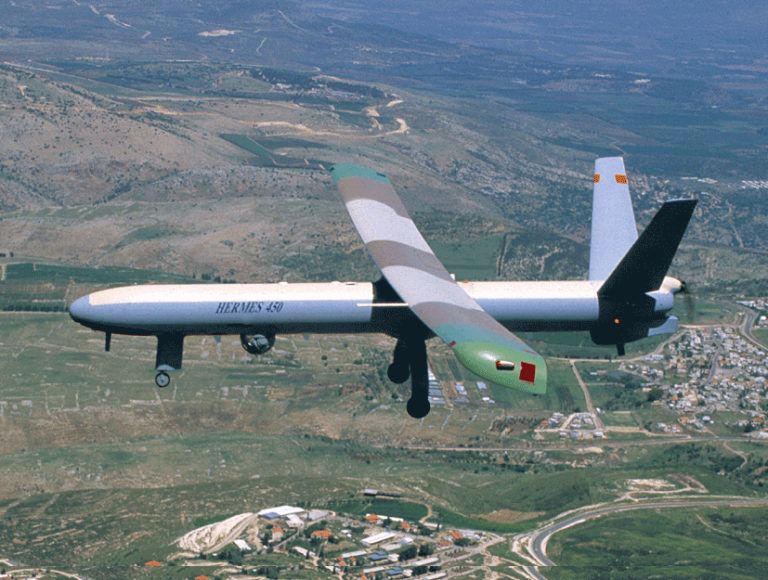 Elbit’s Hermes 450 unmanned airborne vehicle (UAV) in flight.
Nuclear arms
The UK also appears to play a role in enhancing Israel’s nuclear capabilities. Israel is believed to possess 80 to 100 nuclear warheads, some of which are deployed on its submarines. The UK is effectively aiding this nuclear deployment by routinely supplying submarine components to Israel.
According to the commander of Haifa naval base, General David Salamah, Israel’s submarines regularly operate “deep within enemy territory”.
While the UK fiercely opposes Iran’s acquisition of nuclear arms, Britain has a long history of helping Israel to develop nuclear weapons. In the 1950s and 1960s, Conservative and Labour governments made hundreds of sales of nuclear materials to Israel, including plutonium and uranium.
Intelligence
Intelligence sharing, which can aid military operations, is also believed to be extensive between the UK and Israel although details are murky. The Jerusalem Post recently wrote that “the relationship between the two intelligence communities is a close and wide-ranging one”.
Documents revealed by US whistleblower Edward Snowden in 2014 showed the US National Security Agency was providing data to its counterpart, the Israeli SIGINT National Unit (ISNU), used to monitor and target Palestinians.
A key partner of the NSA and ISNU was Britain’s signals intelligence agency, the Government Communications Headquarters known as GCHQ, which fed the Israelis selected communications data it collected. In 2009, during Israel’s Operation Cast Lead in Gaza that left nearly 1,400 people dead, including 344 children, this involved sharing information on Palestinians, the documents showed.
The then director of GCHQ, Robert Hannigan, said in 2017 that his organisation had a “strong partnership with our Israeli counterparts in signals intelligence” and that “we are building on an excellent cyber relationship with a range of Israeli bodies”.
It is unclear what this amounts to. Israeli Prime Minister Benjamin Netanyahu said in a 2017 BBC interview that there was “intense cooperation between our security intelligence agencies” which “has saved many lives”.
However, former MI6 director Sir Richard Dearlove has observed that British intelligence did not always share information with Israel “because we could never guarantee how the intelligence might or would be used”.
In September 2019, the Daily Telegraph published a story stating that Israel might “halt its intelligence co-operation with the UK” if then opposition leader Jeremy Corbyn were to become prime minister and carry out his pledge to impose an arms embargo on Israel.
The article was based on interviews with Netanyahu and also a former MI6 officer who said that a Corbyn premiership “would likely see the intelligence relationship between Britain and Israel ‘put on hold’ for the duration of his time in office”.
The Telegraph noted that “a tip from [Israeli intelligence agency] Mossad led UK police to a house in northwest London in 2015 where Hezbollah-linked operatives were stockpiling tons of explosive materials”.